Posted in Posts and podcasts

A speedy passage – 1950

Irish Examiner 5th June, 1850 page.3 (abridged)
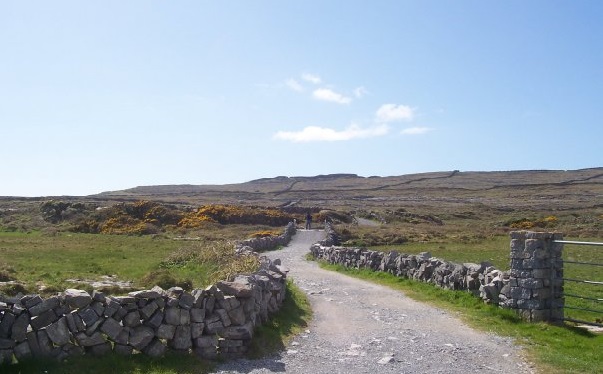
Innismore, Aran Islands, County Galway Photo: Jansena1
Innismore, Aran Islands, County Galway
Photo: Jansena1

A correspondent of the Mail states that the Viceroy carried 1,120 letters and 33 passengers. We find in the same journal the subjoined letter from Mr. Evans, the pilot of Galway;
Galway, June 2, 1850
Sir,
At the request of Mr. Leigh, chief officer of coast guards, I beg leave to inform you that I proceeded as far as the Sound, on the north island of Arran, on board the Viceroy, on yesterday morning, a distance of twenty-seven miles from Galway, which she steamed in the wonderfully short space of two hours and ten minutes. I left her at 12 o’clock precisely, and at one p.m., she was completely out of sight. During all night it was perfectly calm, and at six o’clock this morning a nice breeze sprung up at S.S. East. The wind is now (three o’clock, p.m.) due south, fresh breeze. I have crossed the Atlantic several times by the Cunard steamers from Liverpool, and I am happy to inform you that the Viceroy exceeded any of them in speed at our starting; and I feel quite confident she will realise the hopes entertained of her making a speedy passage.
I am, Sir, your most obedient servant,
Joseph Evans, Master Pilot.
Posted in Posts and podcasts

Fowlers – 1851

Manchester Guardian 7th June, 1851 p 5

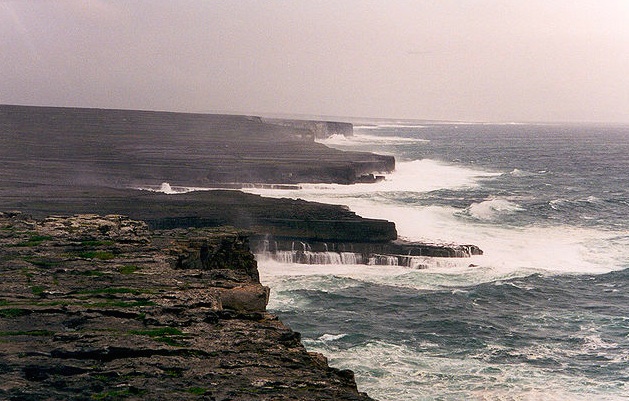
Inismore, Arran.. Wikimedia Commons
Inismore, Arran..
Wikimedia Commons

Irish Cliff Fowlers (abridged)
I shall here outline the different methods I have witnessed on the coast of Ireland of descending steep rocks for birds or eggs. At the Gobbins, a climber has been going down the rocks occasionally in the season for above thirty years.  He has a monopoly of the aerial exercise in consequence of being the only person in the vicinity supplied with a rope for the purpose. His preparation was the work of a moment; throwing his shoes off, and a noose of the rope over his head so as to embrace his body beneath the arms.  Down he dropped from the summit, with much less concern than a lady steps from her carriage. Two or three men (generally his two brothers) ‘give out’ the rope, of which a coil is left back, some little distance from the summit of the cliff. They keep it tight until the egg-gatherer reaches the ledges containing the nests, when he gives a signal to slack it. The liberty thus afforded him to move to either side prevents the necessity of shifting the rope laterally at the summit of the cliff, where it is kept to the same place all the time.

The method adopted at Arranmore, the largest of the islands of Arran off Galway Bay was different. When Mr R. Ball and I visited that island in July 1834 a rock climber – a tall athletic fellow – came up behind, unheard in his ‘pompootes’ .  He was lowered over the loftiest limestone cliffs of the island, perhaps five hundred feet in height. His manner of descent was free and easy. He sat upon a stick, about a yard in length and two inches in thickness, to the middle of which one end of the rope was fastened, the other being held by men above.

When coming near his prey, he held the rope in one hand, and with the other threw a rope fastened to a rod around the birds. Several gulls so taken were brought up. When over the cliff he leapt as far into the air from the surface of the precipice as he could do without injury to himself from the rebound. He likewise performed various antics, and with the stick as a seat, looked quite comfortable and at his ease.
Thompson’s Natural History of Ireland.

Posted in Posts and podcasts

And far away…1910

https://widgetworld3.wordpress.com/podcasts/

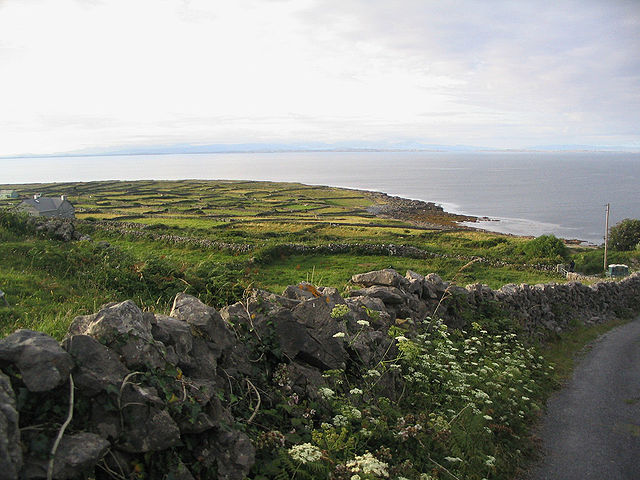
Árainn/Inis Mór Photo: Creative Commons
Árainn/Inis Mór
Photo: Creative Commons

THE WEST AUSTRALIAN 25TH JUNE, 1910
EXCERPT FROM ‘THE LAND OF THE WESTERN GLEAM’ BY E. LONGWORTH DAMES (VI – Galway of the Tribe
s)
…And far away, far out across Galway Bay, there is a faint vision of the mysterious Aran Islands, some of the fairy isles of the west, the last retreat, it is said, of a very ancient people called the Fir Bolgs, a primeval tribe which was in Ireland before even the Gods came there. This is what lies dimly and half seen on a gray horizon against gray skies colouring at evening, and Galway, dreaming away its life in a soft Western langour, with a pale glory of the past about it, like last daylight lingering, looks out upon these for evermore. Ptolemy is said to have spoken of Galway as then existing under the name of Nagnata. And when twilight settles down in a silence that is full of old voices, one may well fell that the place and the country round it, are of far off beginnings and ageless.

Posted in Posts and podcasts

Avoiding tax – the odds were good in 1910/11

Inishmore Wikipedia.org
Inishmore
Wikipedia.org

https://widgetworld3.wordpress.com/podcasts/
Part 1
THE HAWAIIAN STAR JULY 22, 1911 p17
The Galway County Council has found a bold man who has undertaken, on a 50 per cent commission basis, to collect all the back taxes due from the inhabitants of the south and middle isles of Aran. These sturdy farmers and fishermen have not paid for more than five years and, if the new collector succeeds in getting in all that is owing he will pocket $500 for himself. He has arranged for a government steamer and a big force of police, and he expects to invade the islands in a few days.

A View over the karst landscape from Dun Aonghasa, Inis Mór,Aran Islands. Wikipedia.org
A View over the karst landscape from Dun Aonghasa, Inis Mór,Aran Islands.
Wikipedia.org

Local betting in strongly in favor of the Aran islanders. The exports of cattle from the islands to the mainland have been heavy during the past week and there cannot be many head left on the islands now. Most of the fishing boats are provisioned and ready to put to sea at short notice, and a man who was on the islands last week says there isn’t much furniture left in any of the cottages. The probabilities are that when the collector arrives he won’t find much salable (sic) property to seize. If he is a wise man, too, he will see that his steamer is well moored or anchored and guarded at night, for the currents about Aran are treacherous and boats have been known to slip their moorings and drift away.

320px-Arran,_IrelandPart 2
BISMARCK DAILY TRIBUNE SEPTEMBER 2, 1910
TAXES NEVER ARE COLLECTED
Irish Islanders fight off officers in Annual battle.
The Irish peasants dwelling on the bleak islands of Aran and Valentia, off the stormy coast of Galway, absolutely decline to pay taxes. The Galway tax collectors each year storm the islands and endeavor to compel the peasants to pay their taxes. A battle always ensues, and the collectors are driven back to the mainland.

The islanders call the collectors “black soldiers”, and their annual battle with them is looked forward to with as much interest as the peasants elsewhere look forward to the annual county fair day.
This year the Galway county council had difficulty in finding men who would tackle the job of collecting taxes from the islanders, but finally one of the clerks undertook the contract. He has not yet had the courage to proceed to the island battlefields with his assistants.