Gardai carrying out searches following the robbery of the Galway – Ballyvaughan mail car found in a house at Cahermore, Gort, two Mills Bombs, a large quantity of gelignite, a shotgune, sword, pike, and 40 rounds of rifle ammunition.
In raids in Kinvara district revolvers, gelignite and revolver ammunition were discovered. Two men were arrested in connection with the find.
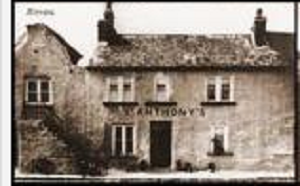
President Cosgrave and Senator Dr Gogarty were in the Kiltartan country on last Friday and subsequently motored to Kinvara, where they lunched at St Anthony’s Hotel. Afterwards they returned to Dublin
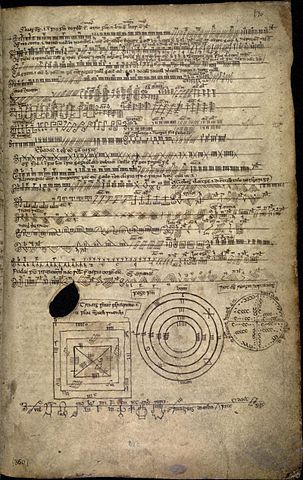
Folio 170r of the Book of Ballymote – (c1390) explaining the Ogham script. Wikimedia Commons
Evidence that an early Irish Empire flourished in the fifth, sixth and seventh centuries, with teachers and missionaries spreading its learning and culture into Germany, France and Switzerland, has been given in a series of lectures delivered at the School of Irish Studies, 6 West 12th Street, New York City by Mr Benedict Fitzpatrick.
Further details In the News at theburrenandbeyond.com
Aran Islands, West of Ireland Photo: Fabio Grasso Creative Commons
Fishermen have legends all their own. They say that the reason why the flounder has one side white is that the Blessed Virgin once placed her hand upon it, and that the spot where her lily hand rested has been the colour of the snow ever since.
An eminent tradition is to the effect that it was the haddock in whose mouth St. Peter discovered the tribute money; that the spots upon its body near the gills was caused by the pressure of the Apostle’s fingers.
The pike, like the passion flower, carries upon it the marks of the Crucifixion such as the cross, nails and sword. This, sailors will tell you, is because the pike remained above the water when all the other fish fled to the bottom of the sea in panic when they found that the Saviour was to be put to death.
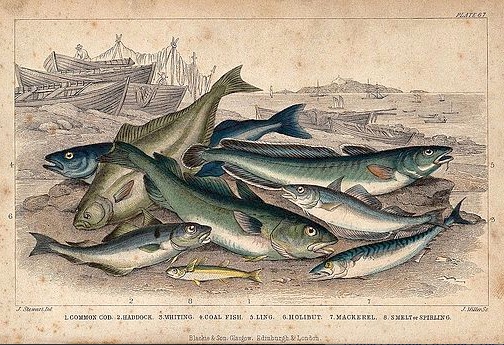
The Blessed Virgin has always been considered the especial patroness of those “going down to the sea in ships.” To her they appealed when in danger of shipwreck and ships sailing past any of her sanctuaries used to salute her by striking their topsails or chewing up the topsail sheets. Most of the ships in the Royal Navy of England were in Catholic days given one of her own sweet names. The fishing fleets of all continental countries have always honour her in a similar manner.Eight different species of fish, including cod, haddock, halibut and mackerel, are lying on a beach. Coloured etching by J. Miller after J. Stewart. Wellcome Images; Creative Commons
While Our Lady as Star of the Sea has ever been the protectress of all sailors, St. Nicholas has in a special sense been the patron of fishing towns. Many caves along the coast of France have been used as chapels in which both the Blessed Virgin and St. Nicholas have had especial honour.
Formerly it was considered a token of great good fortune when mackerel fleets could arrange to start out on May day; and the sailors took delight in decorating May day garlands. When the mackerel nets, with floats attached, were thrown into the water the sailors would sing;
Watch, barrel, watch, mackerel for to catch!
White may they be like a blossom on a tree!
God send thousands, one, two and three!
Some by their heads, some by their tails
God sends thousands, and never fails.
Then the captain would cry “Seas all!” and over the nets would go.
Ships of olden time often bore an image of Our Lady as a figure head. With her leading them they never lacked courage to fare out into the wide waste of waters.
“Catholic Bulletin
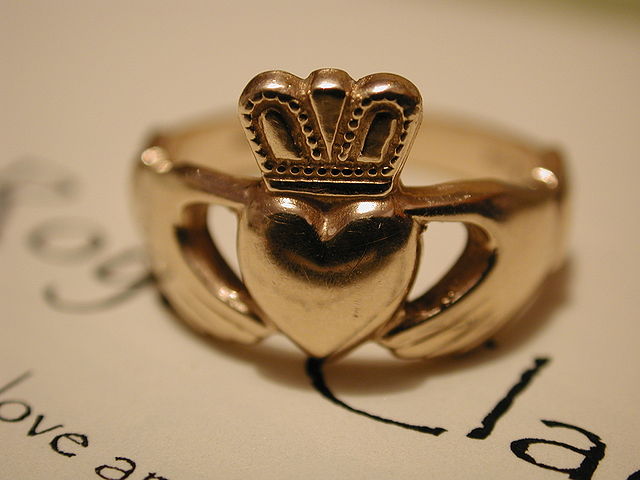
Among quaint old marriage rings, prized and sought after by collectors, the Claddagh ring is probably the rarest. Claddagh is a little district in the north-west of Galway, and its people are popularly supposed to date back to the Armada. Colour has been lent to this belief because the people are tall and dark, and quite unlike other Galway folk, but it is certain that they date far behind and beyond the Armada and their origin is a mystery.
The Claddagh people rarely marry outside their own race. They have always used as marriage rings heavy gold bands, with hands clasped round a heart, and for many centuries these rings have passed from father to son, and each has been given to many a dark-browed bride. On the inner surface of the band the initials of the man and the woman are engraved.
In one ring, which is hundreds of years old, the initials, some roughly carved, almost cover the time- smoothed gold. Irish jewellers make many replicas of these mysterious old rings, but the expert collector can easily detect the modern imitation, and owners of the genuine antiques prize them greatly. The one mentioned had been sought for seven years before a lucky chance brought its present posessor into contact with an old Galway woman who was willing to sell her treasure.


 The Burren and Beyond