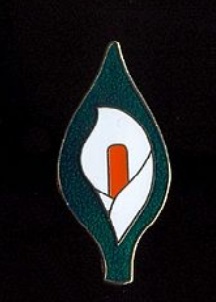
The Easter Lily, worn at Easter in memory of Irish combatants who died during or were executed after the 1916 Easter Rising.
A.O.M. sends us the following extract from an account of the Easter Week 1916 Rising in Galway, written by Comm.Gen Liam O’Maoiliosa, published in Gaelic-American, January 1917:-
At 7 a.m. (Easter) Tuesday, the Clarinbridge and Killeeneen Corps attacked the police, who acted on the defensive in their barracks. An attempt to rush the place failed and firing on both sides went on for over an hour. Then several bombs were exploded in the barracks. To do this, Captain Eamonn Corbett, who volunteered for the job, had to rush up to the windows of the barracks, under fire, and throw the bombs inside the barracks. This he did successfully six times.
Kinvara Branch of Cumann na mBan had eight members, including:
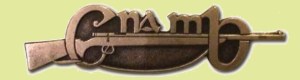
Cumann na mBan clasp
Miss Kate Fogarty
Mary Hynes, Dungora, Kinvara
Miss Aggie Staunton, Clooas, (sic.) Kinvara
Miss Mary Fogarty, Kinvara
Miss P. Regan, Kinvara
Margaret Johnston, Kinvara
The Soldiers of Cumann na mBan
by Brian O’Higgins
All honour to Óglaigh na hÉireann
All praise to the men of our race,
Who, in days of betrayal and slavery,
Saved Eire from shame and disgrace.
But do not forget in your praising,
Of them and the deeds they have done,
Their loyal and true-hearted comrades,
The Soldiers of Cumann na mBan!
Chorus
They stand for the honour of Ireland,
As their sisters in days that are gone,
And they’ll march with their brothers to freedom,
The Soldiers of Cumann na mBan.
No great-hearted daughter of Ireland,
Who died for her sake long ago,
Who stood in the gap of her danger,
Defying the Sassenach foe,
Was ever more gallant or worthy,
Of glory in high sounding rann,
Than the comrades of Óglaigh na hÉireann
The Soldiers of cumman na mBan!
Chorus
O, high beat the hearts of our Mother,
The day she had longed for is nigh,
When the sunlight of joy and of freedom,
Shall glow in the eastern sky;
And none shall be honoured more proudly,
That morning by chieftain and clan,
Than the daughters who served in her danger,
The Soldiers of Cumann na mBan!
Chorus
Brian O’Higgins (1882-1963) penned the lyrics of
The Soldiers of Cumann na mBan in the week immediately prior the 1916 Rising
This song has been arranged and recorded by Joseph Forde.
Although there was no disturbance of any kind in Kinvara or district during the recent Rising, the entire population maintaining an attitude of perfect calm throughout, over a score of arrests were made by the local police. In spite of representations by Mr. W.J.Duffy M.P., and others, scarcely any of those interned have as yet been released. During the week Ml. Stanton of Cloonasee, was released and arrived home quite unexpectedly on Tuesday evening.
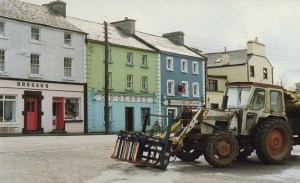
Kinvara, April 1969 Photo: Felix Wikimedia Commons
Seamus Davenport of Kinvara, County Galway, prominent fighter in the Wars of Independence, was married on Saturday in the Church of the Holy Family, Aughrim Street, Dublin, to Miss Julia O’Meara, second daughter of Mrs. O’Meara and the late Denis O’Meara, Kilruane, Nenagh. Mrs. N. Brophy was matron of honour, and Mr. Thomas Gray, P.C. of the Reference Department, Dublin Corporation(who fought in the Longford Brigade, I.R.A.) was best man.
Mr. Davenport is advertisement and sales manager for International Agencies, Dame Street, Dublin. He was the youngest member of the I.R.A. to take part in the 1916 Rising in Galway area, and served in the Mid-Clare and South Galway Brigade in the fight against the Black-and-Tans. During the Civil War he fought on the Republican side and was later imprisoned in Limerick and Harepark. He is an officer in the Volunteer Reserve.
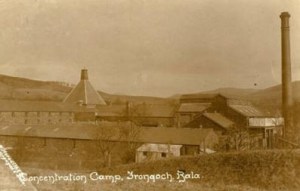
The censor of Frongoch internment camp informs us that Tuesdays and Thursdays are visiting days from 2 to 3 p.m. Prisoners can receive only one visit a month, and applications for permits must be made in writing to the Commandant, allowing sufficient time for reply by post. No admission is granted except on production of the permit. The following have been removed from Stafford to Frongoch;
James Fahy, Doughiska, Galway
Thomas Newell, Castlegar
John Murphy, Athenry
Michael Burke, Doughiska
William Cody, Claregalway
Thomas Silke, Castlegar
Michael Glynn, Lydican
Mr. Joseph O’Flaherty, Loughrea
William Harte, Oranmore
Richard Wilson, Loughrea
Dominic Corbett, Craughwell
Jeremiah Galvin, Slieverue
Christopher Caulfield, Athenry
Martin Walsh, Athenry
Peter McKeown, Athenry
Patrick Kennedy, Athenry
Joseph Cleary, Athenry
Pat Keane, Athenry
Ml Commons, Athenry
Ml Cunniff, Galway
Ml Costello, Galway
Martin Costello, Galway
Pat Costello, Galway
Martin McEvoy, Galway
John Cullinane, Galway
William Higgins, Galway
Michael J. Dunleavy, Galway
Richard Wilson, Galway.
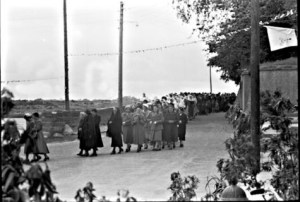
Corpus Christi procession passing Seamount gate (on right) c. 1950 Photo: Cresswell archives
About one hundred years ago Dr. Hynes of Kinvara purchased from Lord Inchiquin a shooting lodge overlooking Galway Bay between Kinvara and Dungora Castle. Here Dr. Hynes built a residence for himself and his family and, dying, bequeathed it to his daughter, Elizabeth, who had married his successor as M.O. of Kinvara, Dr. Nally.
During Easter Week 1916 this residence was occupied by Kinvara Company of the I.R.A. and during the War of Independence it was the secret meeting place of the wanted men. Again, during the Civil War, on account of its fine accommodation and commanding position, it was occupied in turn by both of the warring forces. At that time too, Mrs Nally, now a widow, set in motion the chain of circumstances which has brought it to its present proud position by presenting it to the Sisters of the Convents of Mercy of Gort and Kinvara. The Sisters had long wished to establish a secondary school for girls. Now they had the building with which to make a start but their resources were meagre.
By 1926 a room in one of the stables had been converted into a classroom and some members of the Gort Community took up residence in Seamount House. The work was inaugurated with fifteen boarders and thirteen day-pupils. By 1928 the rest of the stable had been converted into two more classrooms and a large corridor was added to the building. As the fame of the College grew so did the numbers of boarders and day pupils, and so too, did the need for extra accommodation.
In 1938 a fine three storey building was erected which contained dormitories, class-rooms, dressing rooms, and a magnificent recreation hall with a permanent stage. Despite these extensions the sisters were unable to cope with the ever-growing volume of demands for admission and again they had to face the question of expansion of the College buildings. The old buildings were adequate for the 140 pupils in residence there in 1952 but many, many applications had to be refused. So in 1952 Mr. Ralph Ryan, M.E. Galway, prepared plans for the great extension and the work was put in the hands of Messrs. kBurke and Clancy, Galway.
And so, in thirty years, the nuns of Seamount have written a success story of which any large corporation might be proud.
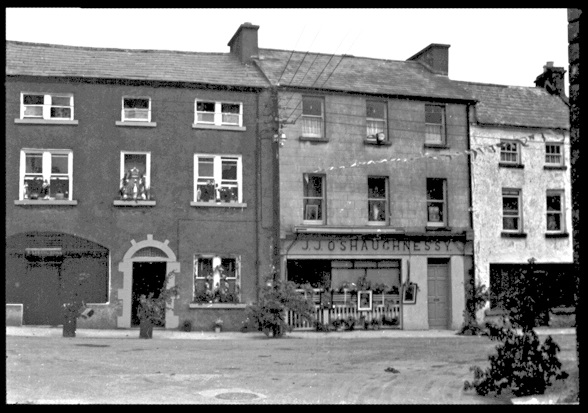
Mr. Thomas O’Shaughnessy, Kinvara, has received a communication that his eldest son, Pvt. Thos. O’Shaughnessy of the Irish Guards, is at present in hospital in England recovering from wounds received out in the war. This is the third time he has been wounded after spending 18 months in the trenches.
Mr Fahy begins his story of Easter Week by recalling the arrest and imprisonment of Liam Mellows in the Autumn of 1915 and his deportation to Reading in April 1916. At that period the Galway County Board of the Irish or Sinn Fein Volunteers, which governed the force, had Mr George Nichols, Galway as chairman; Joseph Howley, Oranmore, treasurer; and Padraic O’Fathaigh, Lurgan, Gort, secretary, with Larry Lardner, Athenry as Brigade Commander. Meetings were held at Athenry and Mellows had his training camp at Ballycahalan. Mr. O’Fathaigh continues his story;
A convention was held in Limerick, at which plans were made for the Easter Sunday Rising. The delegates from Galway were Commandant Larry Gardner, Rev. Fr. Feeney, C.C.; Tresa Bhreathnach, Eamonn O’Corbain and Padraig O’Fathaigh. Mr. Ledden presided at the meeting, and it was arranged that the expected arms from Germany would be taken to Abbeyfeale and there sorted, some to be kept, and the remainder taken by rail to Gort to arm the Volunteers who would muster there on Easter Monday. Handbills about the Gort Monster Meeting were displayed at the Limerick Hall.
“Con” Fogarty would take the arms to Gort. Commandant Colivet would take charge of the Limerick Brigade of the Irish Volunteers at Limerick city. The Clare Battalion, led by Commandant Michael Brennan, would take any Clare barrack they might surprise, but would make no delay in moving to augment the Limerick Volunteers. The Companies of the Galway Brigade would attack the R.I.C. barracks in their area on Easter Sunday.
EASTER SUNDAY 1916
Commandant Larry Lardner was in command, Commandant Liam Mellows having been deported to England. The wily Commandant Mellows, however, succeeded in evading arrest and turned up at Mrs. Walshe’s house in Killeeneen some days before the intended Rising. Liam Mellows ordered that his escape should be kept a secret known only to the Walshe family, Eamonn Corbett and myself.
Liam’s uniform, enclosed in a parcel addressed to Mrs. Walshe, was expected to come via Athenry and its safe delivery was important. Since 1909 I taught Gaelic every Wednesday and Thursday night in Athenry. My visit to Athenry on Wednesday elicited no surprise. Eamon Corbett was mixed up in rate collecting and travelled extensively. We got the parcel safely; George Fahy at the Railway Hotel and Berty Powell at the Railway Station would have scented out any danger. We took the parcel with all speed to Killeeneen; I thus missed the Irish class for the first time in seven years.
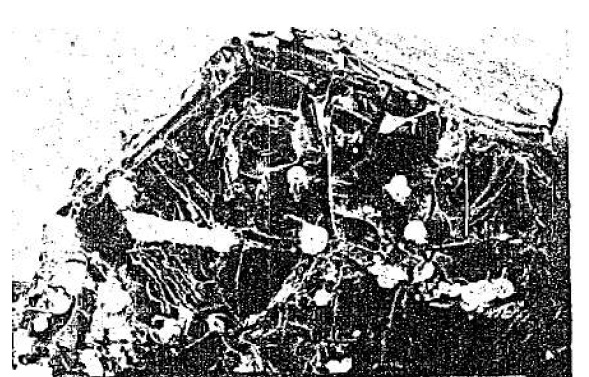
This piece of stone is a portion of one of the walls of the G.P.O. which was burned during the 1916 Easter Rising and it is now on public display at the Bank of Ireland, Eyre Square, Galway.
It was given to the bank for display purposes by Mr G. Nally of Kinvara. His mother came into possession of the stone soon after the Rising and later Mr. Nally took it with him across the Atlantic where it was displayed in America. Some years ago it was returned to this country.
The peculiar colour of the stone is explained by the fact that there is a good deal of glass solidified on the surface. This occurred when glass bottles and jars holding food supplies for the Volunteers occupying the G.P.O. melted when the building burned. Peas can be clearly seen still imbedded in the glass and stone. The piece weighs about two stone and is about one foot long. There are a number of similar unique souvenirs of the Battle of the G.P.O. still in existence in parts of the country but this is believed to be the only piece in the west of Ireland.
Every man, woman and child in Kinvara parish and district, and most people throughout Co. Galway and the West, know that Kinvara Church and Convent have been searched by armed police. A great many well-informed people are aware that the Rev. Parish Priest, the Rev. T. Burke P.P. has made a strong protest to General Sir John Maxwell, the military governor of Ireland. The whole subject is talked of far and wide and the story suffers nothing in the telling. But the new censorship that is exercised today in Ireland, as if a war were actually proceeding within our shores, and the country had got out of hand, decrees that “no correspondence between General Sir John Maxwell and Father Thomas Burke, P.P. Kinvara, is to be published.” So with the shadow of blood on the Irish horizon and feeling and passion inflamed, we are back again to the old coercionist regime. We cannot help asking ourselves is this possible in the 20th century of have the military governors of this country, clothed in the “petty brief authority” that a fateful chance has given them, taken leave of their senses?
If those governors imagine that by suppressing in Ireland the plain, if painful truth, they are serving any good purpose in constitutional or military government they are making a colossal mistake. The affair at Kinvara has been grossly mishandled from the beginning and the characteristically Prussion attitude of the new censorship in Ireland does not improve but considerably aggravates a painful situation. Surely the military governors of this country ought to be able to defend their own attitude, and the attitude of their subordinates, without resorting to the equivocal expedient of a clumsy endeavour to conceal from the public all the facts! Even viewed from their own standpoint, the attitude of the censor in this respect is extremely stupid. It makes a mystery where none existed and renders the people suspicious of an authority that resorts to methods that are given so sinister an aspect. We publish elsewhere the protest made at the conference of priests held at Gort on the 6th of this month. Surely a body of clergymen are entitled to a full, frank and public explanation and apology from the Government for a proceeding that tends to bring the authority exercised in this country into contempt.

 The Burren and Beyond