The W. A. Record (Perth) 7th Sept, 1907 p4. Mr Marconi is engaged in perfecting the arrangements for receiving wireless telegraphic messages from Canada at the new station provided at Clifden, County Galway. The distinguished electrician believes that the station at Clifden is much more powerful and better than the one at Poldhu in Cornwall.
Irish Times, Saturday March 2nd, 1907 Amongst the last awards made by the Royal Humane Society are the names of Constable Michael Carbery, Kinvara, Co. Galway, for the bronze medal of the Society, for plunging into 15 feet of water in Kinvara Harbour at the risk of his own life, and saving that of a man named Keane, who was 76 years of age and who had fallen from the pier.
Last season 400,000 Forest Trees were exported from the celebrated Waterford Nurseries of Messrs Wm.Power and Co., to help in the reafforesting of England, Scotland and Wales. Nevertheless we hear of some people sending outside Ireland for forest trees. What a world we live in.
The Catholic Press 31st July, 1919 p.21 (abridged)
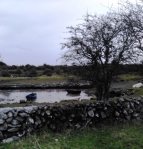
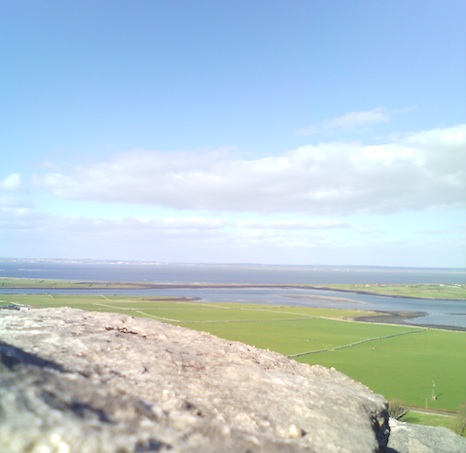
Burren Gate Photo: EO’D
A SOLDIER’S SONG
Barricade song of the Irish Volunteers, 1916
Composed in 1907, with words by Peadar Kearney and music by Kearney and Patrick Heeney. Translated into Irish by Liam Ó Rinn in 1923
We’ll sing a song, a soldier’s song,
With cheering, rousing chorus
As round our blazing fires we throng,
The starry heavens o’er us;
Impatient for the coming fight
And as we wait the morning’s light,
Here in the silence of the night,
We’ll chant the soldier’s song.
chorus
Soldiers are we, whose lives are pledged to Ireland,
Some have come, from the land beyond the wave,
Sworn to be free; no more our ancient sireland
Shall shelter the despot or the slave,
To night we man the Bearna Baoghail
In Erin’s cause come woe or weal,
‘Mid cannon’s roar, and rifle’s peal,
We’ll chant the soldier’s song.
Burren Gate Photo: EO’D
In valley green, on towering crag,
Our fathers fought before us,
And conquered ‘neath the same old flag
That’s proudly floating o’er us;
We’re children of a fighting race,
That never yet has known disgrace,
And as we march the foe to face,
We’ll chant the soldier’s song.
Sons of the Gael, men of the Pale,
The long-watched day is breaking,
The serried ranks of Innisfail
Shall set the tyrant quaking.
Our camp-fires now are burning low
See in the East the silvery glow,
Out yonder waits the Saxon foe,
Then chant the Soldier’s song.
————————————-
Seo dhíbh, a chairde, duan Ógláigh
Caithréimeach bríomhar ceolmhar
Ár dtinte cnámh go buacach táid
‘S an spéir go mín réaltógach
Is fonnmhar faobhrach sinn chun gleo
‘S go tiúnmhar glé roimh thíocht don ló
Fé chiúnas chaomh na hoíche ar seol
Seo libh, canaídh Amhrán na bhFiann
Sinne Fianna Fáil
atá faoi gheall ag Éirinn,
Buíon dár slua
thar toinn do ráinig chugainn,
Faoi mhóid bheith saor
Seantír ár sinsear feasta,
Ní fhágfar faoin tíorán ná faoin tráill.
Anocht a théam sa bhearna baoil,
Le gean ar Ghaeil, chun báis nó saoil,
Le gunna scréach faoi lámhach na bpiléar,
Seo libh canaídh amhrán na bhfiann
Cois bánta réidhe, ar ardaibh sléibhe
Ba bhuadhach ár sinsir romhainn
Ag lámhach go tréan fén sárbhrat séin
‘Tá thuas sa ghaoth go seolta
Ba dhúchas riamh dár gcine cháidh
Gan iompáil siar ó imirt áir
‘S ag siúl mar iad i gcoinne námhad
Seo libh, canaídh Amhrán na bhFiann
Sinne Fianna Fail…
A bhuíon nach fann d’fhuil Ghaeil is Gall
Sin breacadh lae na saoirse
Tá sceimhle ‘s scanradh i gcroíthe námhad
Roimh ranna laochra ár dtíre
Ár dtinte is tréith gan spréach anois
Sin luisne ghlé sa spéir anoir
‘S an bíobha i raon na bpiléar agaibh
Seo libh, canaídh Amhrán na bhFiann
O, to have a little house!
To own the hearth and stool and all!
The heaped up sods upon the fire,
The pile of turf against the wall!
To have a clock with weights and chains
And pendulum swinging up and down!
A dresser filled with shining delph,
Speckled and white and blue and brown!
I could be busy all the day
Clearing and sweeping hearth and floor,
And fixing on their shelf again
My white and blue and speckled store!
I could be quiet there at night
Beside the fire and by myself,
Sure of a bed and loth to leave
The ticking clock and the shining delph!
Och! but I’m weary of mist and dark,
And roads where there’s never a house nor bush,
And tired I am of bog and road,
And the crying wind and the lonesome hush!
And I am praying to God on high,
And I am praying Him night and day,
For a little house – house of my own –
Out of the wind’s and the rain’s way.
The Gathering of the Tribes
Lines on the Grand Annual Reunion and Games of the Galway Men’s Association at Celtic Park, New York, Sunday 9th June, 1907
Dear Galway of gray cliff and shelving shore,
Today your exiled hosts pass in review;
Today with eager hearts they meet once more
Beneath Columbia’s skies of sunny blue.
How yearning souls today will fill with pride
For Erin cradled ‘mid Atlantic foam;
Where e’er we journey or what e’er betide,
With Irish fervour we are true to home.
From Tuam they’ll come where the great McHale
‘Gainst the tyrant Saxon truth’s gauntlet flung,
He kept the glory of bright Innisfail
Resplendent burning in the Gaelic tongue.
Today his memory is revered with pride
Through Eire’s valleys from strand to strand;
And we far sunder’d over ocean-wide,
Are true to Galway and dear Ireland.
Loughrea and Gort will give a generous share,
Where Sassenach a welcome never found,
My must to Arran flies with fleetness rare
On reverent wing to fight on holy ground.
And bouchals tall will come from Corrib’s wave;
Where hamlets nestle by the waters blue,
From Clifden’s hills that never nurst a slave,
Nor grudge their exiles, fearless bold and true.
From green Killimer and Kinvara gray,
Whose legends tell us of olden time,
When noble Ard-Reigh ruled in regal sway,
And Fionn of Fenian hoses was chief sublime;
His spirit true has lived the ages down
And flames to fire within our exiled throng,
Tho’ far apart from Galway storied town,
Or from the value where stands the Cross of Cong.
Sweet mother of brown hill and Em’rald vale!
Thine exiled hosts today pass in review;
True as their sires when foes they name assail
Their filian hearts beat faithful unto you.
True Irishman where’er your homing place,
From Cork’s famed town to Neagh’s wide-spreading lake,
Come pledge with us the gallant fighting race,
One bumper drink, fill high – The West’s Awake!
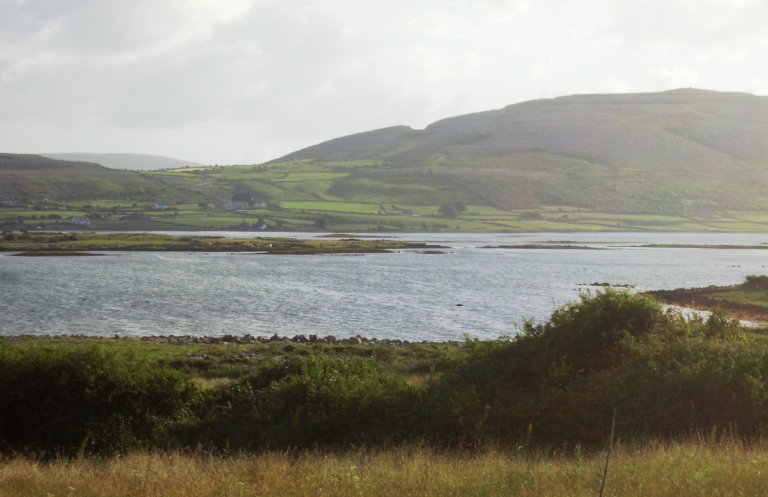
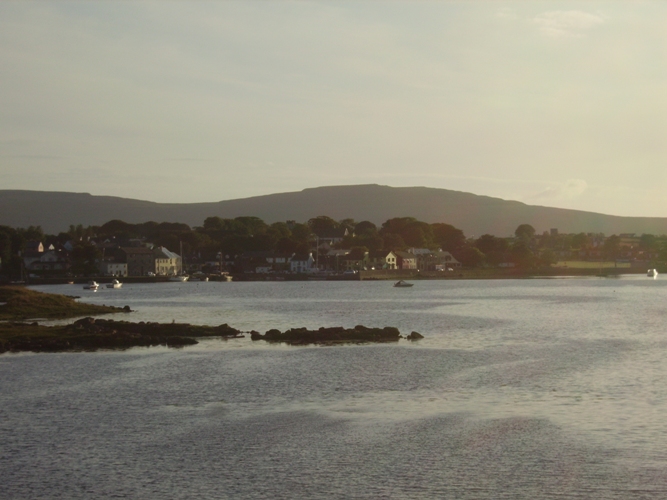
New Quay is encircled on the south side by the rugged range of the Burren Mountains showing the ancient ruins of Corcumroe Abbey, Aughmama Abbey, Mucknish castle, and other castellated ruins along Bellharbour Bay, with the villages of Curranroe, Kinvara, Bellharbour, Ballyvaughan and Finavara, in the immediate vicinity. The air at this district and its surrounds, filled with the ozone and saline of the salt sea of the Atlantic Ocean infuses new life and vigour into one accustomed to living in inland places where the air is entirely devoid of those health giving properties and less embracing.
There are two bathing centres in New Quay supplied with bathing boxes, and a splendid range of sanded strand, one at New Quay and the other at Old Quay, a short distance away towards the Flaggy Shore. The circle of sea surrounding New Quay extends from Curranroe, at the boundary of Clare and Galway, by Munna and Carton, along one of the northern peaks of the Burrin Mountains and continuing on by Old Quay, the Flaggy Shore, Finavarra, Martello Tower and Scanlan’s Island. At this point the entrance is to Bellharbour Bay by a narrow strait dividing Finavarra from Mucknish castle and Ballyvaughan and continuing inland by the southern slopes of Finavarra demesne, and Corcumroe Abbey to Bellharbour Quay and circling outward in the opposite direction by Muckinish Castle, Oughmama Abbey and Ballyvaughan, under the shade of the Burren Mountains.
In fine weather the open sea from the mountain heights and verdant plains of this district, presents one crystal sheet of sparkling surface, with ships, steamers, trawlers, and every style of sailing boat strewn here and there along the surface of the water, from the coast to the circle of the horizon, touching the Atlantic Ocean in the West where the top rigging of the largest barque afloat is seen as a speck above the curvature of the sea, until the full sails and hull of the vessel are exposed to view as it approaches nearer along the surface of the sea.
In stormy weather this open expanse of sea presents an entirely different appearance form what it is in fine weather. To residents of the district the disturbed and placid surfaces of the sea are as familiar as the rising and setting of the sun, but to the visitor or tourist unaccustomed to the fury of the tempest, a short sojourn at New Quay brings the extreme changes caused by the elements into view.
There are intermediate phases in the elements and surface of the sea which only add to the enjoyment of a sail in open boats, but woe betide the boats or even larger vessels, tossed about like shells on the surface of the mountain waves, rolling in silvery breakers from the Atlantic ocean against the cliffs and rock-bound coast.
About one hundred thousand pounds of the estimated two and a half millions annual over-taxation of Ireland would build a small link of railway between Ardrahan and Ennistymon by Kinvara, New Quay, Ballyvaughan and Lisdoonvarna and throw open to the public the enjoyment of the open sea and means of transit for the famous Burren oysters, Redbank oysters and Pouldoody oysters, whose banks are along this particular section of the coast of Clare, particularly New Quay.
Freeman’s Journal September 9th 1907 p.12 (abridged)
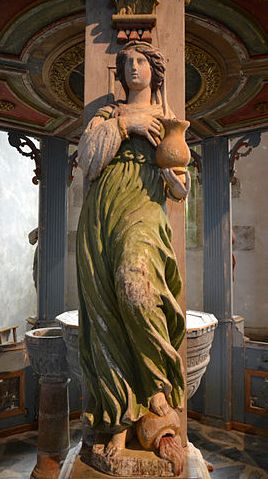
Representation of temperance (painted wood sculpture c1683 at the church of Breton Commana, France). Photo: Lamiot Wikimedia Commons
The splendid demonstration yesterday in Dublin, in the streets and on the platform was conclusive proof of the steady and swift advance of Temperance. As the Chairman Father Aloysius, said in his opening statement, from every part of Ireland, north, south, east, west, contingents representing the various Temperance Societies in the country took part in the procession and the great public meeting which followed.
Such demonstrations are eminently serviceable to the cause. Success is the best reward of honest labour, and the indefatigable workers in the cause of Temperance found their wages and encouragement in such conclusive proofs of its progress.
Temperance Day may now be regarded as an annual festival. Last year it was held in October, and was a very considerable success. But owing to the lateness of the seasons and the inclemency of the weather it was impossible to expect any large country contingent. For this reason an earlier date has been selected and the overwhelming success of yesterday’s celebration most amply justifies the change.


 The Burren and Beyond