The Mercury (Hobart Tas.) 8th February 1891 p3 Servant Girls’ remittances to Ireland Boston December 26 Mr. Patrick Donahoe, who in 1889, on behalf of Irish servant girls, sent 276,778 dol. to Ireland, has during the past two months sent nearly 50,000 dol. Mr. Donahoe does almost one-third of the Irish draft business of Boston. He says that the amount sent this Christmas exceeds the record of any previous Christmas. Mr Donahoe has a curious method of advertising, an announcement beginning, “We will, God willing, continue to our draft business etc.”
The Irish Standard, Jan 10, 1891 p.7 The South Clare railway works have been commenced at Miltown Malbay. Several landowners who refused to accept the offer of Mr. Murphy MP. are now willing to do so, and some have already given up the land through which the line is to run. A cargo of 300 tons of rails has been landed at Cappa Pier, and a large number of car man have been employed drawing the rails to the different working points of the line.
Potato Flowers Photo: Keith Weller Wikimedia Commons
Sir,
I think it right that I should make public what I know on the all-important subject of the threatened potato blight.
On the 19th instant I inspected a field of potatoes on the estate of Comte de Basterot, in the County of Galway, at Duras, in the locality of Kinvara. The crop is a very heavy one, and the field is much sheltered by trees. On the 3rd inst. one rood was well dressed with the preparation of ‘Bonillie Borderlaise’ and quicklime. The remainder of the crop – about half an acre – was not sprayed. On the part dressed not a sign of disease appeared; on the rest of the crop it was quite evident. The “knapsack” used is the light Vermorel spraying machine.
Mr. John Quinn, Duras, Kinvara, Comte de Basterot’s agent and manager, prepared and used the mixture. A letter received from him today informs me that the experiment up to this is a complete success.
I shall be glad to give the recipe for preparation of mixture to anyone applying to me.
Yours,
J. Murray Walker, Land Valuer
73 Waterloo Road,
28th August, 1891
It would seem that Galway is not going to be behindhand in the matter of belief in the supernatural, judging from the state of excitement created a few nights ago by the rumour that a ghost had made its appearance at one of the windows of a house in Abbeygate Street, directly opposite the sacristy of the Pro-cathedral of St. Nicholas. This house, it must be mentioned, was lately occupied by a woman who died after a very short illness. Since her death it became tenanted by another person, but from some cause or other the last mentioned left, and the place remained unoccupied till last week. On the night it was occupied some children were passing to attend devotions at the chapel, when they say they observed a sort of unusual light in the house, and a woman standing near the open window who, in a sepulchral voice said, “offer one prayer for me.”
Some of the children fainted on the spot, and this caused others going to their devotions to inquire into the cause. The tale of the spectre at the window spread like wildfire, and in a quarter of an hour no less than 2000 persons had congregated outside the haunted house. The streets on each side became blocked. The crushing and jostling to get a glimpse at the “visitor from the other world” was such as has never been equalled in Galway. Several persons were thrown down and trampled upon, and it was with the greatest difficulty a strong force of police, after about three hours’ incessant labour, succeeded in clearing the streets sufficiently to allow pedestrians and cars to pass. The tramcars were even compelled to stand still in the streets.
The following night the same state of things have prevailed, but up to the present, the real cause of the rumour has not been satisfactorily explained. Several versions of what the object really was that created such a sensation are given, but the adult portion of the community say that fifty years ago there was also “something seen” in the house, it having been the scene of a most brutal murder – namely, the assassination of a woman named Maxwell by her husband. From the description now given of the late apparition by the children, who say they saw it, the older people say it is one and the same ghost, which has to put up alternate half-centuries in this world and the other. The police are stationed near the place, where four streets meet, and it is as much as they can do to keep the curious from congregating.
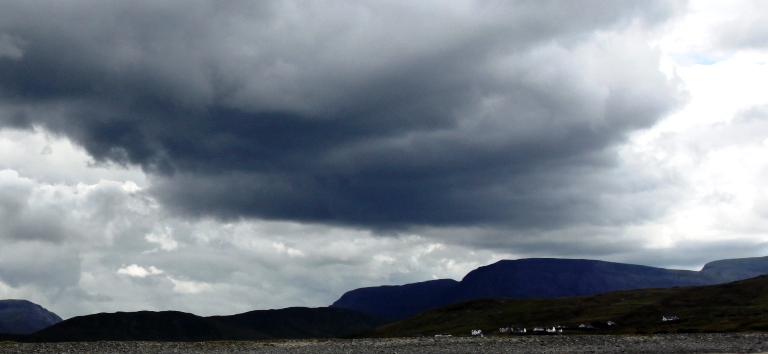
A thunder-storm of very peculiar character broke over this town yesterday morning about half past ten o’clock. The sky all round the horizon was clear, and there were no clouds anywhere to indicate what was about to take place, when we were startled by a loud peal, almost directly over us. On looking up, a dark gathering was now perceived about the zenith, but the general brightness of the atmosphere, so unlike anything that we had ever before observed during a thunder-storm, reminded us of the phenomenon considered by the ancients as a proof of the existence of Jupiter, when thunder claps were heard in a cloudless sky. The darkness above, however, quickly increased, and clouds – coming no one knew whence, but seeming to grow suddenly out of the disturbed air – began to settle over the town in dense masses interlaced with continual streams of vivid lightning.
A grey veil of rain soon appeared to hang down along the entire of the bay, dimming the brightness of the Burren hills, which were evidently at the time in full sunshine. The thunder roll was now almost incessant, and the display of lightning was, perhaps, the finest we ever witnessed. The immense length of the jagged shafts from the zenith to the horizon, and from the horizon back again to the zenith, crossing the sky several other directions, was among the most striking features of the display. The height of the storm was from four to five miles, and it continued stationary for almost an hour, when it slowly moved towards the north-east, leaving us again in bright sunlight.
But all was not yet over, for about two o’clock the sky began to darken toward the south-west, and the thunder recommenced. At half past two a white stream of lightning, accompanied by an explosion of a most terrific character, with a metallic ring in the sound, seemed to fall in the neighbourhood of the square, and we were soon after informed that the Bank of Ireland had, in fact, been struck by the electric fluid. After this the electric discharges continued with little intermission on every side, and shortly before three o’clock there was a shower of immense hailstones, accompanied by rain of such character as might almost suggest the outpouring of a celestial lake, and the streets became flooded almost instantaneously. This shower, fortunately for the hay and other crops about Galway, continued only for a few minutes, while it probably embraced but a narrow tract of country on its route; and it is to be hoped that but little harm was done anywhere by the storm in proportion to its apparently formidable character.
Distant thunder was heard for the remainder of the day. On inquiry at the bank we were kindly shown over the place by the manager, Mr. McDowell, when we found that the lightning first struck one of the chimneys, displacing several stones at the top and throwing one large one bodily into the yard at a distance of several feet from the house. Descending the chimney it penetrated the ceiling of one of the rooms making a very small hole and scattering the plaster in various directions. It then ran along a bell-wire under the ceiling on which it left several deposits that suggested a metallic character by their various iridescent colors of pink, yellow, blue &c. Reaching another apartment, strange to say, it forsook the wire and entered between the stucco plastering and the wall by rather a large breach, and there all further trace of its course was lost.
Several of the inmates of the house were severely affected by the concussion, either violently shaken or thrown down, and one of the servants was rendered insensible for some moments. One of the gentlemen in the bank office saw the lightning, as it appeared to him, playing among the iron railing outside which may, possibly have acted partially as a conductor, attracting a great portion of the electric fluid, and thus saving a great catastrophe.
Happily we enjoy a comparative immunity from thunder storms in Galway. Anything approaching the phenomenon of yesterday has not occurred with the memory of the oldest inhabitant. Galway Vindicator.
There are few villages throughout Ireland near which there is not a hill, cliff, glen or cave which takes its name from the Pooka, but very few indeed know what sort of spectre the Pooka is. A poet once said that he is in existence “since the time of the flood,” and he assumes many shapes – a huge black dog, a cat, a horse, human, rabbit or hare.
The Pooka is wont to give a ride to anyone he meets out at night when he is on the walk; and he does it in two ways. When you meet him in human shape he claps you up on his back, head towards the ground, feet aloft, facing his back. The creature then seizes your ankles and carries you off over mountain and glen, over lake and lakelet, up and down the hills until you, poor rider, are tired, worn and weary. Only then will the Pooka fling you on the ground and let you on your way.
When the Pooka takes the shape of a horse it is up to the poor traveller to keep his grip or bones could well be broken.
Now and then the Pooka meets a smart fellow, who lets him know he can’t play his tricks always. There was a merchant long ago who came to Connemara ere roads were made. He got lodgings of course, for in those days “a welcome and twenty of them” awaited the traveller and wayfarer, and the hospitality of the people of Iarconnaught was spoken of with praise near and far. The merchant let his horse out in the fields and went to sleep. When he had slept his fill, he took his meal and prepared for the road.
He called his horse to harness it but what came across the field instead was the Pooka. The Pooka clapped the merchant on his back and off he started. At first he went in a trot; soon this became a gallop. He went like the wind, over marsh and crag, across river, up and down hill, but failed to throw the man. He gave another rush and came near a large river. The Pooka was on the point of jumping it when the merchant remembered he had his spurs on his heels. He gave a strong dart with his two heels and sent the rowels to the quick into the Pooka. The creature shivered and quaked with fear and besought the merchant to take off the spurs, and that he would let him off. The merchant did so and the Pooka flung him down and away with him across the river in a jump.
But the merchant regretted he had let him off so easily and thought to coax him back so that he would make him cease his pranks. So he asked him to cross the river again.
“Have you the spurs on yet?” said the Pooka.
“I have so.”
“If you have,” says the Pooka, “you may stay as you are. I’ll not go next or near you. But if I ever find you without the spurs, I’ll let you know the differ, or ‘lose a fall’ by it.”
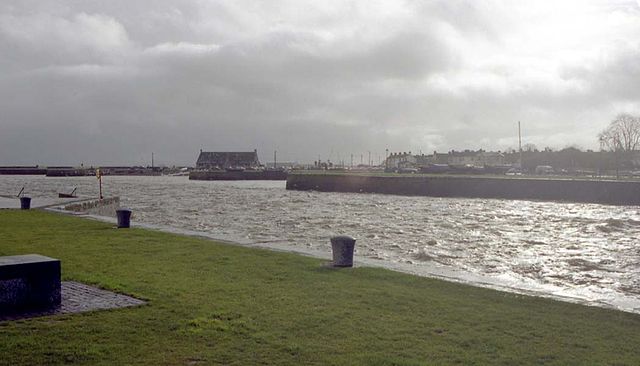
Pontypridd Chronicle and Workman’s NewsGalway Harbour Photo: Art Wikimedia Commons
2nd January 1891
The Dublin Express says that on Christmas night a disturbance took place between about 20 navy stokers, who are home in Galway on furlough from Plymouth, and about 20 men of the Connaught Rangers. A police patrol (three in number) interposed, and succeeded in inducing the military to desist; but when they advised the stokers to follow this example the latter turned on the patrol and beat them, whereupon the police drew their batons and dealt about them with a vigour that soon caused the stokers to beat a retreat through Mainguard-street. Here they were met by the soldiers, who attacked them with their belts, soldiers, wounding several of them, and obliging them to visit the doctors’ establishments to get their injuries dressed. One of the police patrol was also very much injured.
The Connaught Rangers acting under the impression that their assailants were men belonging to H.M.S. Banterer, being ignorant of the Christmas visit of the stokers, determined to have satisfaction, and with this object in view, a party of about 50 of them went to the dock on Friday night, and getting alongside H.M.S. Seahorse, which was also lying in the dock, and which they mistook for the Banterer, they asked the blue jackets to come forward and meet them in fair fight. They were informed by a man on board that the vessel was not the Banterer; and in the meantime word was conveyed to the latter vessel of the hostile intentions of the soldiers, whereupon, it is stated, the officer then in charge of the ship desired all hands to get on deck, and, opening the war-chest, had every man armed.
He then gave orders that should the Rangers make an attack they were to defend themselves, but not to kill, and to endeavour if possible to make prisoners of the entire force, and have them placed in irons.
When the would be attackers did arrive, however, and witnessed, the preparations made for their reception they held a council of war on the wharf at a safe distance from the defenders of the warship, and while this was in progress intelligence was conveyed to the military barracks of what was going on at the dock. A strong picket was at once sent out, on the arrival of which the besiegers beat a hasty retreat; but not before some of the leaders were captured. It is but fair to say for the credit of this gallant regiment that any disturbances which have brought the name of the Rangers into disrepute have on all occasions been brought about by recruits.
Photo: Jon Sullivan Wikimedia CommonsNew Zealand Tablet 24th April, 1891 p9
A conflict took place between two armed police and a number of people at Kilbeacanty. The police, who were protecting an emergency man, entered a public house on their way to Loughgraney, when the party inside, it is alleged, took their rifles and injured them. Assistance having come to the aid of the police, four arrests were made. The names of the prisoners have not yet transpired.



 The Burren and Beyond