Posted in Posts and podcasts

Kilmacduagh – 1876

Tuam Herald 11th November, 1876, p1
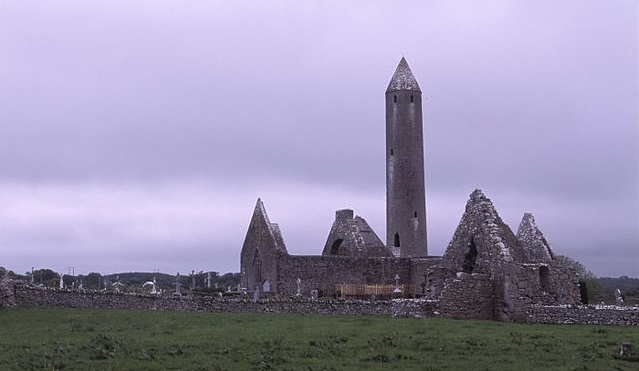
Kilmacduagh
Photo: Jerzy Strzelecki
Wikimedia Commons

Kilmacduagh is a parish in the barony of Kiltartan, County Galway. The See of Kilmacduagh, now a part of that of Galway, was founded by St. Colman, who, being son of Duagh, was distinguished from other Colmans, his contemporaries, by the appellation of MacDuagh. He build a monastery and church called after him, Kilmac-Duagh, whence the name of the parish. The latter comprises 6,015 statute acres. Some ancient remains are to be seen in the neighbourhood, including a round tower, which declines about 17 feet from the perpendicular.

In a lake in the parish, called Lough Deehan, the waters having sunk very low in the year 1784 or 1785, a house was discovered in the mud at the bottom, formed of oak timber of great thickness, the sides and roof of which was formed of wattle-work of the same substance: it appeared as if intended to float, and the timer of which is was constructed was perfectly sound.
Posted in Posts and podcasts

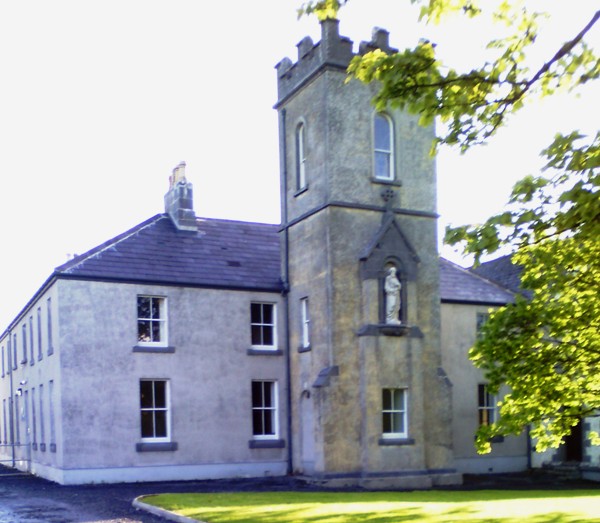
Kinvara Convent – 1876

Freemans Journal 10th April, 1876 p.8

Photo: EO'D
Photo: EO’D

NOTICE TO CONTRACTORS
This Sisters of Mercy at Gort will receive tenders on or before 29th April, for the Erection of Convent, Chapel, and School Buildings at Kinvarra, county Galway, in accordance with plans and specifications prepared by M.A. Hennessy, Esq. Architect, M. Inst., C.E.I., A.R.I.A.I.
Copies of plans &x, may be seen at the Convent, Gort, and at the office of the Architect, 10 Glentworth Street, Limerick.
The lowest or any Tender need not be accepted, and contractors are to tender at their cost.

Posted in Posts and podcasts

The Girls of Galway – 1876

Irish Examiner 1st July, 1876 p.5

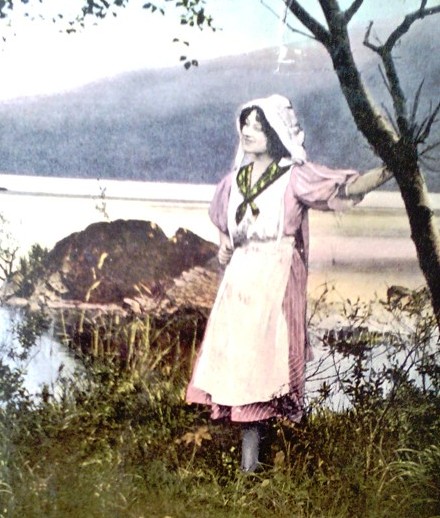
"Dear Little Shamrock" postcard.
“Dear Little Shamrock” postcard.

I toast I give – a health I pledge
Here’s to the girls of Galway!
May sorrow blunt its pointed edge
For them, the girls of Galway!
The fleet of foot – the sweet of smile
The warm of heart – the free from guile
Oh, the genuine daughters of the Isle
Are they, the girls of Galway!

Should you a token ask, by which
You’ll know the girls of Galway
Whom grade and beauty most enrich
These are the girls of Galway!
Descended from the noble race
Of Celt and Spaniard, you can trace
Their lineage in each speaking face
Of the dark-eyed girls of Galway!

Dianas in the hunting field
Are they, the girls of Galway!
‘Gainst craven fear their hearts are steeled
Courageous girls of Galway!
And yet no Amazons are they,
But loving, soft and womanly.
Who can withstand their witchery
The lovely girls of Galway?

With more than Andalusian pride
Step out the girls of Galway!
Oh, ‘mid a thousand else beside,
I’d know the girls of Galway!
Where Pleasure holds her festive sway
No eye so bright, no laugh so gay,
No wit so sparkling in its play
As theirs, the girls of Galway!

Impulsive, open as the day,Galway
Are they, the girls of Galway!
Possessed of every generous trait,
Are they, the girls of Galway!
And naught ignoble, base, or mean,
Finds place where every act’s a queen,
Their very “faults to virtue loan”
The high souled girls of Galway!

Then may they proudly flourish long,
The graceful girls of Galway!
The theme of poetry and song,
The peerless of Galway!
Oh, you may search from Pole to Pole,
Ere you can find the perfect whole
Of charms unique and generous soul
To march the girls of Galway!

A toast I give – a health I pledge
Here’s to the girls of Galway!
May sorrow blunt its pointed edge
For them, the girls of Galway!
The fleet of foot, the sweet of smile
The warm of heart, the free from guile
Oh, the genuine daughters of the Isle
Are they the girls of Galway!
A. McC

Posted in Posts and podcasts

Mr. Murray, Northampton and Galway Cathedral – 1876 – 1922

Connacht Tribune 23rd November, 1957 p.7

http://landedestates.nuigalway.ie

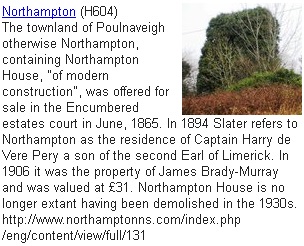
The fund for the building of a new Cathedral in Galway had its origin in a bequest of 500 pounds made by Mr Murray of Northampton House, Kinvara, in the year 1876.
Connacht Tribune 14th January, 1922 p1
For Sale;
NORTHAMPTON HOUSE, KINVARA, CO. GALWAY
This splendid and up to date Mansion contains about 25 apartments, comprising Drawing Room, Dining Room, Bedrooms, Billiard Room, etc., in thorough repair. The woodwork is all pitch pine (nearly new). The fire places are fitted with marble and ornamental mantel pieces. The building is of cut stone, and could be dismantled at a very little outlay.
Northampton is one mile from Kinvara Port and three miles from Ardrahan Railway station (G.S. and W. railway). Offers in writing will be taken and considered up to Monday, 23rd January 1922.
For further particulars apply to
Edward M.Kennedy


Posted in Posts and podcasts

A most extraordinary monster – 1876

Colonist Vol XVII issue 2039 22nd February 1876 p4

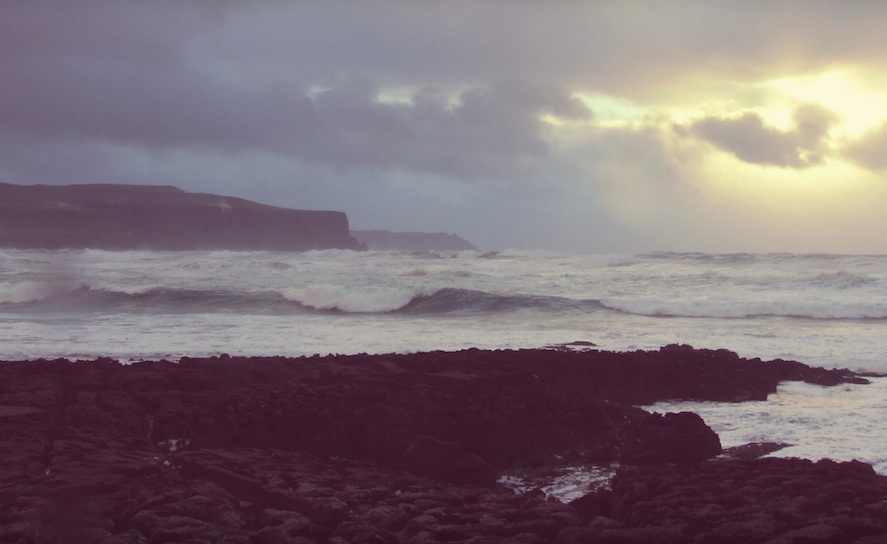
County Clare Photo: Norma Scheibe
County Clare
Photo: Norma Scheibe

The Northern Whig states that a most extraordinary monster was seen a few days ago at Fodera, near Loophead Lighthouse, which is situated on the most western point of the County Clare.  It is thus described:—

lts head and neck resemble a horse, and are of a reddish hue; it has short round ears and flowing mane, and from a poll extend two branching horns like that of a stag, underneath which were eyes glaring and protruding.  It made directly for the narrator, who was on the side of the steep rock.  He at once ran out of reach of the monster, whose approach looked anything but friendly.

It then rose high out of the water and plunged with such force as to cause the water to fly so far and in such quantities as to drench the observer to the skin, he standing 40 feet back from the water at the time.  It remained near thirty or forty minutes before disappearing a moment from view, but rearing its huge body partly out of the water, and giving a chance for further observation.  It was observed to have the tail of a porpoise and two large fins from the shoulders, and on the breast were two large fatty lumps, which shook with every motion of the extraordinary creature.  It then shaped its course westward, still keeping its head and neck well elevated. Its bulk far exceeded that of the largest porpoise ever seen on the coast.

NOTE:  Among the archives of theburrenandbeyond.com is a post titled –  Sea monster in Galway Bay – from the Perth Sunday Times, 1935.  It refers to the shooting of a ‘mysterious sea creature’ at Mutton Island, also in County Clare.

Posted in Posts and podcasts

A strange discovery near Loughrea – 1876

Northern Argus, 20th October, 1876 p4

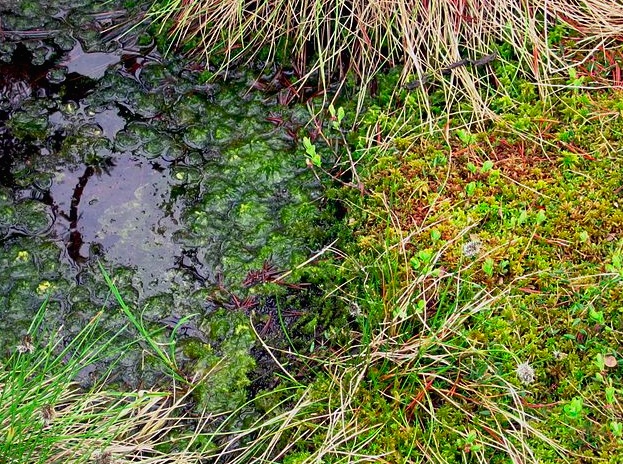
Sphagnum Moss  Photo: Wikimol Wikimedia Commons
Sphagnum Moss
Photo: Wikimol
Wikimedia Commons
(abridged)

A correspondent of the Freeman has sent the following account of a remarkable discovery in a bog near Loughrea:

Last week the body of a full-grown female was dug up by a young man while cutting turf in Carnagarry bog, about two miles from this town. The body is supposed to be buried over 200 years, as the turf was quite close all round it and cut like soap, having no appearance of being recently disturbed. Some years ago there was a bank cut off this place about six feet deep. This recent cutting of a second bank uncovered the body two feet below the surface. The body must have been buried about eight feet deep. .

An inquest was held, and the jury found a verdict of murder by some person or persons unknown. The body had the appearance of a well-tanned leather bag of a dark brown colour. With the exception of the top of the nose being shrunk, and the under jaw a little to one side, the features were perfect. The top of the nose could be easily lifted back to its place, it being just like the finger of a glove. The throat was evidently cut, as the cut was quite visible. The feet and hands appear, to be quite small; the calf of the leg large as it formed a great empty bag, the two sides of which were clapped or drawn together. The police say that her height was about 5ft 7in. Her teeth were regular and sound. Her hair seemed as fresh and glossy as if only buried yesterday; in the knot of hair at the back of her head was found a beautiful carved wooden comb, with a cord and tassle attached.

The oldest inhabitant here never remembers having seen anything like it. Some say the cord and tassle are silk, while others say it is flax. As silk is an animal matter it would rot away, but the flax would stand. The comb is in the possession of Mr. Reeves, sub-inspector of police.

There was also found round her neck another cord with a purse attached, which seems to have thrown light upon the matter.

Lord Ashton says, I hear, that there is an old story in his family that shortly after the battle of Aughrim two servant maids were sent by one of his ancestors from Woodlawn to Loughrea with a purse of money to pay an account. They never returned. One was a red-haired woman, the other black.

About three years ago, while cutting turf in the same bog and bank, but not so deep, only about six feet before mentioned, the skull of a red-haired woman was dug up. Rumour also has it that the body has been dug up again and sent to either Dublin or Galway.

Posted in Posts and podcasts

A daring attempt – Kinvara – 1876

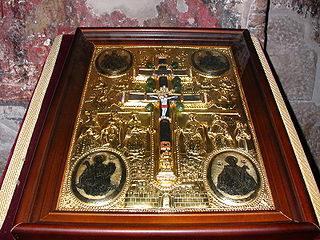
Relic of the True Cross, Decani Monastery, Kosovo Wikimedia Commons
Relic of the True Cross, Decani Monastery, Kosovo
Wikimedia Commons

Freeman’s Journal 21st October 1876 p 17

A daring robbery was attempted on the 10th of August, at Kinvara, near Ennistymon (sic.). The administrator of the parish, Father Molony, was attending a diocesan retreat of the clergy, and in his absence a burglar entered the oratory and abstracted a beautiful gold cross and silver pedestal, the latter containing a gold box set with precious stones enclosing a piece of the true cross. It was a treasured relic in the parish, being the gift of a French Catholic nobleman, Baron de Bastrot, whose ancestry, in the stormy days of the French Revolution, had acquired property in the locality. It is pleasant to say that the burglar was detected in his midnight depredations by some of the female inmates, who raised shrieks sufficient to awake the dead and appal the living. So terrible was their effect on the burglar that in his hurried exit through the window he dropped the booty in the dark, and did not consider it prudent, with Pandemonium at his heels, to stay and pick it up.