Posted in Posts and podcasts

Casting the Reel – 1869

The Newcastle Chronicle (NSW) Tue 21st December, 1869 p2.(abridged)
There was a party gathered one Hallowe’en. They sat round the fire burning nuts and telling stories just as we do tonight. One among them was a lady newly betrothed, the gayest, the proudest, the must beautiful of them all. Her lover sat by her side. Her wild and wilful ways had often given him a heartache, but he loved her dearly.
Someone among the party dared her to go and cast the reel – through a high staircase window that looked down on a dark plantation.
The one who tries this charm must stand at a window alone while the clocks toll for midnight, and, throwing the reel, must wind the thread upon her hand, and call three times; and at the third time, if her heart fail not, they say, her future bridegroom will answer from below.
The lady I tell you of, sprung up and said she would go, for she feared nothing in this world or the next, and though her lover prayed her to remain, she still persisted.
‘You shall see,’she said, ‘whether you have a rival!’
She took a light in her hand, and went alone up the staircase. When she reached the casement she stood still and waited, minute after minute, ’til the clock sounded the first stroke of twelve. Then she flung the reel far down into the darkness, and began to wind the thread.
‘Who is there?’ she cried.
All was still, for the very wind seemed to pause and listen to her call.
Again she called;
‘Who’s there?’
This time there came a soft and smothered sound from below, as though one fetched a heavy sigh. The lady’s hand grew cold, and her breath came short; but she had a dauntless spirit, and said to herself,
‘Tis but the night wind in the trees.’
She waited. Just as the last stroke of the hour sounded, she called aloud for the third time,
‘Who is there?’
And in the stillness an awful voice came up fiom the darkness, saying;
‘I am here.’
The lady shrieked and fled downstairs. When she entered the room again, where her companions were sitting in the pleasant fire-light, she was pale and cold as a corpse. When her lover ran to meet her, she held him off and stared at him as if she scarcely knew him.
After that night she was changed. A secret fire within her seemed burning her away. Her old wild temper was gone. Her proud spirit drooped day by day, and the next Hallowe’en she lay a dying.
All through the night she lay as if asleep, but when the clock began to toll for midnight she looked up. Like one startled and afraid, she panted, in a failing voice, ‘Who is there?

Only she heard the reply.

With a shriek she fell back dead.

Her future groom had indeed called.
His name was Death.
Posted in Posts and podcasts

Great Meeting in Gort – 1869

Tuam Herald 13th November, 1869 p.1
The Land Question (abridged)


Gort, Sunday Night
This patriotic little town may well take credit to itself for the support which it has this day given to the cause of tenant right in this country. It afforded not only to the people on this side of the extensive county of Galway, but to thousands in the northern districts of the county Clare, an opportunity of expressing their opinions on the present unsatisfactory state of the land laws in Ireland, and of pointing out the mode in which the tenant farmers of the country desire that they should be altered. Some influential gentlemen residing in the town and neighbourhood were anxious that the people should, in the form of resolutions, express their grievances with a view to their redress by a Ministry and by a Parliament which have already manifested an anxious wish to remove those evils which have been a source of misery and discontent to the country.

The notice by which the meeting was called was given only a few days back, and yet the meeting of today was a great success, keeping in view the fact that it was not a county meeting, but was composed mostly of people within a circuit of ten miles of the town. The Athenry and Ennis Junction Railway, however, ran special trains, and brought large numbers of people from longer distances. The train which left Ennis at eleven o’clock arrived in Gort at twelve o’clock bringing people from Ennis, Crusheen and Tubber, and the train from Athenry, which arrived shortly after, carried large number of tenant farmers from that station, from Oranmore, Crughwell (sic.) and Ardrahan. The traffic arrangements were under the direction of Mr. Thomas O’Malley, the manager, and were admirably carried out by Mr William Lawlor, the efficient station master of Gort.

Many of the farmers came in on horseback heading bodies of 400 or 500 people. Ardrahan furnished a contingent of about 400, and the united parishes of Ballymena and Crughwell sent by rail about 300 persons, who were accompanied by the Rev. Francis Arthur, P.P. and the Rev. M O’Flanagan, C.C. This body on entering the unfurled their banner, which had inscribed on it the mottoes, “Fixity of Tenure” and “Tenant Right,” and the Rev. M. Nagle, P.P., Kilbeaconty, accompanied a body of his parishioners, numbering, perhaps, five hundred. The Rev. John Barry, P.P., Behagh, and the Rev. Michael Killeen, C.C., accompanied about 800 from their parish, with banners bearing the words, “Fixity of Tenure” and “Tenant Right.” Numbers also came from Corofin, Ballyvaughan, Kilkeely, New Quay, Feakle, Derrybrian, Loughrea, and Kinvara.


A very large body of tenantry came on horseback from Kinvara, accompanied by their landlord, Isaac B. Daly, and Mrs Daly, who drove in their carriage, and who were loudly cheered. By one o’clock there could not have been less than from 10,000 to 12,000 people in the town, all evidently interested in the cause which brought them together. Previous to the commencement of the proceedings a procession was formed, headed by a number of young girls, some of whom were entirely dressed in green, and these were followed by well-dressed young men carrying green banners, having inscribed on them the words, “God save Ireland,” “fixity of tenure,” “tenant right,” and “Cead mille failthe,” (sic.) and the harp in gold was on several of them. There was scarcely a person in the whole procession, which walked round the market-square, accompanied by music, who was not in some way ornamented with green.

They cheered on passing the houses which by some patriotic device attracted attention. An excellent cast of the face of O’Connell was placed in one of the windows of Forrest’s Hotel, and beneath was a saying of the Liberator’s, “He who commits a crime gives strength to the enemy.” At Glynn’s Hotel, there was a sign on a green ground, and the words “Prosperity to Ireland.” These received respectful attention on the part of the people who, as the hour approached for the commencement of the meeting, assembled in front and around the platform which was erected in the middle of the square, and was so spacious as to accommodate about one hundred and fifty persons. On the motion of Mr. L. S. Mangan, Gort, seconded by Mr. Thomas Boland, the chair was taken amidst loud applause by the Very Rev. T. Shannon, P.P., V.G.

Posted in Posts and podcasts

A trip through Clare – 1869

Proceedings of the Royal Irish Academy (1836-1869), Vol. 10 (1866 – 1869), pp. 440-443
M. Brogan – 8th February, 1869 (abridged)

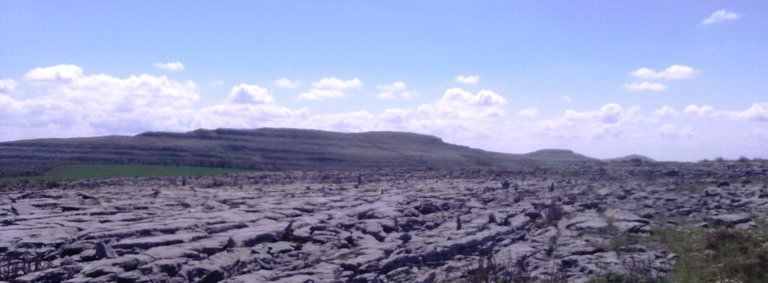
The Hills of Clare Photo: EO'D
The Hills of Clare
Photo: EO’D

When travelling through the country on official duty, I frequently meet with antiquarian remains, some of which may not have as yet been brought under the notice of the Academy. Being recently employed on inspection duty in the county of Clare, my attention was attracted by what I at first conceived to be immense cromleacs, or druidical alters; but which I concluded, on closer inspection, to be sepulchral monuments of some of those stalwart heroes of the olden times who had been “dead and turned to clay” long ere the Milesian adventurers left the sunny shores of Spain to seek and win new home in the green island of Innisfail.

The precise locality of these antiquarian remains is a little south of the public road leading from Gort to Feakle, and about midway between these two towns, in the townland of Druomandoora. The situation is very romantic, being on the northern declivity of the Clare hills, overlooking the deep valley which separates Clare from Galway and which embosoms two beautiful lakes – Lough Graney (Lake of the Sun), and Lough Cooter, with its wooded shores, and islets, and magnificent castle, whose lofty towers and battlements proudly rise over the stately woods by which they are surrounded, and fling their shadows o’er the pellucid lake, “whose tiny wavelets murmur at its base.”
They consist of two sepulchral monuments, distant about a furlong from each other, with two figures inscribed on the adjacent rocks, which in many places present tolerably smooth exposed surfaces. The monument at the greatest elevation on the slope of the hills, though not in the most perfect state of preservation, is the largest. It is called by the people of the locality “Leabadh Diarmaid” (Diarmud’s Bed), while the smaller and more perfect one is called “Leabadh Granu.” I may remark, en passant, that there is a very remarkable sepulchral monument at Coolmore, about three miles north of Ballyshannon, county of Donegal, to which local tradition has assigned the name of “Diarmud and Granu’s Bed.” The rock inscriptions are;

1st. An elaborately and artistically designed figure, somewhat resembling the caduceus of Mercury.
2nd. The impression or outline of the sole of a sandal. I suppose it to represent a sandal; as, if it were intended to represent the naked foot, there would certainly be some attempt, however, rude, to represent the formation of the toes. The foot must have been rather small, probably that of a youth or of a female, as the carving represented it as only ten inches in length, by four and a half inches at the widest part, and two and a half inches at the narrowest part..

My reasons for assuming that the two first mentioned remains are sepulchral, and not cromleacs erected for sacrificial purposes are;

1st. the name accorded to them by local tradition.
2nd. The covering slabs being placed almost horizontally, without the inclination of the covering slabs observable in structures intended for sacrificial purposes; and
3rd. The extreme roughness and irregularity of the upper surface of the covering slabs, formed of the coarse conglomerate rock of the locality. This is most observable in the smaller and more perfect monument, which is covered by a single slab, tolerably smooth on the inner side, but extremely uneven on the outer side, without the slightest mark to indicate that it was ever designed or used for any purpose but that of effectively securing the receptacle underneath. The larger one, of which I give a rude drawing, was covered by at least two large slabs, the end one of which still remains in its original position. The other has been broken into fragments, some of which have been removed; but one large one yet remains, leaning against and overtopping the supporting stones, several of which have also disappeared.

Posted in Posts and podcasts

Athenry – 1869

The Brisbane Courier 11th December, 1869 (abridged)

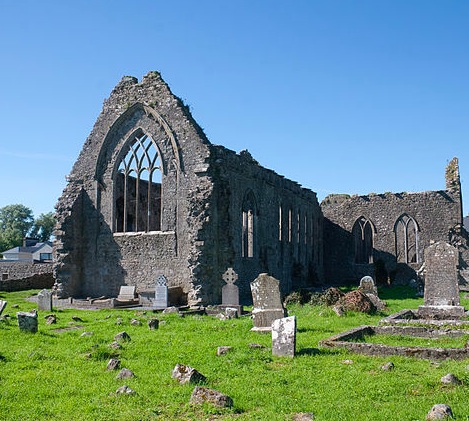
Athenry Priory Photo: Andreas F. Borchert   Wikimedia Commons
Athenry Priory
Photo: Andreas F. Borchert
Wikimedia Commons

The trial of the man for shooting at Captain Lambert near Athenry, on the 12th of July, has ended very unsatisfactorily. The jury were not able to agree and he will have to be tried again. A large sum of money has been subscribed for the defence, and one of the jurors, who was understood to have been in favor of a conviction, was pelted by the mob. The window’s of the judges carriage, also, were broken by stones.

On the evening of the day of the attempted murder a young man was found apparently asleep in the train that runs from Galway to Dublin. In reply to the police, he said that he had got into the carriage at Galway, but two fellow passengers corrected him, and insisted it was at Athenry.  Suspicion was aroused, and he was taken into custody.
He was then discovered to be the son of a tenant whom Captain Lambert had ejected, and a recently-discharged pistol was found in his possession. He had left London on the 11th of July, ” for a trip into the country,” as he told his landlady, and the pistol was traced to a shop in Tottenham Court Road, where he had bought it. In addition to this Captain Lambert positively swore that, he was the person who had fired at him, Yet the jury were unable to agree upon a verdict!

He will be tried again on the 14th of October.