Co. Galway Assizes The Bathurst Free Press and Mining Journal, 1st February, 1860 p4 Thursday, July 28 Robert W was indicted for stealing €4; the property of WG at Galway, on the 22nd of April last. The prisoner, a most intelligent boy, about fourteen years of age, defended himself.
It appeared he was born in Belfast, and for three weeks, prior to the offence had been a servant boy in the employment of a Mr. G who keeps an inn in Galway; and on the night of the 22nd of April he was sent by his master to fetch the prisoner’s trunk from the place where he had been staying to Mr G’s house. The prosecutor had £7 in it at the time and in the morning he missed £4, which he stated the prisoner admitted, in the presence of Mr. and Mrs. G that he had taken.
Mr. G corroborated the statement as to the prisoner’s admission of his guilt. The prosecutor was cross-examined by the prisoner as to his drunken habits and as to several statements he had made about having only £2 in his trunk, with a tact and ability that astonished everyone in court, and enlisted the sympathy of the members of the Bar present, one of whom (a leading Q.C.) stated his intention of adopting him — provided he was acquitted — and bringing him up to the Bar.
The prisoner having finished the cross-examination of all the witnesses produced, proceeded with all the acuteness and self possession of an Old Bailey advocate, to address the jury, commenting on the evidence and on the non production, by the Crown, of a material witness (Mrs G); and he stated that he had made the confession alluded to, under compulsion. the prosecutor having threatened to lash the brains out of him with a stick, which he held over him if he did not confess. The jury acquitted the prisoner.
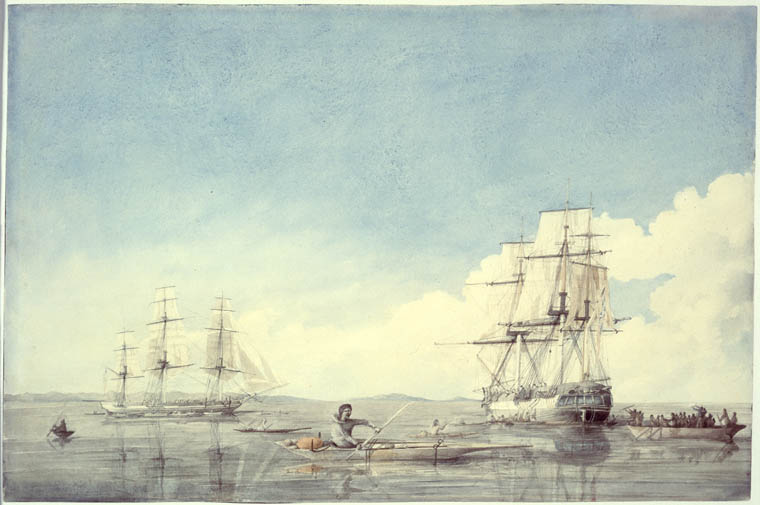
The Hudson’s Bay Company ships Prince of Wales and Eddystone bartering with Inuit off the Upper Savage Islands, Hudson Strait; Robert Hood (1819)South Australian Advertiser p3 DREADFUL SUFFERINGS IN THE POLAR SEA.(abridged)
The only survivor of the crew and passengers of the barque Kitty, a sailor named William Armstrong, arrived at Galway by the Prince Albert last August. Armstrong, on the 29th of June, 1859, shipped as mate of the barque Kitty, from Newcastle-on Tyne, which sailed with a cargo consigned to the Hudson’s Bay Company. She was commanded by Alexander Ellis, and besides her crew of able-bodied seamen she took a few passengers, who intended to settle in the locality.
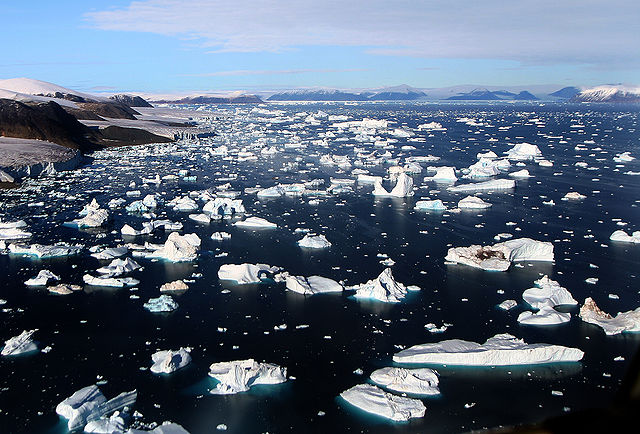
The voyage from the outset was rather boisterous and protracted, for the vessel did not get off the American shore till the beginning of August. On the 11th of that month she was enveloped in a fog off Cape Resolution, and she was suddenly surrounded by huge mountains of ice, so as to render escape almost hopeless. The bergs could be seen through the fog, gradually drawing nearer and nearer, until at last the vessel was touched by them. Icebergs, Cape York, Greenland Wikipedia.org
The crew and passengers wore naturally panic-stricken, but they soon recovered, and commenced efforts to save their lives. Two boats were got out, and as much provisions as could be put into them in a hurry were stowed away. One was under the command of the captain. The other under Armstrong, the mate, left, the ship’s side, just as the bergs closed upon the ill-fated vessel, and crushed her into pieces. She then went down. The remaining boats managed to get through an opening, but only to find themselves in a field of ice, its pieces threatening destruction at every moment.
For days the two boats beat about making attempts to reach the open sea, with no success. The cold began to take effect, and the fearful symptoms of frost-bite became painfully apparent. Remedies such as were within their power were applied, but they were useless. The poor creatures gradually became worse, and dropped off one after another.
Finally the botls separated in a fog. The captain’s boat was never heard of again. Armstrong, with the few persons in his boat still surviving, pursued his course, the little crew in his boat getting fewer in number, while the survivors were becoming weak and sickly. Those who were sinking under the privations, as their hour approached, became maniacs. Two or three besides Armstrong only remained when the welcome cry of ” Land” was raised, and the men strained their eyes and asked one another could it be real. It was at length reached, but too late for some of them. The ecstacy of such a discovery, after being 62 days in an open boat and suffering such privations in a polar region, was too much for them, and all, with the exception of Armstrong, sank to the ground and died. It it is no wonder Armstrong dropped upon his knees, and returned thanks to his God that he had been spared.
Having obtained a little rest, he wandered along the shore, and was fortunate to fall in with some Esquimaux on a hunting expedition. They conducted him to their huts, and there kept him for a considerable time, until he had recruited his strength. They then brought him to a place where some Moravian missionaries were residing, who forwarded him to St John’s in the early part of August. Up to the present no tidings could be got of the vessel, and it was long since supposed that every soul had gone to the bottom.
Haslem Counties Herald.
THE NEW GALWAY STEAMERS – STILL MORE RAPID COMMUNICATION WITH EUROPE
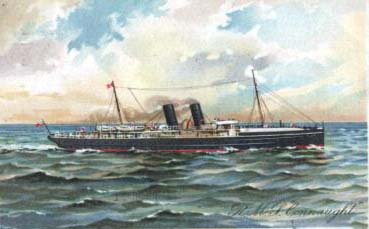
The steamship Connaught, the first of the four new Galway steamers to be called after the four provinces of Ireland, was to have been launched yesterday, and will probably be soon on her way to this continent. The company has entered into a contract with the government binding themselves to convey mails and telegraphic dispatches to and fro between Galway and St. Johns respectively, in six days by the steamers of this line.
This is certainly a bold stipulation. It is quite an American idea, and if carried out will bring the two continents into closer communication than they ever were before. The distance between the two ports is about 1,650 miles, and if it is made in 144 hours, these vessels must run at a uniform speed in all weathers of nearly twelve miles an house. it is said, however, that they will be able to run twenty miles an hour if required.
If they fulfill the terms of the contract, nothing can beat this rapidity of communication except Wise’s balloon or the Atlantic telegraph.
https://widgetworld3.wordpress.com/podcasts/ Photo: Olesachem at The Manhattan Well Diggers Wikipedia.orgThomas L. Cooke visited Kinvara in 1842/’43. He explored the ancient ruin beside Dunguaire…and its cellar. As children, we were warned to stay away from the place on account of the ‘swallow hole’. That, and a fast moving tide, could easily end you.
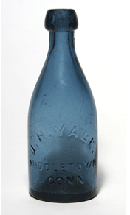
Near the castle already described, but separated from it however by an inlet of the sea, are the ruins of another yet more ancient castle, denominated Dun Guariagh, which signifies “Guaire’s Stronghold.” (I have at present an ancient bottle which was found in a Submarine cellar in this Castle. It is covered with Barnacle shells. – 1860 – T.L. Cooke).

 The Burren and Beyond