Tuam Herald 2nd July 1859 p.3
Corpus Christi in Kinvarra
Not the least amongst the gratifying results which the mission of the Jesuit Fathers has felt after it in Kinvarra, was the scene which our chapel presented on the evening of the great festival of Corpus Christi. At half-past six o’clock p.m. the people assembled in the chapel in great numbers. The Rev Mr Arthur, P.P. commenced the devotions by reciting the Rosary of the blessed Virgin Mary, after which a short exhortation was addressed to the multitude by the Rev Mr McDonough C.C. which seemed to excite amongst them the most lively feeling of pious enthusiasm. Immediately after the exhortation a long train of young girls and boys to the number of 90 entered the sanctuary and were arranged in processional order by the Rev. Mr McDonough. The young girls (who formed the majority of the procession) were tastefully arrayed in white dresses with wreaths on their heads, and carrying in their hands bouquets of flowers. The processional banners were carried by four of the children – two of them by the young girls, and two of the boys. The procession moved several times about the interior of the chapel, through passages made amongst the crowd of adorers, the choir all the time chanting that almost inspired hymn, the ‘Lauda Sion’ composed by the ‘Angel of the schools,’ and read in the mass of Corpus Christi. The procession entered the sanctuary while the choir concluded the hymn. When the remonstrance was deposited on the alter, the choir entoned the Litany of the Blessed Virgin. After which they chanted the entire of the ‘Pange Lingua,’ which, together with the ‘Laudate,’ after benediction, they executed in a highly creditable manner. The ceremonies occupied little more than an hour, and were conducted all through with rubrical exactness and order. – Galway Vindicator.
Tag: 1859
CLARE IN THE OLDEN TIME
Nation 12th March, 1859 p.13
We find the following under the year 1360, in the ‘Annals of the Four Masters’: Brien O’Brien of Thomond gave a very great overthrow to the English of Munster, and took Gerald, Earl of Desmond, and many of the English nobles, prisoners. This battle(?) was so decisive that the clans of Thomond burned Limerick, and Sioda Cam McNamara was appointed governor of it.
The voice of the war-trump rings loud on the gale,
The clansmen are rushing from mountain and glen,
And proud beats each heart, ‘neath its buckler and amil,
At the slogan that summons to conflict again.
From the sheelings of Thomond (1) the kern come fast,
From Cahir of banquets (2) – Kinvarra of storms,
They’re strong as the red-deer (3), more fleet than the blast,
Youth’s fire in their veins, and youth’s grace in their forms.
Beware, valiant Desmond! – Your Normans look pale,
Tho’ boasting their carriage, tho’ haughty their mein,
Like the light’nings red flash is the shock of the Gael,
Their axes are heavy – their sabres are keen.
They have met, they have fought – and yon red battle field
Tells the Norman invader was humbled that day,
‘Neath the spears of Dalcassia (4), the gauntlet, and shield
Of their country in many a foray and fray.
DALCASSIAN
(1) Thomond, or North Munster, at one time included Clare, Limerick and Tipperary, but latterly it came to designate Clare, especially, in which sense it is used here.
(2) Cahir is a fine old ruin on the banks of the Shannon, near Killaloe. It belonged to the McNamaras – one of whose castles I have seen iin an old poem called ‘Of the Rich Banquets.’
(3) The Irish red deer, now extinct, were famous for their strength and fleetness.
(4) Dalcassia, now Clare, was also called Swordland, having been a border territory in Munster, and retained at the point of the sword from the Kings of Connaught.
Bridge of Boats – 1859
Nation 26th February, 1859 p.11
22nd;
Early this morning, the General, the Duke of Wirtemburgh and Lieutenant-General Scravenmore, with all our horse and dragoons, ten regiments of foot, taking with them seven day’s provisions and fourteen guns; ten three pounders and four twelve pounders, marched over our bridge of boats into the county of Clare.
Snuff seizure – Galway – 1859
Irish Examiner 2nd December, 1859 p.4 (abridged)
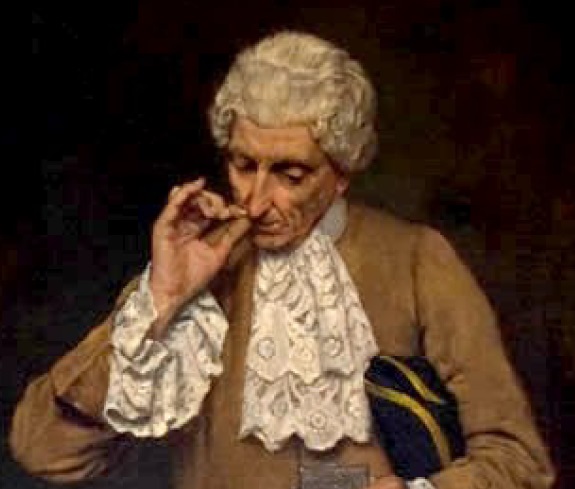
A large seizure of snuff was made on board the steamer Jason yesterday, which arrived from New York on Friday last. There were ten casks altogether, and a great deal of ingenuity was exercised in the packing, so as to make the casks have the appearance of containing flour. On closer examination it was found that a long pipe was passed through the centre of the barrel at the head, the end of which opened immediately below the bung hole. This pipe was filled with flour, so that on taking out the bung, nothing but flour was visible.
The ten casks which were entered as flour, and consigned to a person in this county, were immediately seized and conveyed to the Custom house. The gross weight of the snuff is one ton. It will be in the recollection of your readers that on the last voyage of the Jason 12cwt. of tobacco was seized and one of the parties implicated in the transaction is at present undergoing six month’s imprisonment, the other having paid the sum of £150. The persons who are connected with the present case will be tried in Galway but the exact time is not yet known.
Passenger to America – 1859
Freemans Journal 28th December 1859 p3 (abridged)
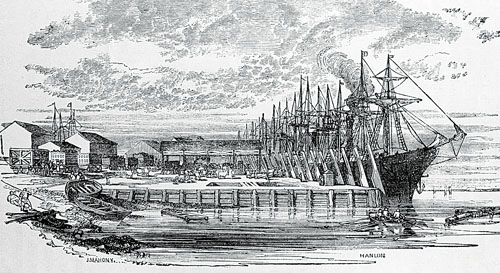
As an evidence of the confidence entertained by the people in the Galway Steam Packet Company, a child about four or five years of age was sent here from Limerick by the coach, labelled and directed “Passenger to America, care of William H. Butler, Esq”. This child was at once taken up by Mr Butler, well cared for and, as the vessel was about to proceed to sea, delivered up to a respectable family who will take care of this young emigrant until the arrival of the vessel in America, where friends will be met to claim it.
Shortly before the sailing of the ship, Captain Thompson, the superintendent, and Mr Butler went on board to inquire of the passengers whether they had any complaints to make or fault to find, but all expressed themselves highly pleased with their position. The mails taken out by the Circassian were heavier than on any previous occasion.
A Narrow Escape – 1859

Wikimedia Commons
https://widgetworld3.wordpress.com/podcasts/
The Sydney Morning Herald 12th February 1859
(abridged)
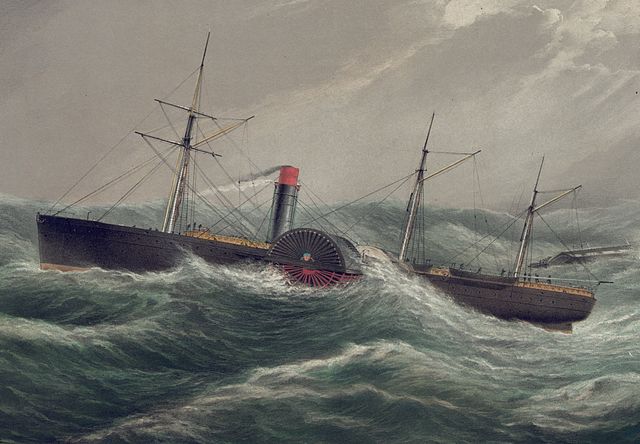
The Pacific had a narrow escape from being caught on the iron-bound cliffs of Clare on her last passage to Galway. The Pacific ran into Liscannor Bay instead of Galway Bay on Monday night, there being no distinguishing landmarks between them, and was actually approaching the shore of Lahinch when some of the fishermen put out in boats, and with lights warned off the steamer from the dangerous coast she was approaching.
The only light at the entrance of Galway Bay is on the Arran Islands. The course of a steamer sailing into Galway should be nearly six miles south of the Arran Light, but miscalculating the distance, the Pacific, when about 16 miles from the island, made for a bay which was supposed to be Galway, but which (fortunately before it was too late) was discovered to be Liscannor. Were it not for the timely warning given by the fishermen the Pacific could not have escaped, except by a miraculous interposition of Providence, from total destruction, on the fatal spot to which she was fast hurrying.
Mitchell’s Maritime Register, 4th of December.