Empire (Sydney, NSW) 19th February 1852 p 4. Great Decrease in Litigation Further accounts from the country mention that there is an enormous decrease in the civil business at the October Quarter Sessions, now in progress; and this applies to Leinster as well as Munster and Connaught. At the Sessions of Kells, County Meath, before the famine, the ordinary number of civil bill processes had been 800. In October, 1849, the number entered had been 444; in October, 1850, it declined to 289; at the Sessions held this week only 130 processes had been entered, although the jurisdiction of the assistant-barristers, by the Act of last Session, has been extended from £20 to £40. This extraordinary falling-off, which has destroyed the business of the attorneys practising at Quarter Sessions, is attributable to the continued decrease of the population and the stoppage of credit in the dealings amongst the country shopkeepers and the peasantry. Meantime remittances to a vast extent are received from America, to enable the friends and relatives of settlers to emigrate. In Kelly, whilst the Sessions were in progress, various sums were obtained, in the shape of bank orders, and many of the farmers are preparing to take a winter voyage across the Atlantic.
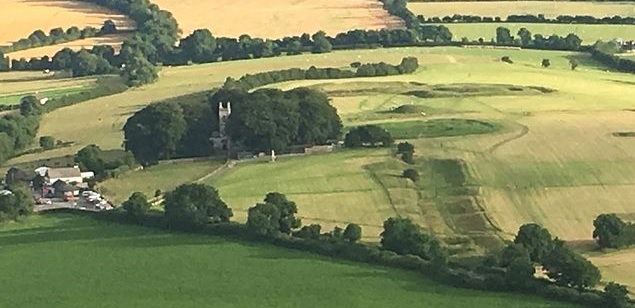
Hill of Tara Photo: Alison Cassidy Wikimedia Commons
The Catholic Layman Vol. 1, No. 2 (Feb. 1852), pp. 16-18
(abridged)
In the year 433 St. Patrick preached at Tara before Leogaire (or Laoghaire), then the supreme monarch of Ireland, on the celebrated hill of Tara, in the county of Meath, the chief residence of the Irish kings from the first establishment of a monarchical government in this country. The national convention or parliament was then assembled in that place, for the celebration of the great national festival of Tara, called “Baal’s fire.” The force with which St. Patrick urged upon them the truths of the Gospel, was such that, according to some accounts, the king himself became a convert to Christianity, and great multitudes of his subjects, including Dubtach, the arch-poet of the kingdom, and Conall, the King’s brother, soon followed his example. Whatever may have been the immediate effect, the preaching of St. Patrick before King Leogaire at Tara, is one of those facts on which all authorities concur.
On Easter Eve, St. Patrick arrived in the evening at a place called Ferta-fer-feic, now Slane. Having got a tent pitched there, he made preparations for celebrating the festival of Easter, and accordingly lighted the paschal fire about night-fall. It happened that at this very time the King Leogaire and the assembled princes were celebrating a religious festival, of which fire-worship formed a part. There was a standing law that at the time of this festival, no fire should be kindled for a considerable distance all around, until after a great fire should be lighted in the royal palace of Temoria, on Tara. St. Patrick’s paschal fire was, however, lighted before that of the palace, and being seen from the heights of Tara, excited great astonishment. On the king’s inquiring what could be the cause of it, and who could have thus dared to infringe the law, the Magi told him that it was necessary to have that fire extinguished immediately, whereas, if allowed to remain, it would get the better of their fires, and bring about the downfall of his kingdom. Leogaire, enraged and troubled on getting this information, set out for Slane, with a considerable number of followers, and one or two of the principal Magi, for the purpose of exterminating those violators of the law. It was immediately before, and in anticipation of the imminent peril in which he was placed when approaching the stronghold of his Pagan enemies, that a remarkable hymn was composed by St. Patrick, and is said to have been sung by him and his followers as a defence against the plots that beset his path. It is familiarly known by the name of “St. Patrick’s Armour” (Lorica Patricii) and is obviously a prayer for protection from the incantations of his Druidical opponents, who were determined on his destruction. And this is a religious armour to protect the body and soul against demons, and man, and vices.
The hymn is recorded in the celebrated M.S. Liber Hymnorum, preserved in the library of Trinity College Dublin. It is written in that ancient dialect of the Irish in which the Brehon laws, and the oldest tracts in the language are written.
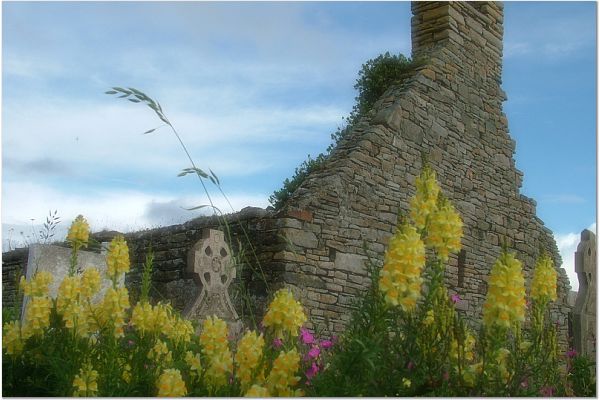
Old Church near Kilbaha Photo: Fred Creative Commons
The Sydney Morning Herald 21st February, 1852 P6 (abridged)
The Clare Journal states, that on Sunday, the 28th of September last, at a chapel in the county of Clare, sentence of excommunication was pronounced by a priest, at the altar, on all the people of Kilbaha, who had sent their children to Kiltrellig school, or who would send their children there for the future. Consecrated candles were extinguished, the bell was rung, the book was closed, the crucifix was prostrated, and the following curse pronounced :-
“I pray God to send down all vengeance on those who sent their children to Kiltrellig school last week, particularly two; may the devil be their guide on the right and on the left, lying and rising, in bed and out of bed, sitting and standing, within and without; may all misfortune attend their families and labourers. And any person or persons sending their children to this school henceforth, may they be struck blind and deaf, so as never to see any of their children again; and may the children sent to this school go wild; may they never leave this world until they be such examples as that the marrow may come out through their shin bones; may they be pained both sitting and standing, and may they never leave this world until they are in such a state that the dogs could not bear coming near the carcasses when dead. I pray to God that every child who goes to the school, that for every day he spends in it his life may be curtailed a twelvemonth, and that they may never enjoy the years of maturity; and those people who send their children to the school, that their crops and their goods may be taken away by the devil, and may all these misfortunes attend any person taking their posterity in marriage thirty years hence. I pray the Almighty to hear this prayer, as the Minister of God; and I now strictly command this congregation to kneel down and pray to God to grant my prayer.”
Note: The above was attributed to a Fr Meehan, priest at Kilbaha. The sentence of excommunication was passed due to the proselytising nature of Kiltrellig school. Tensions were exacerbated by a local landlord who obstructed the building of a Roman Catholic Church in the vicinity. Father Meehan’s solution was to build “The Ark”, a church on wheels in which mass was celebrated.


 The Burren and Beyond