Posted in Posts and podcasts

The Poor Law and its Commissioners – 1846

Freeman’s Journal 5th, January 1846 p2.
(abridged)
We subjoin a notice of motion given in the Board of Guardians of the Gort Union by Daniel MacNevin, Esq., one of the guardians. The facts which appear in the notice illustrate wonderfully the beauty of the new centralizing poor law. It appears that one of the assistant commissioners, a Mr. Handcok (sic.), who represents the Scotch autocracy of Somerset House, and whose sovereign will overrules and supersedes the discretion of the resident gentlemen and ratepayers, chose to apply an outrageously offensive expression to one of the guardians, Mr. Lahiff, a gentleman of very extensive landed property and great influence in the neighbourhood of Gort.
But it is not alone for the personal insult that Mr. Handcock will have to answer to the public and to his employers. On the face of Mr. MacNevin’s notice of motion it is alleged, that on a late inquiry into the conduct of an official in the local pest house (or poorhouse), this worthy assistant-commissioner refused to examine a material witness because she could not speak English. Can anything be more monstrous than this conduct? We trust that the matter will be fairly discussed on the motion, and that, if Mr. MacNevin can substantiate his charges – can prove that, personally, this gentleman is rude, aggressive, and insulting, and that, acting in a quasi-judicial character, he excluded testimony because the witness could only speak her native language – the result will be the exemplary punishment of the party so offending. The following is from the Galway Vindicator:-

GORT UNION – MEETING OF GUARDIANS
At a full Board of Guardians of the Gort Union, on Friday, the 26th of December instant, the following notice was given by D. McNevin, Esq, one of the guardians of said union;-
“I hereby give notice that on the 9th day of January next, I will move for a vote of censure on Mr. Handcock, the Assistant Commissioner of this Union, for insolence and gross misconduct towards this board. In the first instance, for having told one of our chairmen, James Lahiff, Esq., that he (is) a perfect nuisance; in the second place, for having, by his report, misrepresented to the Board of Commissioners, the conduct of these magistrates, members of our Board, two of them being ex-officio Guardians, and for having finally, refused, upon a late inquiry into the conduct of the master of this house, to examine a material witness for said master, inconsequence of her being unable to give her evidence in English, though three gentlemen of our board (perfectly competent to do so) offered to act as interpreters on the occasion, which after the said assistant-commissioner refused, and made his report against the said master, discarding such material witness, and thereby inducing the commissioners to dismiss said master contrary to the unanimous opinion of our board.
The board adjourned until Friday, 9th January next.

Posted in Posts and podcasts

Galway – 1846

Indiana State Sentinel 19th march, 1846

Galway Cathedral Photo: EO'D
Galway Cathedral
Photo: EO’D

The government has again learned the necessity to increase the military force in Galway. A troop of the 13th Light Dragoons from Gort, arrived here on Tuesday, under the command of Captain Hamilton, for the purpose of repressing any outbreak among the people which may arise owing to the exportation of corn from this port.

Two companies of the 30th are likewise expected – one from Loughrea, the other from Oughterard – to aid the force in garrison, if necessary. This increase of troops is said to have been caused by the posting of a threatening notice at the Gashouse last week, to the effect that the merchant stores would be broken up by the people, if any further exportation of corn was attempted.

Posted in Posts and podcasts

Galway Gaol – 1846

Welshman 25th February 1846

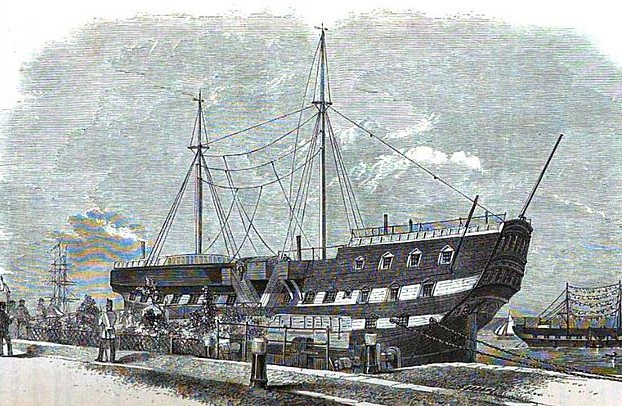
HMS Warrior - Prison Ship Mayhew, Henry and Binny John. The Criminal Prisons of London, and Scenes of Prison Life, Volume 3 of The Great Metropolis, Griffin, Bohn, and Company, 1862,  Wikimedia Commons
HMS Warrior – Prison Ship
Mayhew, Henry and Binny John. The Criminal Prisons of London, and Scenes of Prison Life, Volume 3 of The Great Metropolis, Griffin, Bohn, and Company, 1862,
Wikimedia Commons

At Galway county special sessions the board of superintendence applied for £7,350 for maintenance of the county gaol, bridewells, courthouses etc. The Rev Mr D’Arcy said that from the vast number of prisoners lately committed, the prison was more like a poorhouse than a gaol, there being nearly a thousand prisoners in it.

The state of the gaol was frightful and, in order to relieve it, an application had been made for a hulk to put some of the prisoners in, otherwise the spread of contagion would be awful. After some discussion the presentment was passed.

Posted in Posts and podcasts

Tulla – 1846

Parable of the Hidden Treasure by Rembrandt (c. 1630). Wikimedia Commons
Parable of the Hidden Treasure by Rembrandt (c. 1630).
Wikimedia Commons

Morning Chronicle 10th January, 1846
Workmen employed by Mrs Dr. Silver at Mount Agentino, near Tulla were throwing down an old house (said to be the oldest in Clare) when they discovered a small leather bag in the wall. It contained thirty nine guineas, of the reign of George II. They also found a curious shaped bottle full of gold and silver coins of various dates, said to be of the value of £250; nine curiously chased silver spoons; an antique fish trowel and a valuable enamelled gold ring. The spoons and ring had the arms and initials of O’Grady on them.

Posted in Posts and podcasts

Foy’s Hill? – 1847

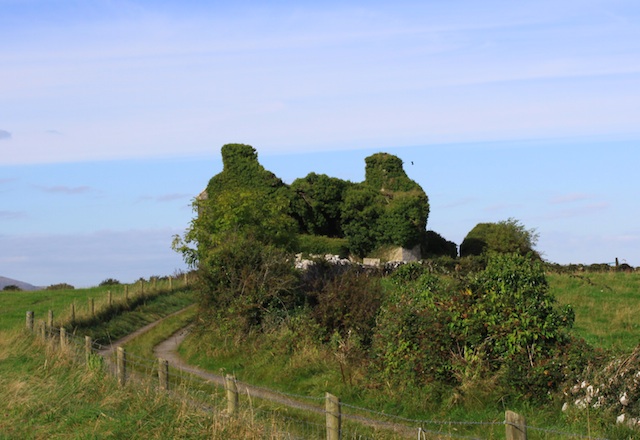
Foy's Hill, Kinvara Photo: Norma Scheibe
Foy’s Hill, Kinvara
Photo: Norma Scheibe
Epidemic Diseases of the Great Famine

Published in 18th–19th – Century
History, Features, Issue 1 (Spring 1996), The Famine, Volume 4 (abridged)

In December 1846, the board of health in Drumkeeran, County Leitrim, resolved to hire a house for use as a fever hospital, there being no such institution within a radius of eighteen miles. The proposal caused ‘inconceivable alarm’ in the town. Sixty-two of the residents, including merchants, shopkeepers, tradesmen, labourers, publicans, and householders, as well as Pat Gallaher, the schoolmaster, addressed a memorial to the Lord Lieutenant, objecting to the establishment of a fever hospital in the centre of the town. They stated that they were not so much opposed to the institution, as to its location.
A rather similar appeal was made by the residents of Kinvarra, County Galway, in July 1847. They claimed that the imminent opening of a fever hospital in the town placed their lives and those of their families in ‘the greatest peril’. They argued that the chosen site was too close to the town, that it either adjoined or was within eight feet of a range of houses occupied by some 300 individuals and was no more than sixty yards from the town centre.