The Times, LondonGuinea Wikimedia Commons
17th July, 1788 (abridged)
A short time ago some labourers were clearing the race ground of Loughmore, near Limerick. They found a small brass box, containing a piece of parchment five inches square, on which is written the admission of a fellow or scholar at Mungret University. Mungret University was at an early age famous. At the top is a picture of St. Patrick. It is signed Gulielmus Nophine, with the date A.D. 485. It was purchased for a guinea and sent as a present to a member of the Irish Academy.
Photo: André Karwath Wikimedia CommonsThe Times
London, Middlesex, England
October 25, 1788
Cyder is so cheap this year, that on the condition of giving two hogsheads, in either the counties of Limerick or Waterford, one of them is filled (or tilled) land given in return for the other. Cyder is certainly an healthy beverage, but should not be drank too fresh, or in great quantities. It is known by experience that those who drink nothing but this liquor, are stronger, more healthy, and look better than those who drink wine; of which Lord Bacon gives a remarkable instance of eight old people, who were near, and others above one hundred, who during their whole lives drink nothing but cyder, and were so vigorous, that they danced and jumped about like young men.
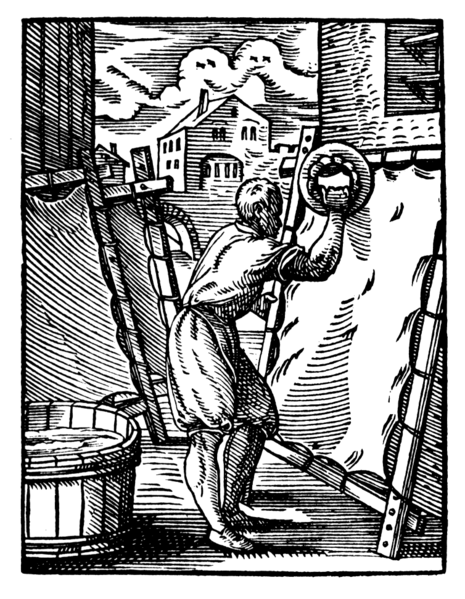
German parchmenter, 1568 Eygentliche Beschreibung aller Stände auff Erden, hoher und nidriger, geistlicher und weltlicher, aller Künsten, Handwercken und Händeln …” / from Jost Amman and Hans Sachs / Frankfurt am Main / 1568 / thanks to http://www.digitalis.uni-koeln.de Wikimedia CommonsThe Times London, Middlesex, England July 17, 1788
A short time since as some labourers were clearing the race ground of Loughmore, near Limerick, they found a small brass box, containing a piece of parchment five inches square, on which is written the admission of a fellow or scholar at Mungret University, which was at an early age, a famous one; at the top is a picture of St. Patrick, and it is signed Gulielmus Nophine, with the date A.D. 485. It was purchased for a guinea and sent as a present to a member of the Irish Academy.
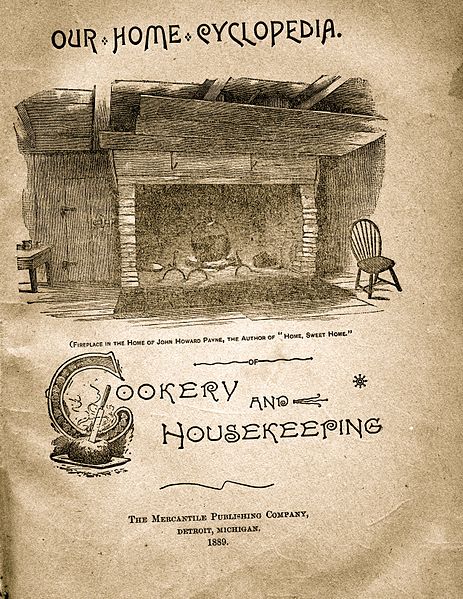
Title page of “Our Home Cyclopedia,” of “grocery and housekeeping – 1889 Mercantile Publishing Company Wikimedia CommonsTHE TIMES (LONDON)
28TH MARCH, 1788 (abridged)
Mr. Conolly of Ireland has brought forward a motion for abolishing the tax upon HEARTHS, and the Irish Ministry will not oppose it. In Ireland, hearth-money is at this day more oppressive than ever it was in England.
This tax has ever been hateful, and as the subject is again revived- we will give its history. In Doomesday-Book, compiled by order of William I. there existed a tax called fumages or fuage, which common people termed smoke farthings. This tax was paid by custom to the King, and was rated upon every chimney in a house.
Edward, the Black Prince, after his successes in France, in imitation of the English custom, imposed a tax, one florin upon every hearth in his French dominions. This tax is mentioned in the twenty-third volume and four hundred and sixty-third page of the Modern Universal History, and in Spelman’s Glossory under the word Fuage.
In the fourteenth year of the reign of Charles II, a statute was passed in Parliament that all houses liable to church and poor, should pay two shillings for every hearth. This payment was granted as an hereditary revenue to the king for ever. Subsequent statutes allowed a surveyor, appointed by the crown, a constable and two other inhabitants of the parish, to view the inside of every house in the parish.
Hearth-money was eventually abolished by a statute, passed in the first year of King William and Queen Mary. The statute declared-that hearth money is “not only a great oppression to the poorer sort, but a badge of slavery upon the whole people, exposing every man’s house to be entered into, and searched at pleasure, by persons unknown to him. To erect a lasting monument of their Majesty’s goodness in every house in the kingdom, the duty of hearth-money was taken away and abolished.”
Ireland awaits and the Minister will acquire well earned popularity by not opposing its annihilation.
NOTE: The hearth tax was abolished in England in 1689 – It was abolished in Ireland during the 19th Century.


 The Burren and Beyond