(abridged).
Another branch of the Magraths had some possessions in the vicinity of Kinvara, in the district of Hy-Fiachra-Aidhne, County of Galway, but a few only of their descendants are to be met with in that county at the present day. Of this branch the church of Kinvara was the burial place, and until late years this sacred edifice, the foundation of St. Coman, of whom mention is made in the ancient tale known as the Imramh, or Expedition of the sons of Ua Corra, was exclusively the place of interment of the Magrather O’Hynes. The possessions of the Hy-Fiachrain Magraths lay around the Bally magrath, near Ardrahan; but the proprietors thereof, having taken an active part in the disturbances of 1641-9, the lands of Balymagrath and Kilteenan were granted by Cromwell to the family of Taylour, or Taylor.
Connacht Tribune 28th November, 1975. p6
Assistant County Manager, Mr. John Howlett, accompanied by Councillor Toddie Byrne, Rev. M. Brennan, C.C. and Mrs M. Monahan and Mr. Paddy Geraghty, Town Representatives on the Community Council, inspected the old church of St. Coman, Kinvara. They had in mind the possibility of doing up the church and making it accessible to the public.
From Duchas.ie
Collected 1937/1938
Ballinderreen, Co. Galway. Teacher: Treasa Bean Uí Bheirn
Collected by Rose Niland from Martin Kelly, Tyrone, Co. Galway
About fifty years ago a horse-man used to pass the Ballinderreen road towards Kilcolgan every night. A certain woman used to look out after it so she lost the sight of one of her eyes. My grandfather and a few companions were coming from a dance from James St. Georges about two o’clock one night and as they were coming back at Glynn’s they heard a galloping horseman coming towards them. They said it must be some man going to the Loughrea horse fair. So when the horseman was within five or six yards of them they moved in one side of the road to let it pass. They heard something like a breeze of wind passing between them and the wall but they saw nothing. Just a few yards behind them they heard the horse galloping again. They knew then that it was no living person that was in it but the fairy horseman that used to pass the way every night.
Long ago there lived a woman in the parish of Ballindereen in a place a place called Cloughballymore This was a terrible witch who lived in the side of a tree in the night time and in an underground passage in the day time.
She was called the Long black hand because she had a big black hand. She used to kill everyone that would pass from setting sun till dawn and they used to be found dead on the side of the road and their skin used to be black.
About that time there lived a rich man who had a lot of money and land in the same place. The witch was interfering too much with him.
One night he had a great feast and a very brave man was in it called “O Hynes” He said he would kill her if he got a good horse and a sword.
He got them and he went to where she lived and when he arrived at the gates “are you within he cried” “I am and soon will be with you the elf replied”
The she made a drive for him but she caught the horse by the tail but he struck her and cut the hand in two. “Another blow my gallant knight if I survive you’ll die” said the Long Black Hand. “O no he said I think that one will do.”
She followed him home and was telling him to give her back her hand.
She was never seen again by anyone and O Hynes got a lot of money from the rich man, but he died soon after those events
Proceedings of the Royal Irish Academy (1836 – 1869), Vol.5 (1850-1853), pp. 355-366;
(abridged excerpt from On Rhyming Rats to Death )
On the death of Dallan Forgaill, the chief ollave, or poet of Erinn, about A.D. 600, Senchan Torpest, a distinguished poet of Connacht, was selected to pronounce the defunct bard’s funeral oration, and was subsequently elected to his place. Senchan formed his establishment of bardic officers and pupils on a larger scale than had been known since the revision of the bardic institution at the great meeting of Dromceat, some twenty years previously. As chief poet, he was entitled to make visitation with his retinue, of any of the provinces and to be entertained at the court of the provincial kings. The honour of being so visited was sought for with pride and satisfaction by the kings of Ireland.
Senchan, having consulted with his people, decided on giving the distinguished preference of their first visitation to his own provincial king, Guaire the Hospitable, king of Connacht. They were received hospitably and joyfully at the king’s palace, at the place now called Gort, in the county of Galway. During the sojourn of Senchan at Gort, his wife, Bridget, on one occasion, sent him a portion of a certain favourite dish. Senchan was not in his apartment when the servant arrived there; but the dish was left there, and the servant returned to her mistress. On Senchan’s return, he found the dish and, eagerly examining it, was sadly disappointed at seeing it contained nothing but a few fragments of gnawed bones.
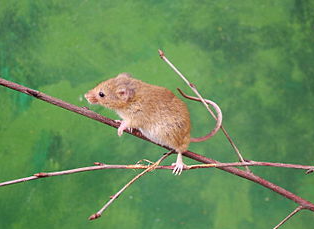
Shortly after, the same servant returned for the dish, and Senchan asked what its contents had been. The maid explained it to him, and the angry poet threw an unmistakeable glance of suspicion on her. She, under his gaze, at once asserted her own innocence, stating that as no person could have entered the apartment from the time she left until he returned to it, the dish must have been emptied by mice.
Senchan believed the girl’s account and vowed that he would make the mice pay for their depredations, and he composted a metrical satire on them;
Mice, though sharp their snouts,
Are not powerful in battles;
I will bring death on the party
For having eaten Bridget’s present.
Small was the present she made us,
Its loss to her was not great,
Let her have payment from us in a poem,
Let her not refuse the poet’s gratitude!
You mice, which are in the roof of the house,
Arise all of you and fall down.
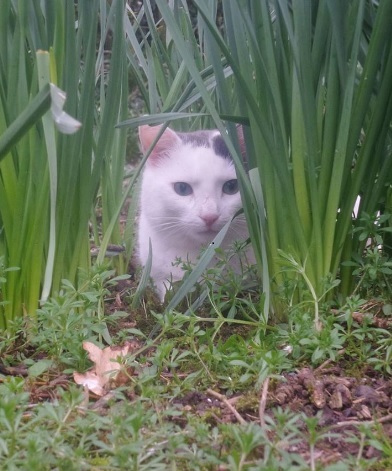
And thereupon ten mice fell dead on the floor from the roof of the house, in Senchan’s presence. And Senchan said to them: “It was not you that should have been satirized, but the race of cats, and I will satirize them.” And Senchan then pronounced a satire, but not a deadly one, on the chief of the cats of Erinn, who kept his princely residence in the cave of Knowth, near Slane, n the County of Meath.
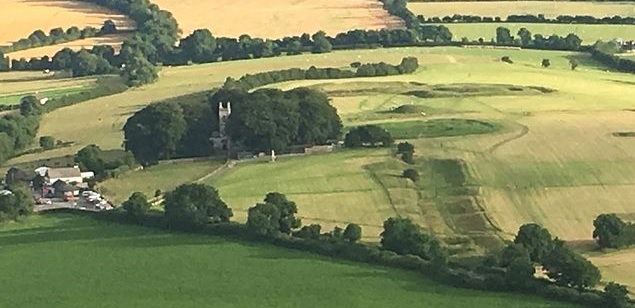
Hill of Tara Photo: Alison Cassidy Wikimedia Commons
The Catholic Layman Vol. 1, No. 2 (Feb. 1852), pp. 16-18
(abridged)
In the year 433 St. Patrick preached at Tara before Leogaire (or Laoghaire), then the supreme monarch of Ireland, on the celebrated hill of Tara, in the county of Meath, the chief residence of the Irish kings from the first establishment of a monarchical government in this country. The national convention or parliament was then assembled in that place, for the celebration of the great national festival of Tara, called “Baal’s fire.” The force with which St. Patrick urged upon them the truths of the Gospel, was such that, according to some accounts, the king himself became a convert to Christianity, and great multitudes of his subjects, including Dubtach, the arch-poet of the kingdom, and Conall, the King’s brother, soon followed his example. Whatever may have been the immediate effect, the preaching of St. Patrick before King Leogaire at Tara, is one of those facts on which all authorities concur.
On Easter Eve, St. Patrick arrived in the evening at a place called Ferta-fer-feic, now Slane. Having got a tent pitched there, he made preparations for celebrating the festival of Easter, and accordingly lighted the paschal fire about night-fall. It happened that at this very time the King Leogaire and the assembled princes were celebrating a religious festival, of which fire-worship formed a part. There was a standing law that at the time of this festival, no fire should be kindled for a considerable distance all around, until after a great fire should be lighted in the royal palace of Temoria, on Tara. St. Patrick’s paschal fire was, however, lighted before that of the palace, and being seen from the heights of Tara, excited great astonishment. On the king’s inquiring what could be the cause of it, and who could have thus dared to infringe the law, the Magi told him that it was necessary to have that fire extinguished immediately, whereas, if allowed to remain, it would get the better of their fires, and bring about the downfall of his kingdom. Leogaire, enraged and troubled on getting this information, set out for Slane, with a considerable number of followers, and one or two of the principal Magi, for the purpose of exterminating those violators of the law. It was immediately before, and in anticipation of the imminent peril in which he was placed when approaching the stronghold of his Pagan enemies, that a remarkable hymn was composed by St. Patrick, and is said to have been sung by him and his followers as a defence against the plots that beset his path. It is familiarly known by the name of “St. Patrick’s Armour” (Lorica Patricii) and is obviously a prayer for protection from the incantations of his Druidical opponents, who were determined on his destruction. And this is a religious armour to protect the body and soul against demons, and man, and vices.
The hymn is recorded in the celebrated M.S. Liber Hymnorum, preserved in the library of Trinity College Dublin. It is written in that ancient dialect of the Irish in which the Brehon laws, and the oldest tracts in the language are written.
(abridged)
The youthful comrades whom we loved, can we forget then? Never!
The heartfelt pressure of each hand remains with us forever.
Though many a mile of sea and land since then our paths may sever.
Can we forget those olden days? No, comrades, never! Never!
Some east and west, some north and south have drifted o’er life’s ocean,
Yet looking back at those fond days each heart throbs with emotion;
Though we be sundered far for years, perhaps, indeed, for ever,
Can we forget those olden days? No, comrade, never, never!
Some gained the rugged hill of fame, while some are toiling lowly;
Their hearts, though withered up, are filled with aspirations holy,
Shall we look coldly down on those who failed in life’s endeavour?
I hear each friendly voice ring out, “No, comrades, never! Never!”
Then here, old comrade take my hand; we’ll drain a glass together.
We care not for the want of wealth, nor troubles heed a feather.
We pledge our comrades in this cup, and wish them joy for ever.
Can we forget those olden days? No, comrades, never! Never! Artane
Kilmacduagh Photo: Jerzy Strzelecki Wikimedia Commons
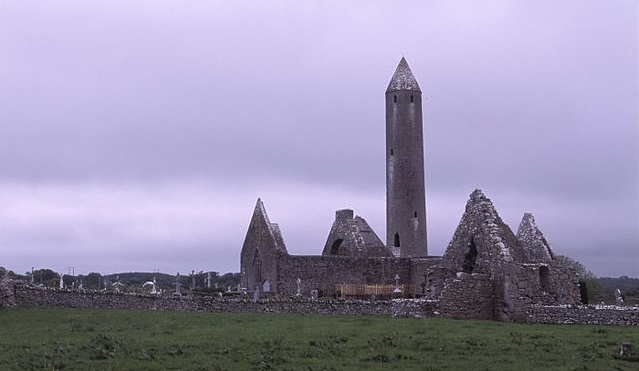
Kilmacduagh is a parish in the barony of Kiltartan, County Galway. The See of Kilmacduagh, now a part of that of Galway, was founded by St. Colman, who, being son of Duagh, was distinguished from other Colmans, his contemporaries, by the appellation of MacDuagh. He build a monastery and church called after him, Kilmac-Duagh, whence the name of the parish. The latter comprises 6,015 statute acres. Some ancient remains are to be seen in the neighbourhood, including a round tower, which declines about 17 feet from the perpendicular.
In a lake in the parish, called Lough Deehan, the waters having sunk very low in the year 1784 or 1785, a house was discovered in the mud at the bottom, formed of oak timber of great thickness, the sides and roof of which was formed of wattle-work of the same substance: it appeared as if intended to float, and the timer of which is was constructed was perfectly sound.
St. Caimin of Inis-Cealtra, was half brother to King Guaire, and he is also called Coman of the Third Order of the Saints. Dr. Lanigan things the two identical and, if so, Coman was the founder of the Church of Kinvara. He was a great scholar, versed in Hebrew as well as older languages. He composed commentaries on some of the Psalms, and his commentary on Psalm cxviii is to be found in the Franciscan Monastery at Dublin, having been originally in and seen by Sir James Ware in the Franciscan Monastery at Donegal.


 The Burren and Beyond