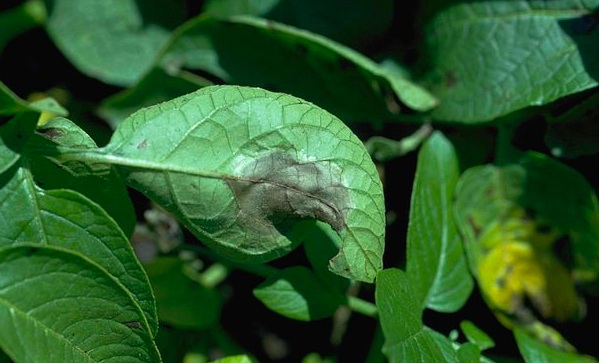
“Late blight on potato leaf 2” by Howard F. Schwartz, Colorado State University, United States – Wikimedia Commons –
THE Argus 26th December 1848 p4
From Gort, in Galway, about July 29, the reports were favourable, but recent returns show that on the 6th August a general failure of the crop was anticipated, the fields were black, but at that time it had not generally destroyed the Potato; on the 10th, however, matters were much worse, and opinions were entertained that it would be desirable to consume what Potatoes were sound, while they remained so, “for the blight was extending.”
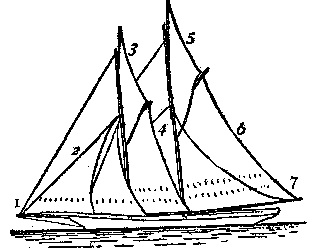
Schooner rigging: 1) Bowsprit; 2) Jib, followed by fore staysail; 3) (Fore) gaff topsail; 4) Foresail; 5) Main gaff topsail; 6) Mainsail; 7) End of boom Wikimedia.orgTHE TEESDALE MERCURY 1ST MARCH, 1893 P3
SAD FATALITY AT SEA
The schooner Jeffery, of Jersey. Captain Davey arrived in Penzance Harbour on Sunday afternoon from Kinvarra, Galway Bay and reported having experienced terrific weather on the voyage.
In her voyage from Ireland the Jeffery has been out between four and five weeks, and some anxiety had been felt respecting her safety. On Wednesday last E—- C—-, one of the seamen, was washed overboard. Captain Davey threw a lifebuoy to him and he succeeded in getting inside it. An attempt was then made to get a boat out, but there was such a tremendous sea running that on getting over the side of the ship the bottom of the boat was stove in, thus rendering it useless.
The crew then tried to get the vessel down to the man by wearing round, but they were unable to reach him.
The death is announced form Gort Convent, county Galway, of Mother Mary Aloysius Doyle, the last of the 16 nuns of the Order of Mercy, who left Ireland in Decemlier, 1854, to assist Florence Nightingale in nursing the Soldiers in the Crimea. She was 94 years of age. She was summoned to Windsor several years ago by the late Queen Victoria to be decorated, but was too old to undertake the journey. Her sister, aged 90, a nun in the same convent, still survives.
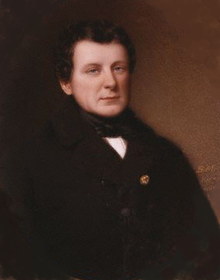
O’Connell, MP for Clare 1828 – 1930 Painting by Bernard Mulrenin 1836
The Warning
Hear you not that wild wind moaning,
Shrieking o’er our withered land?
Hear you not our mountains groaning
To tell us sorrow is at hand?
See you not our people dying.
Young and old are swept away ;
The proud and strong around are lying,
Ere life ebbs out they turn to clay!
Hear you not that Ocean storm?
Convulsed Atlantic shows her sorrow:
See you not that shipwreck’d form?
All, all portends of grief to-morrow.
List, oh list, the Banshee crying
Around the walls of Derrynane;
Away from us our Chieftain’s dying,
The Mileslan dirge her midnight wail.
Alas! alas! the morn looks sad,
The sun lies hid behind yon cloud,
In deepest dye of mourning clad,
Close wrapped as in a grave-like shroud.
Hush, oh hush, all hearts are breakiig
Weep, oh weep, his spirit’s fled.
Hark! a mighty voice is speaking
“Slaves, your friend O’Connell’s dead.”
Poland grieved o’er Kosciusko’s pall;
Columbia wept her Washington;
Each nation’s mourned her hero’s fall,
Proud England still has Wellington;
But ours – oh ours – the wide worlds’ friend,
In every clime the tyrants’ dread;
What slaves shall now know sorrow’s end,
Their champion all, O’Connell’s dead.
Yes; his fall through every clime will ring,
The myriads shout his hallowed praise;
And those will weep his funeral song,
Who heeded not his glorious rays;
Aye, they will seek a borrowed fame,
As earth is brightened by the sun;
And those will claim O’Connell’s name!
Whose every deed his bosom wrung.
“Cracked and splintered hurley” Jeff Meade Philadelphia, US Wikimedia Commons
The Advertiser (Adelaide, South Australia)
13th March, 1912 p9. (abridged)
Yesterday a band of men hiding on both sides of the road at Gort in County Galway, fired at six men on their way home from a hurling match. All the men were injured, two of them seriously. No arrests have been made.
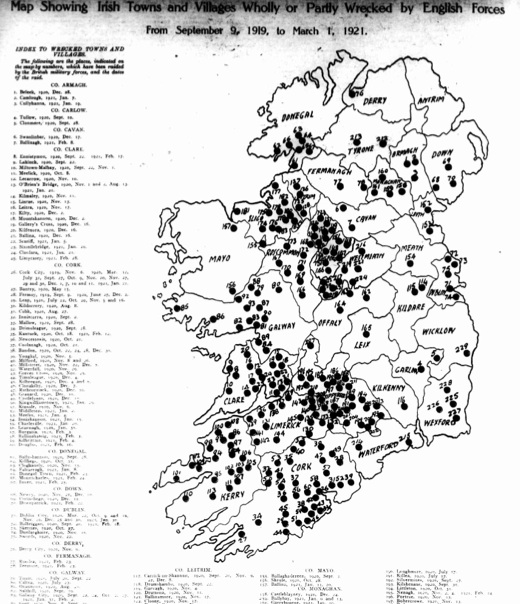
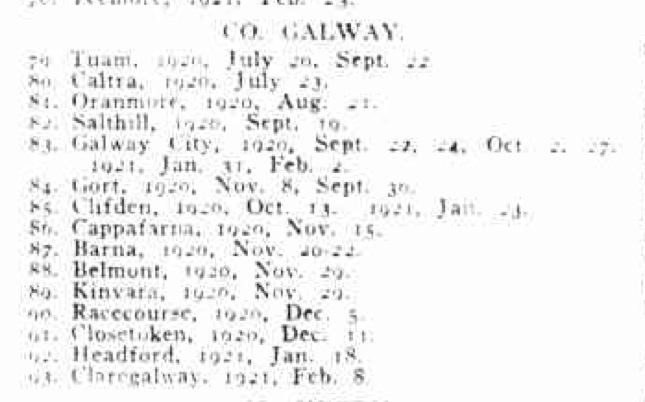
Map Showing Irish Towns and Villages Wholly or Partly Wrecked by English Forces From September 9, 1919, to March 1, 1921. INDEX TO WRECKED TOWNS AND VILLAGES.
The Catholic Press (Sydney, NSW : 1895 – 1942) 8 September 1921
Connaught Journal January 30 , 1823
New Garden & Farm Seeds.
Elizabeth Cloran of Loughrea respectfully informs the Customers of her House and the Public, that she has arrived to her from London, per the New Harmony for Dublin, her annual, extensive and general assortment of Garden, Farming, Flower Seeds, which she having imported from one of the most eminent Seedsmen in London, is enabled to recommend with perfect confidence.
She is also constantly supplied from the most respectable Druggists in Dublin, with every Genuine Medicine in the Apothecary business, to the compounding and dispensing of which the strictest care and attention is paid by a Gentleman, regularly qualified in that Profession. Oils, Colours, Horse, Cow, Sheep and Dog Medicine, and a choice selection of all the Patent Preparations from the Medical-Hall, 34, Lower Sackville-street, Dublin.
She hopes from her anxiety at all times to procure every Article of the best description, Her moderate charges, and the particular attention to the orders she may be favoured with to merit a continuance of that liberal patronage which she has experienced since her commencement in business.