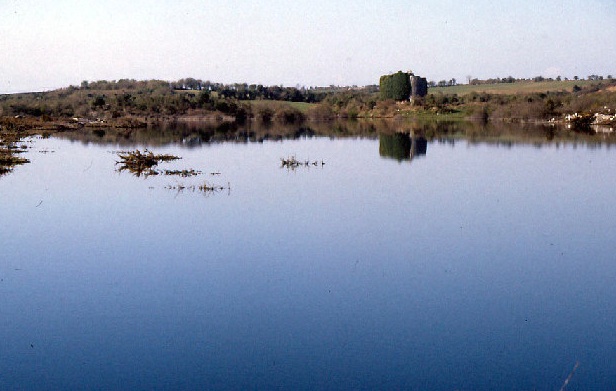
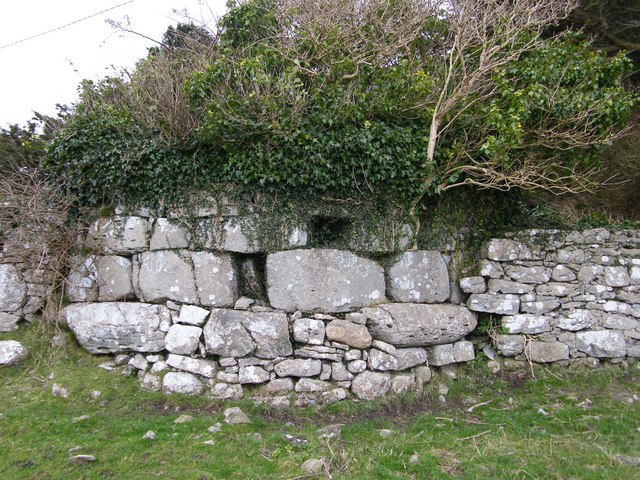
Newtown Castle, west of Gort Photo: Dr Charles Nelson Wikimedia Commons
At the Petty Sessions at Gort, County Galway, a priest names O’Higgins was committed for trial upon a charge of inciting to murder. He was escorted to jail by a detachment of cavalry.
KILLEENEY, a parish, partly in the barony of DUNKELLIN, but chiefly in that of KILTARTAN, county of GALWAY, and province of CONNAUGHT, 4 ½ miles (N. W.) from Gort, near the road from that place to Kinvarra; containing 820 inhabitants, and 5931 statute acres, as applotted under the tithe act. The land is very coarse and rocky, and the only seat is Normangrove, the residence of John Burke, Esq. It is a vicarage, in the diocese of Kilmacduagh, forming part of the union of Kilcolgan; the rectory is appropriate to the see, the deanery, and the vicarage of Ardrahan.
The tithes amount to £98. 0. 6., of which £21 is payable to the Ecclesiastical Commissioners, £7. 7. to the dean, £42 to the incumbent of Ardrahan, and £27. 13. 6. to the vicar. There are some remains of the old church, with a small burial-ground attached. About a mile from Kinvarra is a hole in the rock, called the Pigeon Hole, which leads to a natural cavern, three or four hundred feet in extent. Here are the remains of the castle of Cahir Irlane, which is said to have belonged to the Killikellys.
HC Deb 14 November 1916 vol 87 cc619-21W619W
§Mr. DUFFY
asked the Home Secretary whether he is aware that the view held generally in Ireland that the continued imprisonment of political prisoners at Frongoch is a fruitful policy leading to unrest and exasperation, and certain to keep open the sore created by the Easter Week disturbances in Ireland; whether representations have been made to him respecting the cases of John Kilkelly, John Glyn, Patrick Hansberry, John Burke, John Whelan, and David Hanlon, from the Kinvarra district, county Galway; and whether he will review their cases with a view to their discharge?
Mr. SAMUEL
With regard to the first part of the question, I would refer the hon. Member to what my right hon. Friend the Chief Secretary and I said in the course of the Debate on 18th October. With regard to the second part, I had received no representations about the men mentioned before the question appeared on the Paper; but their cases are now being dealt with in accordance with the general statement which I made in this House on 10th October in reply to a question by the hon. Member for North Galway.
Lahinch is doomed unless £16,000 can be expended on defences to cheek the ravages of the sea. Slowly but surely it is giving way before the battering of the Atlantic, writes an ‘Irish Independent’ special representative in mid-February.
Permanent defences must, be erected, because patchwork is only a waste of time and money. This is the opinion of experts and of residents who are watching with growing apprehension the estimated yearly inroads of four yards along the beach.
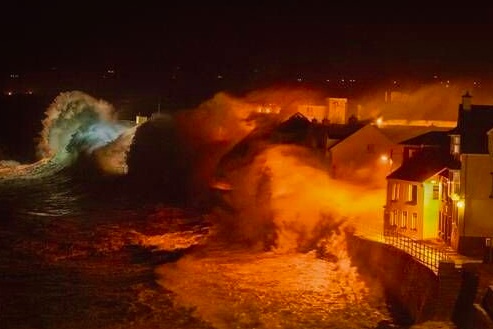
Only one who has visited the place can appreciate the terrific force of the waves here. Giant breakers are pounding relentlessly against the promenade wall, and heavy stones dislodged from a high cliff about 310 yards away are being hurled against it with a force that only the most massive defences could withstand.
The past winter. has been one of the worst experienced in Lahinch within living memory.
The long, high ridge of stones and shingle at the western end of the promenade has been, I was told, pushed back about 15 or 20 yards by the sea during the past few months. During high tides or storms waves break on top of it and are carried inland in clouds, of spray. Soon, it is feared, the sea will claim the low-lying land at the back and cut off the famous golf course from the town. In places at the back of the links the sea has eaten in up to 50 yards, I was told, during the past 25 years.
Mountainous Seas.
So mountainous has the sea been here since Christmas that not only have the waves come over the promenade, 27 feet high, on several occasions, but the spray has fallen in showers on the roofs and chimneys of houses — some of them three storeys high. The sea has even coursed along one of tho principal streets, and 25 yards away from the promenade edge has torn, up the tarred surface of the road, compelling householders to build temporary defences outside their floors.
In one untenanted house facing the Atlantic steel shutters are used outside the timber shutters to keep out the waves, but they offer poor resistance, being dislodged almost every night. Only by constant vigilance during the past month has the town been saved.
On one occasion about a fortnight ago the sea was prevented from breaking through by workers throwing dozens of bags of sand into a break suddenly created. Had the sea got through, residents are convinced that half the town would have been swept away.
Because the ground is much lower to the back, and as many houses are built on a sandy foundation, they would fall an easy prey to the sea.
Constant Repair Work
‘They talk about Greystones and other places,’ said Mr, Considine, a County Council clerk of works, ‘but here you have the full force of the Atlantic.’ He was in charge of a gang of men carrying out a slow and most laborious work. In the hope of preventing the sea from eating under the promenade, they arc putting down concrete protections. To prevent the tide from carrying away the day’s work during the night, it has to be covered with timber, and two feet of shingle and stones, all of which has to be removed every morning before work can be begun. Were it not for the constant attention of Mr. Considine and his workers, one can conjecture what the fate of Lahinch would be.
The. people have now centred all their hopes on tho Coast Erosion Committee, because the financial resources of the County Council are -unable to cope with this most difficult problem.
This famous beauty spot is almost solely dependent on visitors. Over 2000 persons are often present during golf tournaments. So much do the people fear the headway tho sea has made in recent years that all new houses, are now being built a considerable distance inland.
County Surveyor’s Opinion
‘There is no doubt about it, Lahinch must go if the Government do not build sea defences there,’ said Mr. F. Dowling, County Surveyor, to me. ‘And even if they ‘ do build them the place will be still in danger; but I would like to see the defences tested.
Every year, since the winter of 1923 when two houses had to be vacated, the County Council has spent £300 on repair work, he explained. The sand and clay on which some of the town, is built make no fight against the sea, and he did not believe that there were such seas and wind in any other part of Ireland as in Lahinch.
It was unfair, he said, to expect the rate payers to expend money here year after year. If the sea got in at the promenade it would sweep away the whole town. His estimate for the defences, which would consist of reinforced concrete, with a stone, facing, was about £16,000.
At Cappa, on the outskirts of Kilrush, the occupants of two homes are in danger of being washed out during a storm or high tide. For about a mile between Kilaysart and Labasheeda, the road along which the mail car deliveries are made is being attacked by the Shannon to such an extent that in some places there is scarcely room for one cart. Mr. Dowling ‘s proposal was to divert the road at an estimated cost of £2000, but the County Council turned that down owing to lack of funds.
At Kilkee in recent years tho sea has made tremendous caverns through the rock,and these cut clean under the road. People were living in houses over caverns and were not even aware of it. As most of Kilkee, however, is built on rock there is no immediate danger.
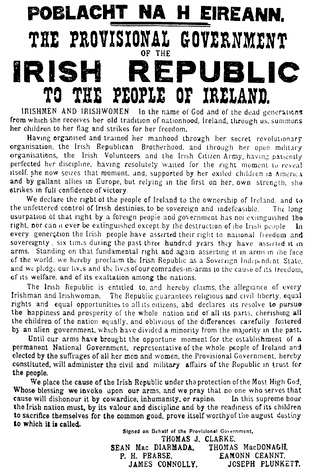
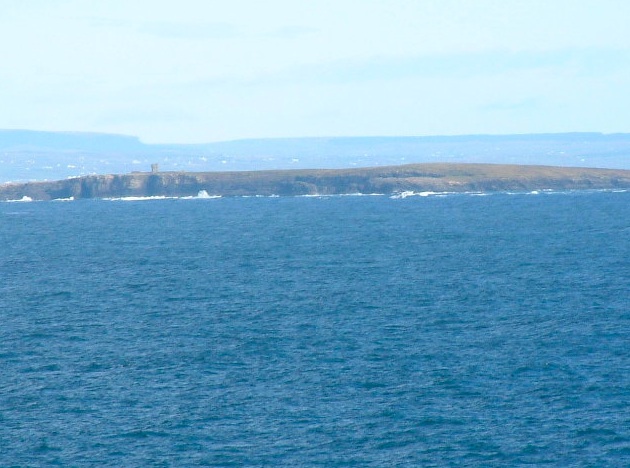
A Sinn Fein tribunal in County Clare sentenced three men to a fortnight’s detention on Mutton Island for refusing the tribunal’s order to rebuild farm wall which they had demolished. The constabulary learned of the incident and sent a boat to rescue the marooned three who, however, stoned their would be rescuers, declaring themselves citizens of the Irish Republic and therefore the constabulary had no authority to intervene. The constabulary withdrew. The prisoners had ample provisions.
HANSARD 1803–2005 → 1910s → 1911 → May 1911 → 16 May 1911 → Commons Sitting → ORAL ANSWERS TO QUESTIONS.
Land Purchase (Ireland).
HC Deb 16 May 1911 vol 25 cc1832-7
Ballybranigan EJO’D
Mr. DUFFY
asked whether the claims of the evicted tenants for the farm of Ballybranagan Kinvarra, and the mansion and lands of Hermitage, Kinvarra, have been considered; and what do the Estates Commissioners propose doing for them?
§Mr. BIRRELL
The lands referred to are included in the estate of Blake Forster offered to the Congested Districts Board, and will be inspected as soon as practicable. Unless the Board acquire the estate they cannot consider the claims of evicted tenants. The Estates Commissioners are unable to identify the evicted tenants referred to from the particulars given in the question.
(abridged)
Some of the landlords in the vicinity of Kinvarra have given very substantial rent abatements. Col. Llewelyn Blake, Northampton House, Kinvarra, and Cloughballymore, Ballindereen, has allowed his tenants on both properties the same reductions as he gave last year, viz. 25 per cent off the reduced rent or 50 per cent off the old rent.
Edward J. Murphy Esq, Tullyra Castle Ardrahan, has also allowed his tenants an abatement of 25 per cent off the reduced rents.
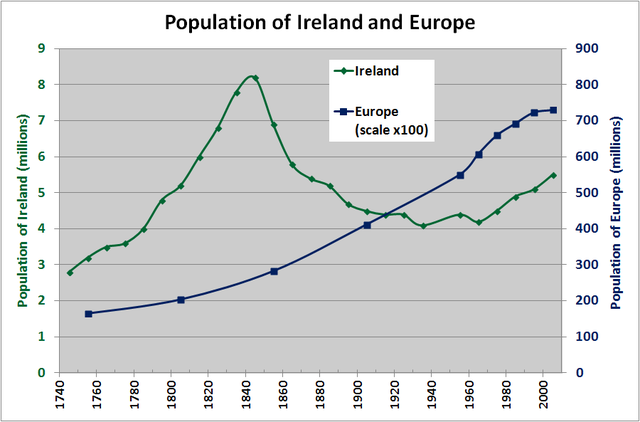
Population of Ireland and Europe 1750 to 2005CC BY-SA 3.0 Ben Moore – Own work Wikimedia Commons
ENFORCEMENT OF THE POOR RATES
The Limerick Chronicle of yesterday contains the following extract of a letter from Kinvarra.
“On Tuesday morning, at eight o’clock a large military force, about 300 strong, of cavalry and infantry, including 4th Light Dragoons, 69th and 89th detachments, under Colonel Sir Michael Creagh, with 56 of the constabulary under Mr Macmahon, S.I., accompanied by two stipendiary magistrates, Messrs Davys and Kelly, marched from here to the district of Kinvarra and Doorus, where the collection of poor rates was successfully resisted on a former occasion.
On arrival at Doorus this force was joined by 100 rank and file of the 68th under Major Smith and officers from Galway. Having crossed the bay in man-of-war boats, the entire party then traversed the county in different directions for eight or nine hours, presenting a formidable array, and meeting with no resistance or obstruction while the poor rate collector and his men were busily engaged collecting the rates, and received a large sum, although the doors in almost every village and hamlet were closed: however all who could pay, paid their rates, and the people themselves had removed the barricades some days before.
About thirty of the principals concerned in the former riots have been arrested by the police and lodged in Gort Bridewell.
On Monday last the military and constabulary were again out collecting poor rates, under Sir Michael Creagh, accompanied by two resident magistrates, and after traversing a considerable extent of barren country and visiting many a desolate village, the troops returned to Gort, having experienced no resistance.”
Dublin, Wednesday evening.
NOTE:
The Poor Rate was a form of taxation arising from the Irish Poor Law enacted by the British Government in 1837.
Erseroum, dated May 15 says that an attack of the Russians on Ardrahan has been bravely repulsed by the Turks.
The Times Vienna correspondent says;
According to the dits of the Russians themselves they intend going down once more to Adrianople, and having got there, to inform the powers that having accomplished their task, they now call on Europe to consult on what should be next.
Last week when discussing famous Irish athletes in connection with the running hop, step and jump, the name of Mat. Roseingrave, of Gort, cropped up, and I promised to give some particulars of his career in Australasia.
Roseingrave, as we knew him, was the beau ideal of an athlete — tall and symmetrical in build — and he knew from A to Z all the fine points of athletics,especially in the jumping, hurdling and field game departments. I suppose most people who saw him in action will say he was at his best as a jumper in general and a broad jumper in particular.
M. M. Roseingrave arrived in Sydney early in 1896 — I heard of his coming from Mr. T. M. Malone. At any rate he made his debut here at the St. Patrick’s Day sports in Sydney, on March 17, 1896. He had entered in four events, and it devolved upon the writer to handicap the boy from Galway, although I had but a hazy notion of his athletic capacity.
In those days we had two first-class hurdlers in the late W. G. Cole and B. H. Richards. Roseingrave beat Richards by a yard in 19sec. Later on the Irishman won the running broad jump at 22ft l01/2in (a record for these parts.), the running high jump at 5ft 7m, and was second in the 161b shot putt handicap, his actual putt being 30ft 9in. It was quite a sensational start.