Posted in Posts and podcasts

The Irish Wolf dog – 1914

Connaught Telegraph 12th September, 1914  p. 6
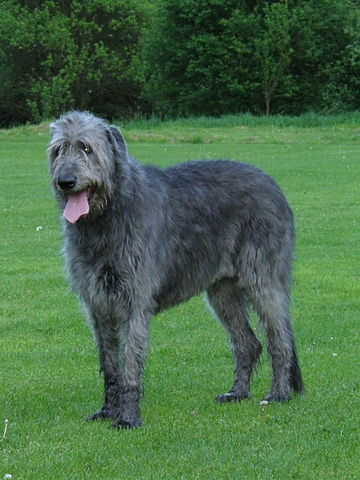
Irish Wolfhound Photo: Dux Wikimedia Commons
Irish Wolfhound
Photo: Dux
Wikimedia Commons

The Irish wolf dogs were formerly placed as the supporters of the arms of the ancient monarchs of Ireland. They were collared with the motto, “Gentle when stroked, fierce when provoked.” It is worthy of note that the Welsh laws of the ninth century made it an illegal act to maim or kill an Irish wolf dog; further, the fine was heavy and larger than most imposed for the wilful wounding or destruction of the ordinary greyhound. The Irish wolf dog was valued among the nations; but he appears to have died out in the eighteenth century. It is supposed that the last wolf was killed at Dingle, Ireland, in 1710.

Rev Edmund Hogan’s History of the Irish wolf dog tells that in the first century of the Christian era the King of Ulster and the King of Connacht each offered the King of Leinster 6,000 cows, a chariot and horses for a famous wolfhound and went to war to decide the issue. Going back over the centuries it is interesting to note that Pliny relates a combat in which the dogs of Epirus bore a part. He describes them as much taller than mastiffs and of greyhound form, detailing an account of their contest with a lion and an elephant. The allusion to the greyhound-like dog, bigger than the mastiff certainly points to the old Irish wolf dog. Strabo B.C. 54 A.D. 24 describes a large and powerful greyhound as having been in use among the Celtic and British nations and as being held in such high estimation by them as to have been imported into Gaul for the purposes of the chase. Selius describes a large and powerful greyhound as having been imported into Ireland by the Belgae, thus identifying the Irish wolf dog with the celebrated Belgic dogs of antiquity, which were taken to Rome.
Posted in Posts and podcasts

Kinvara – 1904

Tuam Herald 9th April, 1904 p.4

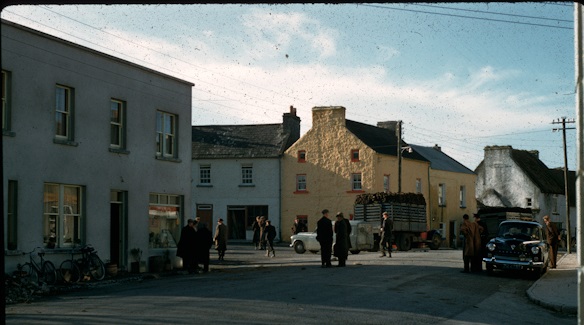
Photo: Cresswell Archives

W.H.Stuart, Esq., Estate Commissioner Inspector, visited Kinvara last week for the purpose of conferring the Mr Thomas P. Corless, J.P. Chairman Gort District Council on the evicted tenants question. The Estate Commissioners have, it is said, in contemplation the purchase of large and valuable grazing farms in the district for the purpose of dividing them out amongst the people. The ever vigilant P.P., Father Burke, interviewed the inspector at Corless’ Hotel during his stay and gave him every aid in his good work.

Posted in Posts and podcasts

Seamount Concert – 1924

CONNACHT TRIBUNE 29TH MARCH 1924 p.5se
A very interesting concert was held in the convent school, Kinvara, on the nights of the 16th and 17th of March. The concert was organised by the nuns in aid of the church, all the artistes being from the boarders of Seamount House and pupils of the convent national school The first part of the programme consisted of a varied and choice selection of vocal and instrumental music and dancing, interspersed with tableaux, Irish dialogues, and some very pretty pieces acted by the smaller children. The item “An Bhean Deirce,” was particularly well done; also the dancing. The opening chorus was very impressive, the stage being artistically decorated and lighted, and the children and young ladies dressed and grouped with exquisite taste. There were twelve violins in the band, and the performance showed very careful training, and was much appreciated. In addition there was a solo on the ‘cello by Mr C O’Dea and one on violin by Miss M Flatley, who promises to be a perfact master of this instrument.
In the operetta, “The Wishing Cup,” with which the second part of the programme opened, Miss P. Murphy was a magnificent success as Gipsy Queen; Miss C Johnston acted the part of Elsa very dramatically; Miss Boland and Miss Hayes also did their parts exceedingly well, the latter being gifted with a very sweet singing voice. About thirty took part in this operetta, and the movement and the acting of the different performers was so perfect that there was not a dull moment in it from start to finish. They all, gipsies, fairies, maids and will-o-the-wisps, played their parts with marked success. This operetta was followed by a short amusing farce, which was very well staged and brought a most enjoyable entertainment to a close.
The large crowd present both nights appeared highly appreciative of the efforts of all the performers. This concert has been the most successful held in Kinvara for a long time, and reflects great credit on the nuns who were responsible for the organisation of it and the training of the children, which gave a real pleasure to all who were privileged to be present.

Posted in Posts and podcasts

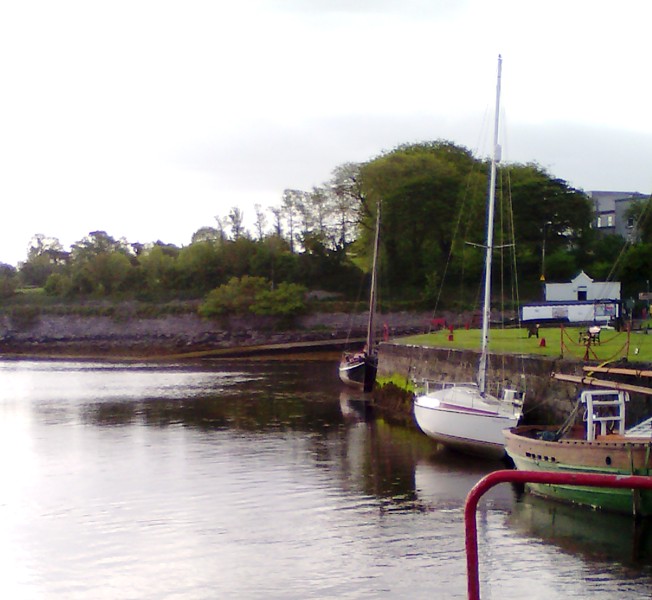
A close call – Kinvara Quay – 1896

Tuam Herald 30th May 1896  p.2(abridged)

Photo: EO'D
Photo: EO’D

On Friday last while Sergeant Feeney of the Kinvarra station was on patrol duty with a party of his men, he noticed an unusual volume of smoke in the direction of Kinvarra Quay, and at once went in that way.  He found that a large boat belonging to a man named McDonagh from Connemara, and which had been moored at the quay was on fire. He and his men immediately jumped on board the boat and on entering the hold found two of the boatmen asleep. Having roused the men the entire party proceeded to extinguish the flames.  Were it not for timely arrival of the police, the certainty is that the two men would have been burned to death.

Posted in Posts and podcasts

Ghost Castle – 1862

Belfast Newsletter 8th September, 1862 p.4

Photo: EO'D
Photo: EO’D

An islander of the British Isles, and possibly a Highlander, purchased some time ago in the Landed Estates Court, a property in a maritime Irish County, upon which stood what might be described in the words of one of your illustrious bards;
“An old, old monastery once, and now
Still older mansion, of a rich and rare
Mixed Gothic, such as artists all allow
Few precedents are left us to compare
Withal.”

The building did not satisfy the taste of the new proprietor. He scarcely got possession of his title deeds before he commenced improving at once the land and the mansion. The improvements made rapid progress under the special superintendence of the new lord of the soil, who planned and directed early and late. It is his semi-nocturnal predilection for business that raised him to the dignity of a ghost story here.

He was in the habit of remaining about the mansion and grounds long after everyone else had retired, contemplating the progress of improvements or devising fresh ones. While engaged in this manner one evening shortly after twilight, he beheld upon the site of what had been an old out office a luminous figure. It first bore resemblance to the human shape, then gradually assumed the form more and more as twilight deepened. Finally it presented to the gaze of the astonished proprietor the perfect outline of a man, formed of light of a bluish tinge and subdued brilliancy.

Mr—— stood contemplating the apparition till it vanished from his view, owing, as he thought, to some change in the atmosphere, for he felt the air very much colder about the time of the disappearance. He said nothing about the apparition to anyone as he mistrusted his judgement and thought a vivid imagination might have played a trick on him. He resolved however, to discover if possible whether the phantom were reality or illusion. Accordingly he wandered about the scene of the vision every evening after twilight and occasionally his watchfulness was rewarded by a sight of the figure. It sometimes appeared an indistinct mass of still flame, and sometimes presented some outlines of a human form. Seldom did it appear in the complete human shape in which it first presented itself.

Having satisfied himself that his imagination was not trifling with him, the gentleman began to make inquiries of the people about his demesne as to whether any former proprietor of the property or any other person in any way connected with the castle had met an untimely end or disappeared suddenly and mysteriously from the mansion, or, if there were any tale of mystery connected with the place. None was forthcoming.

The lord of the Castle set a considerable number of them to search the spot, the site of the old out offices, where he had so frequently seen the apparitions. At a considerable depth before the surface a skeleton of a man was found. By all appearances he had been a warrior and the place of repose was the cause of the troubled times led by the spirit. The remains were respectfully and decently removed

Posted in Posts and podcasts

Kinvara – 1916

Connacht Tribune July 1st 1916 p 4

www.buildingsofireland.i
http://www.buildingsofireland.i

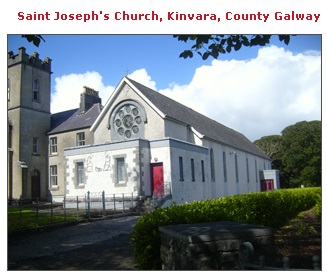
Every man, woman and child in Kinvara parish and district, and most people throughout Co. Galway and the West, know that Kinvara Church and Convent have been searched by armed police. A great many well-informed people are aware that the Rev. Parish Priest, the Rev. T. Burke P.P. has made a strong protest to General Sir John Maxwell, the military governor of Ireland. The whole subject is talked of far and wide and the story suffers nothing in the telling. But the new censorship that is exercised today in Ireland, as if a war were actually proceeding within our shores, and the country had got out of hand, decrees that “no correspondence between General Sir John Maxwell and Father Thomas Burke, P.P. Kinvara, is to be published.” So with the shadow of blood on the Irish horizon and feeling and passion inflamed, we are back again to the old coercionist regime. We cannot help asking ourselves is this possible in the 20th century of have the military governors of this country, clothed in the “petty brief authority” that a fateful chance has given them, taken leave of their senses?
If those governors imagine that by suppressing in Ireland the plain, if painful truth, they are serving any good purpose in constitutional or military government they are making a colossal mistake. The affair at Kinvara has been grossly mishandled from the beginning and the characteristically Prussion attitude of the new censorship in Ireland does not improve but considerably aggravates a painful situation. Surely the military governors of this country ought to be able to defend their own attitude, and the attitude of their subordinates, without resorting to the equivocal expedient of a clumsy endeavour to conceal from the public all the facts! Even viewed from their own standpoint, the attitude of the censor in this respect is extremely stupid. It makes a mystery where none existed and renders the people suspicious of an authority that resorts to methods that are given so sinister an aspect. We publish elsewhere the protest made at the conference of priests held at Gort on the 6th of this month. Surely a body of clergymen are entitled to a full, frank and public explanation and apology from the Government for a proceeding that tends to bring the authority exercised in this country into contempt.

Posted in Posts and podcasts

For sale – Kinvara – 1910

Connacht Tribune 5th March, 1910 p8

The Quay, Kinvara Photo: EO'D
The Quay, Kinvara
Photo: EO’D

At a special meeting on Monday, Mr T.P.Corless, D.C., presiding, and the following being present;
Messrs. Thomas O’Halloran,
Bartley Bermingham,
Michael Corless,
Augustus J. Johnston
Edward Holland
Michael Connolly
the chairman submitted a letter from Mr Coghlan Briscoe T.C. stating that he forwarded the tenants memorial to the Congested Districts Board, and was bringing all possible pressure to bear on the board to purchase Kinvara from the trustees of the Sharpe estate. Mr Briscoe’s powerful appeal for justice, made before the Town Tenant’s Executive in Dublin, was loudly applauded. The action of the agents in threatening legal proceedings against the tenants was severely commented on.

Within the last few days notices have been served on the tenants to pay up or Mr Concanon, solicitor, will be instructed to proceed for the recovery of the rent. The committee have decided to await developments and appeal to the tenants to withhold the rents. In view of the situation that now exists on the property the committee earnestly exhort all who have not as yet joined the League to do so at once, as the fight has now reached an acute stage. The committee are in communication with Mr Briscoe and Mr Wm Duffy M.B. and several well known leaders, with a view to holding a public meeting and infusing new life into the district. On the motion of Mr Corless, seconded by Mr Thomas O’Halloran, a resolution thanking Mr Briscoe and the “Freeman” was passed.