Posted in Posts and podcasts

Galway – 1928

Galwaygalway
Oliver St. John Gogarty

A gray town in a country bare,
The leaden seas between,
When light falls on the hills of Clare
And shows their valleys green,
Take in my heart your place again
Between your lake and sea,
O city of the watery plain
That means so much to me!

Your cut-stone houses row on row,
Your streams too deep to sing,
Whose waters shine with green as though
They had dissolved the Spring:
Your streets that still bring into view
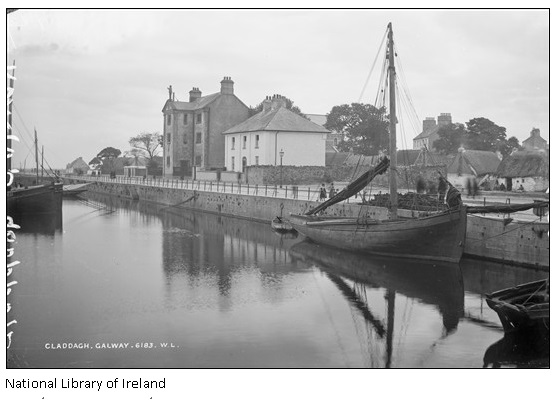
The harbour and its spars;
The chimneys with the turf-smoke blue
That never hides the stars!

It is not very long since you,
For Memory is long,
Saw her I owe my being to
And heart that takes to song,
Walk with a row of laughing girls
To Salthill from Eyre Square,
Light from the water on their curls
That never lit more fair.

Again may come your glorious days
Your ships come back to port,
And to your city’s shining ways
The Spanish dames resort!
And ere the tidal water falls
Your ships put out to sea.
Like crimson roses on grey walls,
Your memories to me.

Posted in Posts and podcasts

The Doorus Flamingo – 1967

Connacht Tribune 8th September, 1967 p.1 (abridged)

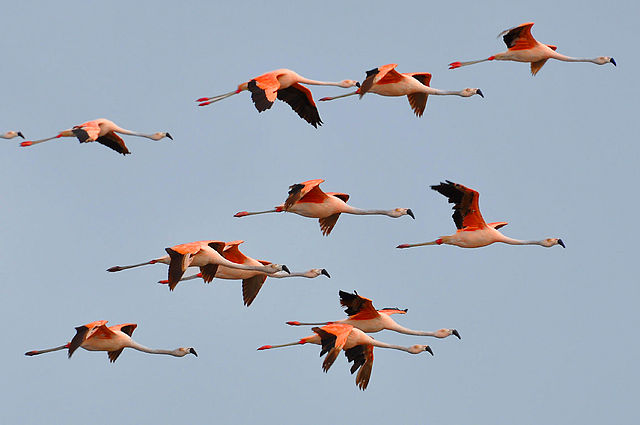
Flamingo flock, Brazil Photo: Cláudio Dias Timm Wikimedia Commons.
Flamingo flock, Brazil
Photo: Cláudio Dias Timm
Wikimedia Commons.

A south Galway ornithologist this week issued a “don’t shoot” appeal to local farmers and sportsmen. He believes that a strange bird that turned up on the shores of Galway Bay at Kinvara is a Flamingo!
Ornithologist Mr John A. Bevan issued the appeal after he saw the bird opposite the An Oige hostel in Dooras. The bird has marked similarities with a Flamingo. It is white in colour with a touch of pink on its breast and it has a hooked beak.
The Flamingo, sighted four times before in Ireland (between 1938 and 1947), is usually found only on the south-west coast of South America. Mr Bevan believes it must have escaped from captivity. A spokesman at Dublin zoo said: There are thirty Flamingoes here. It cannot be one of ours because their wings are clipped so that they cannot fly.
The area around Kinvara where the bird was sighted is a noted district for many types of wildfowl.

Posted in Posts and podcasts

At the mercy of the waves – 1893

Irish Daily Independent 22nd May, 1893

Kinvara Bay Photo: Norma Scheibe
Kinvara Bay
Photo: Norma Scheibe

Sir,
A report appeared in the Independent of the 29th April from the Cork Evicted Tenants’ Association, inquiring if there was any evicted tenants who did not get grants for the last twelve months.

I wish to inform you that I was evicted in 1887.  Immediately after the eviction I took forcible possession in presence of the sheriff and the evicting party. The property being in Chancery, I was arrested on an attachment order and sent to Galway Jail for twelve months, my wife and children keeping possession during my confinement. After my release I joined my wife and children, where were laid up with typhoid fever.  I was rearrested and sent back to jail for another twelve months. My wife was also arrested.

After my liberation the Kinvarra Branch of the National League made an application to the Central Branch in Dublin, and I received two grants in succession. Some time afterwards the Kinvarra Branch broke up, and since 1889 I was left to provide for a helpless family, and never since then got a penny from any quarter. At the late general election I was asked to vote for the McCarthyite. I refused to do so, and voted for the Parnellite. Some time after I got forms down from the Evicted Tenants’ Commission. I took them to the parish priest and he told me to take them to the Parnellites, that he would not do anything for me being one. I am now in a helpless condition, and am appealing to your association to do something for me. If not I will be left at the mercy of the waves.

Michael Treacy,
Kinvara,
Co. Galway

Posted in Posts and podcasts

St. Coman’s, Kinvara – 1866

Freeman’s Journal 8th December, 1866 p.4

Engraving, St. Coman's Photo: Norma Scheibe
Engraving, St. Coman’s
Photo: Norma Scheibe

The Council during its sitting considered a requisition sent to it by the guardians of the Gort Union to close Kinvara burial ground, alleging that it was overcrowded and intramural. The inhabitants petitioned the Council not to close the burial ground, stating that there was ample accommodation, and that the sanitary condition of the town would not be injured by the burial ground being left open. The Rev Francis Arthur P.P. attended the council to support the petition. The council having considered that there was not sufficient reason for closing the burial ground refused to make an order for enclosing. The petitioners were represented by Messrs Blackburne, Mullens and Mr R B Forster.

Posted in Posts and podcasts

Seamount Bazaar – 1890

Nation 11th January, 1890 p.18

Seamount Image: landedestates.nuigalway.ie/LandedEstates
Seamount
Image: landedestates.nuigalway.ie/LandedEstates

The Sisters of Mercy’s concert and bazaar at Kinvara came off on Thursday the 2nd inst. Both were a great success, and a proof of the popularity of the nuns. The Misses and Master Corless, the Burlington, Dublin; the Misses Regan, Miss Burke, Lisdoonvarna; Miss McCuley, Miss Delia Corless, Kinvara; the Misses Kennedy and the Misses Sheahan, Gort, contributed their share to the day’s pleasure. Any notice of the concert would be incomplete if one were to omit reference to the successful part taken by the gentlemen, clerical and lay, who kindly gave their services in the cause of charity. Father O’Donohue, Balyvaughan, and Father Nestor, Clarenbridge, sang, and so did Fathers Sweeny and Tully. The lay element was well represented by Dr. Glynn, Gort, and Mr Hewson, Tyrone, who both sustained the role of first class vocalists.

Posted in Posts and podcasts

Notes on Kinvara – 1936

Connacht Tribune 4th January 1936 p 13

Kinvara Photo: EO'D
Kinvara
Photo: EO’D

About the reign of Henry VIII Rory Mór Darag O’Shaughnessy took the Castle of Doon from Flan Killikelly, totally demolished it, and erected one near its site which he named Doongorey. In 1612 it became the property of Thomas Taylor, who encircled it with a strong baun or wall, and it is now in a good state of preservation.
On 1st of November 1755, the day of the earthquake at Lisbon, a castle on the western boundary of the parish, which had formerly belonged to the O’Heynes, was destroyed to its foundation and a portion of it swallowed up, and at the same time the chimneys and battlements of Caherglissane rocked and then fell into a chasm which was formed by rending the rock to the depths of several fathoms.
A quay about fifty yards long was build here in 1773 by the late J French Esq (great-grandfather of the present Baron de Basterot) which was lengthened and raised in 1807 and such an addition made to it in 1908 as converted it into a kind of dock. At high tide there is 12ft of water at the pier, which is then accessible to vessels of 150 tons burden.
There are some remains of the old church, which was for ages the burial-place of the O’Haynes and Magraths, no others being allowed to be interred within its walls. Near the shore are two extensive subterranean caverns. A castle stood near the pier, but its materials have been used in building.

Posted in Posts and podcasts

The Ballinderreen Corps – 1914

Connacht Tribune 25th July, 1914 p.6

Courthouse Lane with Corless's top right Photo: Cresswell archives
Courthouse Lane
Corless’s top right
Photo: Cresswell archives

The Ballinderreen Corps marched from the town to Kinvara on Sunday under the command of Mr J. Linane and Mr L Quinn. On arrival at Kinvara, they drilled in front of Mr. T.P.Corless’s hotel, after which Mr. Corless entertained them. Afterwards they marched back to Ballinderreen, when the corps sang “A Nation Once Again,” and then dispersed.

Posted in Posts and podcasts

This strange and lovely land – 1956

Swan on Kinvara's blue Photo; Norma Scheibe
Swan on Kinvara’s blue
Photo; Norma Scheibe

Oh, for the gift of a fairy brush
And magic to guide my hand.
I’d paint, in the peace of a spellbound hush,
This strange and lovely land.

Cloud shadows on a barren hill,
On the rocky coast of Clare,
A watered sky, that goes drifting by,
And salt in the morning air.

Small fields of stone with rocks around;
A smiling woman at a door,
And always on our ears the sound
Of the sea, on the murmuring shore.

A grey keep in a field of green
Swans on Kinvara’s blue,
White pebbles on the sand, washed clean,
Age old, but ever new.

A wheeling gull, a curling wave,
The hiss of spreading foam,
Cliffs, and a distant secret cave,
Some ancient hero’s home.

Captain Meany

Posted in Posts and podcasts

The art of making rebels – 1920

Connacht Tribune 3rd July 1920 p4

William Hynes Kinvara. Photo: Connacht Tribune 1920
Photo: Connacht Tribune 1920

(abridged) How the Government Persecuted a Kinvara man and his friends. Mr William Hynes, Kinvara, one of the hunger strikers recently released from Wormwood Scrubbs, was arrested at Abbey, Loughrea, early in spring and confined in Galway prison. He was remanded on a few occasions while “The minions of the law” were trying to make a case against him, but subsequently he was released without a stain on his character. The Government, not to be outdone, arrested him a few weeks later, and deported him to Wormwood Scrubbs along with Mr Patrick Kilkelly, now the chairman of the Gort District council, and hundreds of others. Mr Hynes is the youngest son of Mr Patrick Hynes, Doongora, Kinvara and comes of a good old stock of fighting Nationalists. He is grandson of the late “honest Bartly Hynes,” of Killina, the first man in Ireland to be prosecuted for having his name in Irish printed on his cart, and who, to credit be it said, refused to pay the fine imposed by a pair of British “Removables.” His brother Mr Michael Hynes, was arrested after the Rebellion of 1916, and imprisoned at Frongoch. His cousin, the late Mr Patk Hamberry was jailed, following the Rebellion, and died as a result of his cruel treatment immediately after his release.

Posted in Posts and podcasts

Kinvara promenade and swimming pool – 1959

Connacht Tribune 5th December, 1959 p.10

Kinvara  Photo: EO'D
Photo: EO’D

Galway County Council decided,on the proposition of Senator R. Lahiffe, to approach Bord Failte with a view towards; (a) giving a grant towards the building of a promenade along the convent road from the quays at Kinvara and the erection of a swimming pool opposite Seamount College; (b) giving a grant towards the development of the beach at Traught, Kinvara.