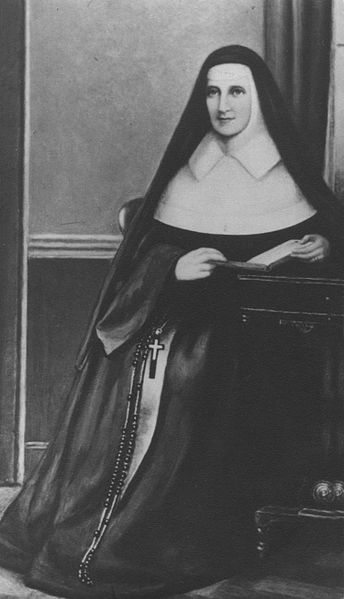
Mother Catherine McAuley, R.S.M. foundress of the Religious Sisters of MercyThe Catholic Press Thursday 31st August, 1916 (NSW: 1895-1942)
Seamount searched
A gentleman’ in a high official position, who recently returned from a visit to tho old world, called on .the ‘Catholic Press’, to tell us that the condition of Ireland is beyond description. Soldiers are every where. It was the first time he saw a country under martial law, and he does not want another experience. The distress in Dublin, he says, is appalling;
The ‘Irish- Rosary’ for July bears out this statement, ‘and adds:
In several quarters victimisation ot wage-earners suspected of sympathising- with or of having had relatives in the recent upheaval is being brutally practised. Persons arrested on suspicion, in these days of wholesale arrest on the flimsiest pretext, are also subject to the same prosecution on release. It takes the form, I need hardly say, of exclusion from employment. Certain proprietors and firms are giving free rein to their insane and wicked partisanship, the aim being apparently to starve fellow-citizens.
The ‘Irish Weekly and Ulster Examiner’ for July 8 presents another aspect of the case in this resolution:
We, the priests of the Diocese of Kilmacduagb, have heard with amazement of an outrage perpetrated against the Convent of Mercy and community. Kinvara, on Sunday, June 4, by the police, who said they came to search the convent for rebels. We enter our solemn protest against their search of the convent, and we say that the search, and the manner in which that search was made, was a gross outrage on religion and an un called-for indignity and insult to the Sisters.
Catholics well know that religious Sisters never harbor strangers or externs in their convent, and that the sisters’ cells are privileged, no strangers being allowed to enter them. Thia immunity was violated by the police, and the manner in which the cells were searched was equally offensive to manliness ,and common decency.
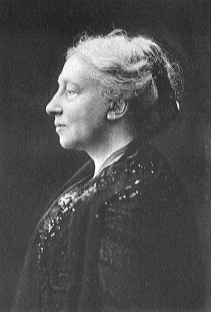
Augusta Lady Gregory Project Gutenberg Wikipedia.orgOur Irish Theatre: A chapter in Autobiography by Lady Gregory. New York: The Knickerbocker Press. G. Putnam’s Sons, New York, London. 1913. pp. 4-7
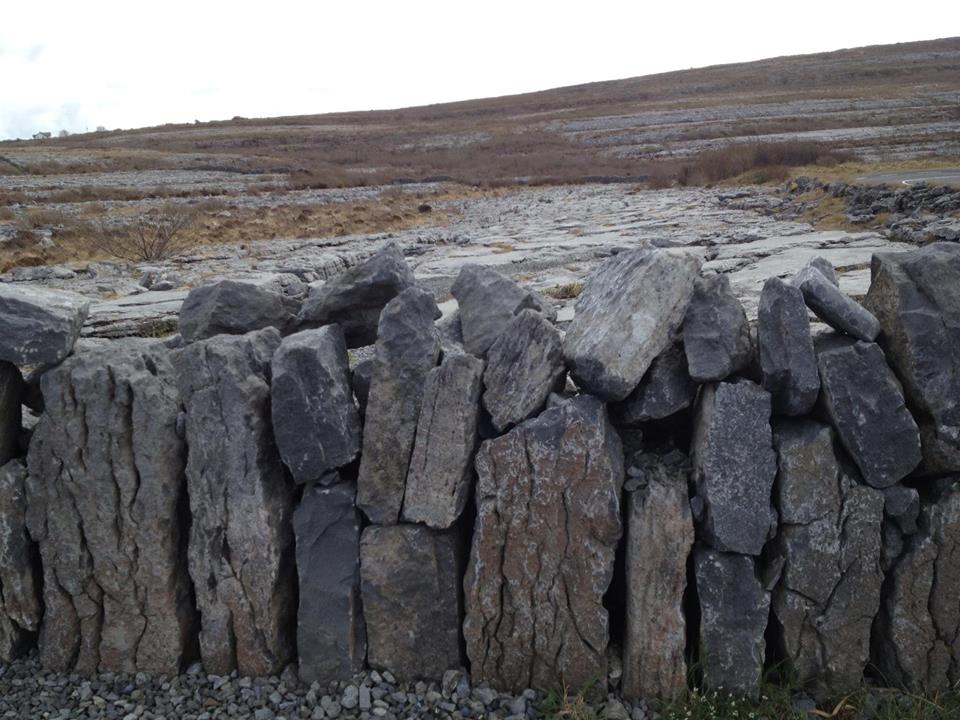
Later in the year I was staying for a few days with old Count de Basterot, at Duras, that is beyond Kinvara and beside the sea. He had been my husband’s warm friend, and always in the summer time we used to go and spend at least one long day with him,–we two at first, and then later I went with my son and the boy and girl friends of his childhood. They liked to go out in a hooker and see the seals showing their heads, or to paddle delicately among the jellyfish on the beach. It was a pleasant place to pass an idle day. The garden was full of flowers. Lavender and carnations grew best, and there were roses also and apple trees, and many plums ripened on the walls. This seemed strange, because outside the sheltered garden there were only stone-strewn fields and rocks and bare rock-built hills in sight, and the bay of Galway, over which fierce storms blow from the Atlantic. The Count remembered [Page 4] when on Garlic Sunday men used to ride races, naked, on unsaddled horses out into the sea; but that wild custom had long been done away with by decree of the priests. Later still, when Harrow and Oxford took my son away and I had long spaces of time alone, I would sometimes go to Duras to spend a few days.
I always liked to talk and to listen to the Count. He could tell me about French books and French and Italian history and politics, for he lived but for the summer months in Ireland and for the rest of the year in Paris or in Rome. Mr. Arthur Symons has written of him and his talks of race,–to which he attributed all good or bad habits and politics–as they took long drives on the Campagna. M. Paul Bourget came more than once to stay in this Burren district, upon which he bestowed a witty name, “Le Royaume de Pierre.” It was to M. Bourget that on his way to the modest little house and small estate, the Count’s old steward and servant introduced the Atlantic, when on the road from the railway station at Gort its waters first come in sight: Voila la mer qui baigne l’Amérique et les terres de Monsieur le Comte. For he–the steward–had been taken by his master [Page 5] on visits to kinsmen in France and Italy–their names are recorded in that sad, pompous, black-bordered document I received one day signed by those who have l’honneur de vous faire part de la perte douloureuse qu’ils viennent d’éprouver en la personne de Florimond Alfred Jacques, Comte de Basterot, Chevalier de l’ordre du Saint Sépulcre, leur cousin germain et cousin [who died at Duras (Irlande) September 15, 1904]; la Marquise de la Tour Maubourg, le Vicomte et la Vicomtesse de Bussy, la Baronne d’Acker de Montgaston, le Marquis et la Marquise de Courcival, le Comte et la Comtesse Gromis de Trana, la Countesse Irène d’Entreves, and so on, and so on. I do not know whether the bearers of these high-sounding names keep him in their memory–it may well be that they do, for he was a friend not easily forgotten–but I know there is many a prayer still said on the roads between Kinvara and Burren and Curranroe and Ballinderreen for him who “never was without a bag of money to give in charity, and always had a heart for the poor.”Augusta Lady Gregory
On one of those days at Duras in 1898, Mr. Edward Martyn, my neighbour, came to see the Count, bringing with him Mr. Yeats, whom I did [Page 6] not then know very well, though I cared for his work very much and had already, through his directions, been gathering folk-lore. They had lunch with us, but it was a wet day, and we could not go out. After a while I thought the Count wanted to talk to Mr. Martyn alone; so I took Mr. Yeats to the office where the steward used to come to talk,–less about business I think than of the Land War or the state of the country, or the last year’s deaths and marriages from Kinvara to the headland of Aughanish. We sat there through that wet afternoon, and though I had never been at all interested in theatres, our talk turned on plays. Mr. Martyn had written two, The Heather Field and Maeve. They had been offered to London managers, and now he thought of trying to have them produced in Germany where there seemed to be more room for new drama than in England. I said it was a pity we had no Irish theatre where such plays could be given. Mr. Yeats said that had always been a dream of his, but he had of late thought it an impossible one, for it could not at first pay its way, and there was no money to be found for such a thing in Ireland.
We went on talking about it, and things seemed [Page 7] to grow possible as we talked, and before the end of the afternoon we had made our plan. We said we would collect money, or rather ask to have a certain sum of money guaranteed. We would then take a Dublin theatre and give a performance of Mr. Martyn’s Heather Field and one of Mr. Yeats’s own plays, The Countess Cathleen. I offered the first guarantee of £25.
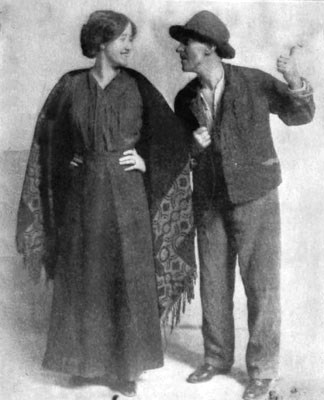
Irish actors Sara Allgood (“Pegeen Mike”) and J. M. Kerrigan (“Shawn Keogh”), in the J. M. Synge’s play The Playboy of the Western World, Plymouth Theatre, Boston Date 1911 (Isabella Stewart Gardner Museum Archive, Boston) copyright expired (before 1923)http://www.galway.ie/en/media/Gort%20Rural%20District%20Council,%20G01-10.pdf
Gort Rural District Council
Archives Collection
1889 –– 1924
G01/10
‘That we …protest most emphatically against the libelous comedy “The Playboy of the
Western World”, that was belched forth during the past week in the Abbey Theatre, Dublin, under the fostering care of Lady Gregory and Mr Yeats. We congratulate the good people of Dublin in howling down the gross buffoonery and immoral suggestions that are scattered throughout this scandalous performance. It is an extraordinary thing that any Christian much less an Irishman should so grossly libel his country, as to suggest that any Irish girl should be found wooing with no trace of modesty a man whose sole claim to affection is that he murdered his father. It is time that we should stop the children of this Union from partaking of the hospitality of Lady Gregory in the future, as a protest against her active participation and co-operation in the libeling of the Irish character’ (p449)
From the New York NY Herald, Friday, April 30, 1886 TRIPLE SHEET http://www.fultonhistory.com/Fulton.html https://widgetworld3.wordpress.com/2013/07/26/yours-obediently-agnes-bell/ DISTRESS IN GALWAY
_____________________
A PITEOUS APPEAL IN AID OF THE RACK-RENTED TENANTRY
The dire distress and appalling destitution in the small town of Kinvara are vividly described by Lady Agnes Bell in the letter we publish below. That lady takes up the cause of the indigent and needy and gives a few of the most prominent cases of oppression and tyranny exercised on the unfortunate people by the landlords, and concludes her letter by a pathetic appeal for help, be it ever so modest in amount. The Rev. P. McDonagh, parish priest writing, says:- “Lady Agnes has already expended large sums of money in food and clothing and is still doing all in her power for the distressed of the country.”
The following is Lady Agnes Bell’s letter:-
Maryville House,
Kinvara,
County Galway,
Ireland,
April 15,1886
TO THE EDITOR OF THE HERALD:-
Knowing well the sympathy and widespread feelings of charity that exist in New York for the poor and oppressed Irish tenantry, I now venture to make an earnest appeal to the readers of your estimable journal for the relief of some of the poorest poor of Kinvara.
The distress in this small town is appalling to a degree impossible to describe. Words are inadequate to properly express the sufferings endured by the rack-rented families, evictions taking place every day, and women and children being turned wholesale into the streets, without the least hope of ever being able to find shelter and food.
TYRANNIC EVICTIONS
One man, Thomas Finney, living near me, I saw the other day pay his rent at the rate of ₤1 an acre for land only worth 2s.6d..while he had only straw to lie upon and indian meal as food. One Patrick Donohoe was about to be turned out of his holding with a sick wife and two little girls in a state of starvation, only that I took his cabin and land myself and put him in again.. I could mention hundreds of such cases, but will not trespass upon your valuable space. Only a few weeks ago a family were evicted, and the landlord would not allow any of his tenants to give them shelter for the night. The woman’s own brother dare not take her in, although she was enceinte. The consequence was, in the morning her corpse was found in the snow with a new born babe dead in her arms.
SEND A QUARTER
In conclusion I would only beg and pray each and every one of your readers to send a trifle say twenty -five cents-to the following gentlemen, or to myself, to be fairly distributed amonng the distressed long suffering and patient inhabitants of Kinvara.
Yours, obediently.
AGNES BELL.
Subscriptions will be gratefully received by the Rev. P.McDonagh, parish priest, Clarenbridge county Galway and the Rev. P. Newell parish priest, Kinvara county Galway.
Excerpt of review titled Lady Gregory’s Note-book An entertaining volume.
“The greatest wonder I ever saw was one time near Kinvara at a funeral. There came a car along the road and a lady on it having a plaid cloak, as was the fashion, and a big hat, and she kept her head down and never looked at the funeral at all. I wondered at her when I saw that, and I said to my brother it was a strange thing a lady to be coming past a funeral and not to look on at it at all. And who was on the car but O’Gorman Mahon, escaping from the Government, and dressed up as a lady! He drove to Father Arthur’s house in Kinvara and there was a boat waiting, and a cousin of my own in it, to bring him out to a ship and so he made his escape”.
Lady Gregory claims the right to praise “The Kiltartan History Book,” because as she says, “there is not in it one word of my own.” But she has contrived all the same to impart a share of her sly humour into almost every page.
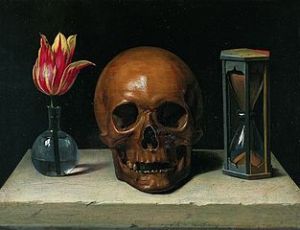
Philippe de Champaigne (1602–1674) Still-Life with a Skull Date circa 1671 Tessé Museum Wikipedia.org
AN tOSTAN Marbh
Story: Emer O’Donnell
Script Consultants: Dan Reel
Michael Doheny
Donal C. Hanlon
Emer O’Donnell
Cast:
Voice Over: Tiernan Boland
Male 1: Donal C. Hanlon
Male 2: Dawid Ciesielski
Woman: Emer O’Donnell
Night Porter: Dan Reel
Security Guard 1: Michael Doheny
Security Guard 2: Colm Dunne
Newsreader: Leo Lynch
KINVARA HARBOUR
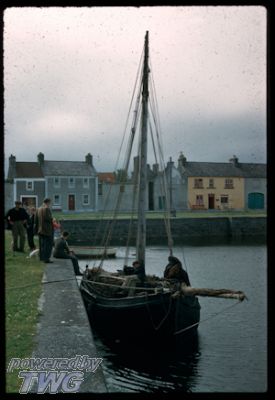
The harbour at Kinvara embraces a small inlet of Galway Bay, containing its waters along the fringe of the village. When you round the bend at Seamount College it presents itself, postcard perfect. We used to swim there, even had competitions – the most notable being the Green Island swim – a race from the pier to the small patch of green outside the Doctor’s surgery (beside Seamount) and back again. A trophy for the winner and a sense of pride for all else who actually completed it!
Kinvara Harbour has history – aspects of which can be found among Hansard Papers, Commons Sittings question and answer sessions. Kinvara Harbour page on widgetworld3 contains excerpts from these papers:
PIERS AND HARBOURS (IRELAND)— KINVARRA HARBOUR.
HC Deb 24 November 1882 vol 275 cc15-6
AN COISTE BODHAR
Story: Script Emer O’Donnell
Script Consultants: James O’Malley
Michael Doheny
Donal C. Hanlon
Emer O’Donnell
Cast:
Barman: James O’Malley
Niall: Michael Doheny
Eamon: Ray McEnany
Man: Donal C. Hanlon
Woman: Emer O’Donnell
Production: Dawid Ciesielski
Recorded at Gort Media Centre Studios – thanks to Sinead, Peadar, Tom, Heather, Gerry and Kevin!
It was one night,” he says, “after walking back from Kinvara and down
by the wood beyond I felt one coming beside me, and I could feel the
horse he was riding on and the way he lifted his legs, but they do not
make a sound like the hoofs of a horse. So I stopped and turned around
and said, very loud, ‘Be off!’ and he went and never troubled me after.
The Celtic Twilight (1902)
W. B. Yeats
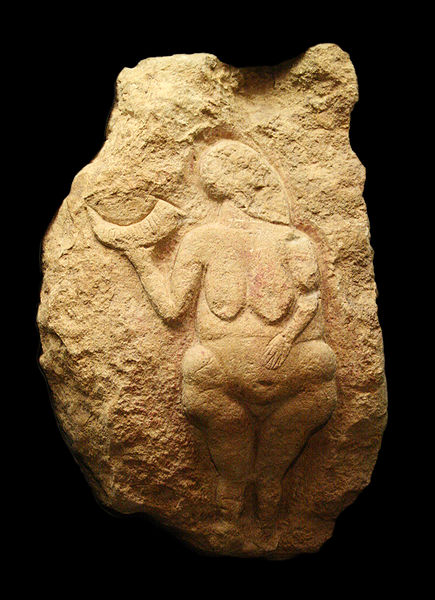
Venus of Lausselhttps://widgetworld3.wordpress.com
If you could be a “fly on the wall” anywhere and at any time in history, where and when would you choose?
I would like to watch the creation of the ‘Venus of Laussel’. Also known as “Femme a la corne” this is a female image carved into the limestone entrance of a rockshelter in Marquay, Dordogne, southwestern France. It was blasted from its place decades ago and is now in the Musee d’Aquitaine, Bordeaux. The bas relief is about one and a half feet high and is roughly 25,000 years old.
The image shows a woman with her left hand is over her stomach, and her right holding a ‘horn’. The ‘horn’ (for want of a better description) has 13 notches carved in it. A ‘Y’ is carved on her thigh. The woman was coloured with red ochre.
A cache of stone tools were excavated at the base of this image while other bas-reliefs were found inside the shelter.
I have sooo many questions regarding this cave, these images, these tools. Oh to be a fly on the wall!!