Dublin – A spectral figure, grey in color and about eight feet in height is said to have haunted the railway line near Galway for nights.
The apparition, which is described as “tapering toward the top,” walks from the railway viaduct across the bank of the stream and then disappears.
A number of people have visited the place toward midnight when the apparition is due to appear. One man declares that he saw it jump from the top of the viaduct into the Corrib where it disappeared.
It was not “drowned”, however, for on the succeeding night it was seen again by a number of students from Queen’s college Galway. One of the students volunteered to go over and talk to it, but when it appeared he changed his mind.
On a Sunday evening a party of six men, armed with shotguns, revolvers and sticks, sallied forth to “lay the ghost.” They had been in ambush but a short time only when the specter loomed up before them. One of the men raised a revolver, but before he could fire he fell in a swoon. The expedition was abandoned and the man was taken into Galway where he was medically attended.
These strange reports have created excitement in the district, and search parties are out nightly for the purpose of unravelling the mystery.
https://widgetworld3.wordpress.com/podcasts/ Part 1 THE HAWAIIAN STAR JULY 22, 1911 p17
The Galway County Council has found a bold man who has undertaken, on a 50 per cent commission basis, to collect all the back taxes due from the inhabitants of the south and middle isles of Aran. These sturdy farmers and fishermen have not paid for more than five years and, if the new collector succeeds in getting in all that is owing he will pocket $500 for himself. He has arranged for a government steamer and a big force of police, and he expects to invade the islands in a few days.
A View over the karst landscape from Dun Aonghasa, Inis Mór,Aran Islands. Wikipedia.org
Local betting in strongly in favor of theAran islanders. The exports of cattle from the islands to the mainland have been heavy during the past week and there cannot be many head left on the islands now. Most of the fishing boats are provisioned and ready to put to sea at short notice, and a man who was on the islands last week says there isn’t much furniture left in any of the cottages. The probabilities are that when the collector arrives he won’t find much salable (sic) property to seize. If he is a wise man, too, he will see that his steamer is well moored or anchored and guarded at night, for the currents about Aran are treacherous and boats have been known to slip their moorings and drift away.
Part 2 BISMARCK DAILY TRIBUNE SEPTEMBER 2, 1910
TAXES NEVER ARE COLLECTED
Irish Islanders fight off officers in Annual battle.
The Irish peasants dwelling on the bleak islands of Aran and Valentia, off the stormy coast of Galway, absolutely decline to pay taxes. The Galway tax collectors each year storm the islands and endeavor to compel the peasants to pay their taxes. A battle always ensues, and the collectors are driven back to the mainland.
The islanders call the collectors “black soldiers”, and their annual battle with them is looked forward to with as much interest as the peasants elsewhere look forward to the annual county fair day.
This year the Galway county council had difficulty in finding men who would tackle the job of collecting taxes from the islanders, but finally one of the clerks undertook the contract. He has not yet had the courage to proceed to the island battlefields with his assistants.
Creative Commonshttps://widgetworld3.wordpress.com/podcasts/
The Broad Ax., March 11 1905 p 4 TAKEN AT HIS WORD
Canon McAlpine recently delivered an address to Irish unemployed at Clifden, Co Galway, declaring that people would be fools to starve “so long as fat sheep were grazing on the hillside or sleek kine were browsing on the plain”.
A few nights afterward a humorist stole all his reverence’s turkeys and left a note thanking him for the hint.
The Castle Road EO’DThe mountain sentinel., May 6, 1852 p3 https://widgetworld3.wordpress.com/podcasts/ IRELAND AS SHE IS
In Horace Greely’s “Glances at Europe” published in New York in 1851, page 317 we find the following passage:
“Walking with a friend through one of the waste streets of Galway, (Ireland,) beside the outlet of the lakes I came where a girl of ten years old was breaking up hard brook pebbles into suitable fragments to mend roads with; we halted, and M asked her how much she received for that labor, she answered: “Six pence a car load.”
“How long will it take you to break a car load?”
“About a fortnight.”
Further questions respecting her family and c., were answered with equal correctness and propriety, and with manifest truth.
Here was a mere child, who should have been sent to school, delving from morning till night at an employment utterly unsuited to her sex and her strength, and which I should consider dangerous to her eyesight, to earn for her poor parents a halfpenny per day.”
Such being the miserable pittance paid for labor of the hardest kind, is it any wonder the population of Ireland is, at this time, a million and a half less than it was seven years ago; that her poor houses are crowded and that every vessel which leaves her shores is crowded with men, women and children!!!!
I would love to be in Galway when the flowers begin to bloom,
And the hawthorn scents the air for miles around.
When the birds begin to warble their welcome to the spring
No sweeter spot on earth can e’er be found;
When Croagh Patrick starts to brighten and clad in verdant green,
I dream about its slopes and sadly moan;
As I listen to the Claddagh rippling onward to the sea,
I would love to be in Galway, “Home, Sweet Home”.
I would love to be in Galway when the tide breaks on the shore.
And the silver mists are rising from the sea.
When the summer sun in brightness lights the valleys all around,
And nature’s jewels are sparkling, I can see
The little old thatched cottage and the ivy creeping round
And the skylark thrilling in the vaulted dome:
Among quiet nooks and dells fairy music softly swells.
I would love to be in Galway. “Home, Sweet Home”.
I would love to be in Galway in the autumn of the year,
When the gentle sighing zephyrs sweep the vales;
And the turf fire burning brightly as the children cluster nightly
To listen to those dear old fairy tales.
Then my thoughts go home to mother and my home across the sea.
In dreams across Atlantic’s wave they roam.
I would love to be in Galway just to close my eyes and rest.
Oh, I would love to be in Galway,
“Home, Sweet Home.”
————————————————————-
The Bridge of Tears (Droichead na nDeor in Irish) in West Donegal, Ireland. Family and friends of emigrants would accompany them as far as the bridge before saying goodbye, while the emigrants would continue on to Londonderry Port. Wikipedia.orgEAST OREGONIAN: SEPTEMBER 29, 1913 P 4
THE FAR CALL – JUDD MORTIMER LEWIS
The Galway roads are calling, calling to the Galway-born;
They can see the dew-wet hedges shining jeweled in the morn!
They can hear the heart-born laughter of each childhood-known gossoon,
And o’nights they hear the fiddles in a well remembered tune,
And the Galway voices call them where the Galway children play.
And their hearts turn back to Galway
Aye, from half the world away!
And the Devon roads are calling, calling to the Devon-born;
They can smell the English roses in the sweetness of the morn;
They can see the white winged fishers homing when the day is done,
On a sea all crimson glory form the setting Devon sun;
And the blue-eyed Devon lassies call them from the long ago,
And their hearts are sick for Devon when the sun is red and low.
And the Scottish hills are calling – call the Scottish banks and braes;
And the Holland dikes and lowlands;
and call loud Italian ways.
From wherever men were children,
North or South or East or West,
Comes the call to those who’ve wandered when their faltering limbs would rest,
It is not the home ways calling when the evening sun sinks low,
It is lost youth calling, calling; but they never seem to know.
Mr Andrew Lang, in an article in the “Morning Post” on the evolution of bowling, says that originally the batsmen defended no stumps, but a hole in the ground. The object of the bowler was to get the ball into the hold, whether by a daisy-cropper or a full pitch. The wicketkeeper- or hole-keeper- stumped or rang out the batsmen in the same way, by putting the ball in the hold. Cricket was played thus in the “Late Celtic” or “La Tene” period in Ireland; of about 200 B.C.-220 A.D. In the most ancient Irish epic of mingled prose and verse, which reflects the institutions of the aforesaid “Late Celtic” period we have the score of a match:- Cuchulainn against One Hundred and Fifty Colts of Ulster.
Ulster. b. Cuchulainn……….0
Cuchulainn, not out………….-
The figures of the hero’s score are not given, but if he made a single he could “declare”. In this match we have to reckon with the Celtic tendency to exaggeration. It is improbable that Cuchulainn’s analysis read: “Balls 130, wickets 150, wides 0, no-balls 0.”
The Sydney Gazette and New South Wales Advertiser 16th September, 1820
MERMAID
We extract the following article from The Galway Advertiser:-
Naturalists have hitherto doubted of the existence of mermaids and mermen:
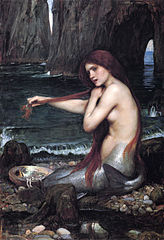
We have it now in our (sic.) to set at rest the doubts of sceptics upon this duplex order of animals, one having been lately discovered basking upon the rocks of Derrygimla, in Errisberg (Connomara), after the ebbing of the tide. It was discovered by a female of the lower order, who was then about four months pregnant; she was suddenly startled by a kind of scream, which was followed by the plunging of an animal, half female and half fish, her lower extremities having the conformation of a dolphin. This woman was so terrified as to miscarry, and has never been able to leave her bed since.
The tide being out, the animal had some difficulty in reaching the water. Thomas Evans, Esq. of Cleggan, a Gentleman well known to many of our readers, just arrived upon the coast in time to witness her last plunges. Having gained the water she disappeared for a few moments, but again appeared perfectly composed. Mr. Evans now had a favourable opportunity of examining this so long-doubted genus; it was about the size of a well grown child of ten years of age; a bosom prominent as a girl of 16; a profusion of long dark brown hair; full dark eyes; hands and arms formed like the human species, with a slight web connecting the upper part of the fingers, which were frequently employed throwing back her flowing locks, and running them through her hair. Her movements in the water seemed principally directed by the finny extremity; for near an hour she remained in apparent tranquillity, in view of upwards of three hundred persons, until a musket was levelled at her, which having flashed in the pan, she immediately dived, and was not afterwards seen. Mr Evans declares she did not appear to him to possess the power of speech for her looks appeared vacant, and there was an evident want of intelligence.
As this is the season of the fishery, we are in hopes some of our fishermen may draw her in their nets, as it is extremely probable, at the time she was first discovered, she was in search of some place to deposit her young. We understand several depositions upon oath as to this animal’s appearance are to be made. We are promised a more minute description which we shall be happy to lay before our readers.
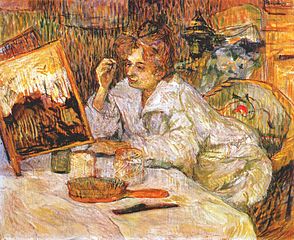
1889 Henri de Toulouse-Lautrec painting of a woman applying facial cosmetics
widgetworld3.wordpress.com
The Colac Herald (vic: 1st November, 1878)
Supplement
FOR THE LADIES – COSMETICS ETC
In an article on “making up” the Pictorial world says:
“With the utmost recklessness our fashionable fair luxuriate in cosmetics, washes, and powders, and many other triumphs of the perfumer.
Yet so long as their end is gained by fancying they have improved their complexion, added an eight of an inch to their eyebrows, or imparted a sunset gilt to their hair, they but little trouble themselves with such commonplace subjects are the hygiene of analytical chemistry. A lily whiteness is given to the skin – what matter whether it be done by arsenic or bismuth? A bloom is given with the proper peach-blush tint. What matters if the carmine be adulterated with red-lead? An ordinary passable good head of hair is made to rival the locks of Diana. What matters it whether it be done by a golden wash or something else equally delightful and dangerous?
Albrecht Dürer’s drawing contrasts a well turned out bourgeoise from Nuremberg (left) with her counterpart from Venice. wikipedia.org
And this rage for entering in the race for beauty is by no means confined to the well-to-do women of the upper and middle classes. The main of all work, charwoman, and the humblest of the humble, have their cheap favourite shops, where they can purchase the most attractive, beautifying trash at the lowest prices. By recent inquiry it has been discovered that the popular cheap aids – even expensive aids – to beauty are far more dangerous than even exaggeration-loving rumour has reported. Some unfortunate children, who were honoured by being treated to the charms of their mothers’ powder puffs, have actually died through the effects of the poisonous compound – chalk and arsenic. It is a known fact that the majority of hair dyes have a most injurious influence on the health of those who constantly indulge in using them. Neither need one go further than the nearest skin doctor to be tole of the horrors of bismuth, cheap rouge and face washes. The Nemesis of disease, ill-health, and worse still, of ugliness, without doubt lies in wait for those who will not trust to Nature as the best beautified, and for ever rush to the chemist and hair-dresser: but a word to the foolish is always a word wasted, and no amount of preaching, magazine moralising, or even coroner;s inquest reports, will stop the fanatics who throw themselves down before the Juggernaut of fashion and vanity.
https://widgetworld3.wordpress.com/podcasts/ SEEING THE WORLD
Travel Notes [XX-by the Hon. P.McM.Glynn, K.C. Minister for Home and Territories] The Register 18 June 1917 p6
Driving round by the flaggy shore to Ballyvaughan and then across a gap in the Burren Mountains towards Kinvara, from which a fine view of the inner part of Galway Bay, the promontory of Aughinish and the swift current of the sea between it and the mainland, is open; along dusty limestone roads; the crumbling walls of deserted houses are seen in many places by the way. Most people of the past seem to have gone to heaven or the United States.
Politics, as they go, are still matters of conversational interest here. The Sinn Fein movement is mentioned by some with sympathy for motive and contempt for methods and organization. The rising came as a surprise, if not a shock to some persons, but there were, or are, scattered sympathisers or objectors to the more drastic of the methods of repression among the middle as well as the working classes. For among those who paid the inevitable penalty of revolt in time of war were some leaders of ripe scholarship and, in other respects, stainless lives; “Poets of the Insurrection” as they were called, whose mistakes of judgment, policy and method are lightly regarded by those of emotional temperament to whom disinterestedness primarily appeals. Discontent now turns on the recent check to Home Rule as expressed in the Government of Ireland Act 1914. There is a feeling that the political system – Union Government – is still the source of any economic maladjustments and that the country will at once flower under the working of autonomy.
The Catholic Press Saturday 4th April, 1896 THE FUTURE OF IRISH MUSIC
The following is taken from a lecture recently delivered at Belfast by M George McSweeney:-
“Mr Arthur Percival Graves, the author of ‘Father O’Flynn’ has done a great deal for Irish music. He has written scores of songs to Irish airs, and his ‘Irish Song Book’ ought to be in every Irish home. But I think I will be doing no injustice to Mr Graves when I say that Mr Francis A Fahy is, in my humble opinion, the best Irish song-writer alive. As they say in the Irish language, he has more of the true blas on his lips than any singer who has appeared in our generation. I trust that Mr Fahy may continue to use his talents in the same direction.
Freeman’s Journal Thursday 14th November, 1907 Personal
Of interest to all lovers of Irish song is any information of the persons who compose the words and music. Reference to two of Ireland’s most gifted children in this respect was madce by Dr Annie Patterson in a recent lecture at Cork. She said;- “Happily, active, and in his prime is Francis A. Fahy. Cheery, bright and full of wit and sympathy are the lyrics he writes, many of which have been delightfully set to music by a gifted countrywoman of ours, Mrs Adelaide A. Needham. We want more poets like Mr Fahy, who is as modest as he is accomplished, and whose work is not only good literature, but is wholly racy of the son.(sic.)