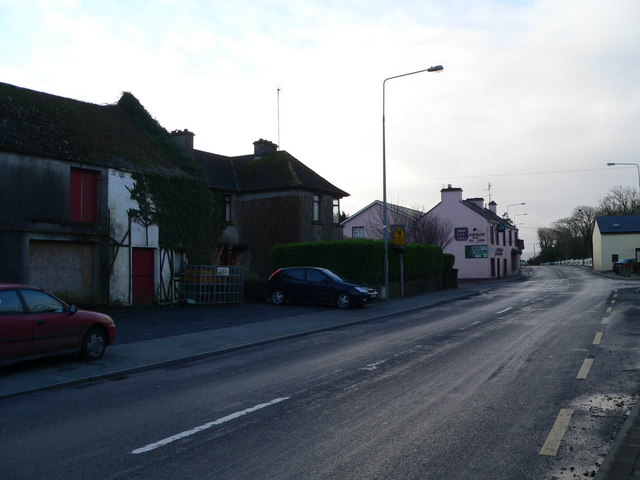
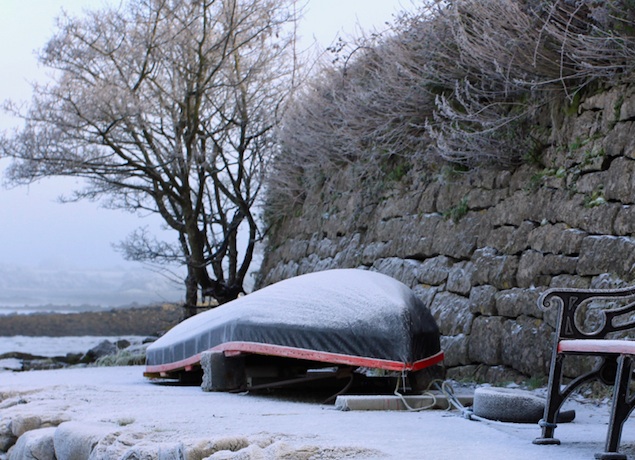
Newtown House, Doorus Photo: A McCarron Wikimedia CommonsA Topographical Dictionary of Ireland
Samuel Lewis – 1837
DURAS, a parish, in the barony of KILTARTAN, county of GALWAY, and province of CONNAUGHT, 16 miles (E. S. E.) from Galway: the population is returned with Kinvarra. This parish, which is situated on the bay of Galway, takes its name from a small fertile island close to the shore, which was granted by Cromwell to Major John Walcot, whose grandson sold it to Mr. French, from whom it descended in the female line to the Baron de Basterot, its present proprietor. A great portion is rocky and incapable of cultivation; but some of the land is very rich and produces excellent wheat. Limestone is abundant, and much is quarried for agricultural and other purposes. The late Mr. French raised embankments in several places to prevent the encroachment of the sea, and built a long bridge to connect the island with the main land; great improvements have also been made by bis successor.
The principal seats are Duras Park, that of P. M. Lynch, Esq.; and Duras House, of the Baron de Basterot. Great numbers of oysters and other fish are taken off the coast, and about a mile and a half to the west of Duras Point a pier has been constructed, which, though dry at low water, is accessible to vessels of 60 or 80 tons’ burden at the return of the tide; the expense of its erection was partly defrayed by a grant from Government. From the west end of the pier a ledge of foul ground extends to Deer Island. Here is a large flour-mill, worked by the tide. The parish is in the diocese of Kilmacduagh; the rectory is partly appropriate to the see, and partly to the benefice of Ardrahan; the vicarage forms part of the union of Kilcolgan; the tithes are included in the composition for Kinvarra, which see.
In the R. C. divisions it is part of the union or district of Kinvarra; the chapel was erected by the late P. M. Lynch, Esq., and was enlarged and a spire added to it by his son, the present proprietor of Duras Park, by whom it has been also endowed with £10 per annum. On the island of Duras are the remains of an ancient friary, with a burial-ground; and there are the remains of a druidical altar, near which some ancient silver coins have been found.
Main Street, Kinvara Photo: Cresswell ArchivesTHE INTERMOUNTAIN CATHOLIC 16TH JULY, 1910 P6
CONNAUGHT(abridged)
The town of Kinvara presented an animated appearance Tuesday June 14 in connection with the arrest of six prisoners, Michael Donohoe, Patrick Healy, John Hynes, Thomas Gorman, Bartley Quinn and John Smith for cattle-driving off the lands of Ballyvauleen, Kinvara. The prisoners were arrested here previous Sunday, driving cattle through the town, and were released on Sunday evening and re-arrested about 6 a.m.
Dublin Penny JournalTUBBER MAC-DUACH (KINVARRA, COUNTY GALWAY).
From The Dublin Penny Journal, Volume 1, Number 25, December 15, 1832.
The place called Tubber-macduach, or Tobar Mhic-Duach, “the well of Duach’s son,” is situated about a quarter of a mile from Kinvarra, in the County of Galway, on the Loughrea side. Here is a small spring of water, neatly walled in, and shaded by a few hawthorns, in blighted contrast with the verdure of which there appears in the background the remains of a blasted and withered ash, whose aspect indicates that it has long stood companion to the holy fountain. The upper wall, apparently of recent erection, is in form a square of about seven feet to the side, having a small stile for the more easy admission of pilgrims. Beneath the square wall is another of a circular form, fencing in the whole, as represented in the annexed cut.
On the left hand side as you enter by the stile, you find in the interior of the upper wall a small niche, intended for holding a cup, and also serving as a receptacle for the offerings of devotees. Unfortunately for the guardians of the place, however, such tributes now consist of nothing more than a few worthless rags, brass pins, and the like. Mr. Sheehan, who when I visited this spot, resided hard by, caused a handsome stone cross to be erected in front of the well, between it and the high road, and the exertions of the parish priest, (Rev. Mr. Quinn,) were not wanting on the pious occasion.
This well seems to have been formerly the resort of St. Colman, who flourished about the beginning of the seventh century. He was a member of the illustrious house of Hua-Fiacra-Aidne, in Connaught, and was a near relative to Guare,[1] King of that Province, who began his reign about the year 604, and held the sceptre thirty-eight years. The saint was, from his father’s name, Duach, surnamed Mac-Duach, by which appellation he is more generally known than by that of Colman.
The earliest accounts of Colman’s life say that he lived as a hermit in the forests of Burrin, County Clare, attended only by one young clerk, his disciple. Their food was water-cresses and wild herbs–their drink the pure spring–and deer-skins served them for clothes. Having constructed a habitation and oratory encircled with trees, they remained in Burrin forest seven years, without conversing with any other person.
Colman’s reputation becoming very great, he was taken notice of by his relative, Guare, who was a prince[2] of great piety and liberality. He offered Colman as much land as he choosed for the establishment of a religious community, but the Saint, it is said, refused to accept of more than a small spot, on which he afterwards erected a monastery, and where he became bishop. This place was not far from his former habitation, and has, from his name, been called Kilmacduach. The foundation of that church took place in the early part of the reign of Guare, and probably before the year 620. After a life well spent, St. Colman died on the 3rd of February, but the precise year of his demise is unknown. His memory is held in high veneration in the diocese of Kilmacduagh.
From what has been already mentioned, the reader will perceive that the hermitage of Colman, alias Mac-Duach, must have been somewhere in the neighbourhood of the fountain just described, which springs in the barony of Kiltartan, part of the ancient Hy-Fiachra-Aidhne. This well is also near the barony of Burrin,[3] in the forests of which St. Colman is said to have secluded himself. It must likewise be remembered, that he and his attendant are reported to have lived upon water and water herbs, both which Tubbermacduach was capable of furnishing them with. I shall only remark farther, that the parish of Kinvarra, or Kinmarra, in which the spring rises, is a prebend in the diocese[4] of Kilmacduach, which See was, as I have already mentioned, founded by St. Colman.
Most probably this well, (like many others of the same description,) was used by the Saint, whose name it bears, for the purpose of baptizing converts to Christianity. Thus Archbishop Usher (Primord. p. 862-3.) says that St. Patrick baptized his converts in Dublin, including Alphin, the king’s son, in a well near Patrick’s Church, which in after ages became an object of devotion for the faithful, and so continued until it was enclosed within the foundation of a house, in the 17th century.[5]
NOTES:-
[1] Guare’s father was Colman, son of Cobhtach, who was cousin-german of Duach, the father of Saint Colman.– Vide Colg. A.A.S.S. p. 248.
[2] 2. Lanigan’s Eccl. Hist, Tr. 342.
[3] Burren barony was formerly denominated Hy-Lochlean, and was part of Corcumruaidhe district. The ancient proprietors of it were the O’Loghlins, of the race of Ir, by Fergus-Riogh and Maude, Queen of Connaught.–See Seward Top. Hib. title Burren, and Macgeogh. Hist. d’Irl. fo. 215.
[4] Harris’s Ware’s Bishops at Kilmacduach.
[5] See 1. Mac Geoghagan Hist. d’Irl. 258. to the like effect.
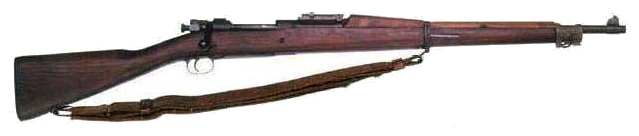
Springfield Rifle Wikimedia CommonsTHE CATHOLIC PRESS 21ST APRIL, 1921 P16 abridged
Another Shocking Atrocity. FROM THE CORRESPONDENT OF THE LONDON ‘DAILY NEWS.’ GALWAY, Thursday.
A sensational story of the burning of the house of a widow and the stripping and ill-treatment of seven young men who were inside at the time comes from Caheroncen, (Cahercon)Kinvarra.
Mrs. Bridget Quinn was visited in the evening by 14 men, supposed to be members of one of the divisions of Crown forces. They were dressed in civilian clothes and wore false moustaches. They arrived in a motor lorry, and declared that they were looking for the murderers of policemen.
To seven men who were playing cards in the house they shouted ‘hands up,’ and, covering them with rifles and revolvers, took them outside, where they were kept under guard while the house was searched. Then the men were compelled to strip and lie flat on the ground.
They declare that all that was in their clothes was taken, and the clothes burned.The house of Mrs. Quinn was burned to tho ground, and, having implored the raiders, she was permitted to free a team of horses in a stable.
The naked men were told to sing ‘God Save the King.’ They stated that they did not know the words, and the National Anthem was then sung for them, and they were compelled to repeat it, and then told to clear off, shots being discharged after them.
A doctor who attended fhem subsequently told me their bodies bore marks, and, although they had not been seriously hurt, they were in a very nervous condition. No member of the Crown forces has ever been attacked in the district.
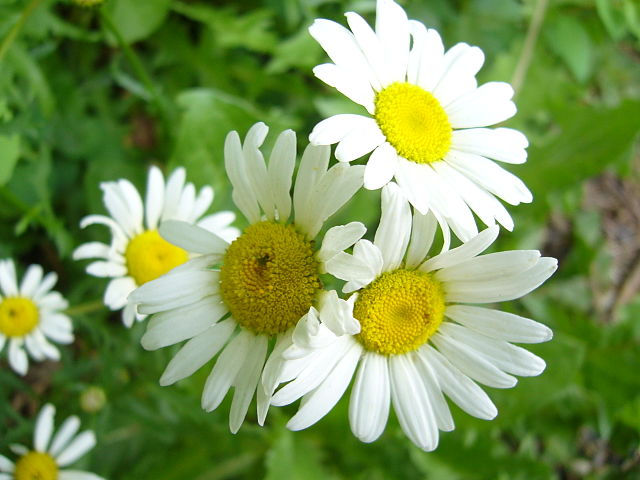
Photo; Aiden Clarke Creative CommonsTHE MORNING STAR AND CATHOLIC REGISTER 21ST JUNE, 1868 P3
With feelings of deep regret, says the Galway Vindicator, we record the demise of the Rev. John Lennon P.P., which sad event occurred on the 11th ult. at his residence, Ballinderreen. Father Lennon had been for a long period paster of the parish of Ballinderreen, and to his strenuous exertions are due the splendid repairs of the parish chapel, and the erection of a national school in the parish The school and chapel, also the residence of Father Lennon, are on the estate of Charles St. George, Esq., of Tyrone House, and to his unbounded liberality Father Lennon owed the restoration of the chapel, the erection of the national school and numerous other laudable works which have been completed through his instrumentality. We would draw the attention of the public to the friendly relations which existed between Mr St. George and the Rev. Mr Lennon and advise others of our landed proprietors to follow the example so noble set them by this highly popular gentleman. That he is one of the best – if not the best – of our western landlords, the absence of “notices to quit,” evictions, and their concomitant result – emigration – and the flourishing state of his tenantry, amply testify. We understand that the Rev. Mr Geoghegan, R.C.A., Kinvara, succeeds Father Lennon in the parish.
COMHAIRLE CHONTAE NA GAILLIMHE
MINUTES OF LOUGHREA AREA COMMITTEE MEETING
HELD AT LOUGHREA REGIONAL OFFICES ON THURSDAY 20th SEPTEMBER, 2012
Kinvara
Cllr Fahy advised that he and Cllr Feeney attended a meeting of Kinvara Community Council where Deputy Colm Keaveney was also present, concerns were raised regarding the N67 road realignment project, the old road becomes a lay-by and leads to concerns of illegal parking.
Kinvara Sewage Scheme
In reply to Cllr. Fahy’s, query regarding the Kinvara Sewage Scheme, Mr. Cullen advised that the 20% local funding is a local contribution from Galway County Council, he advised that discussions are well advanced regarding attaining a Site for the Treatment plant.
Water Services Investment Programmes
Kinvara
Mr. Cullen advised that site investigation and ecological survey work has commenced, which will lead to contract documents being prepared and moved along to the tender process.
Galway County Council Archives ‘…to acquire, preserve and make accessible the documentary memory of county Galway’ U:\Archives – Collection Management\Descriptive Lists\Poor Law Unions\G01-12 Gort PLU2, 2009-11.doc ix
By January 1848 temporary fever hospitals were established in Kinvarra and Killeenavau (G01/12/7, p28). In April 1848 the Board accepted the tender of Martin Linnane ‘for the erection of Fever sheds near Kinvarra for one hundred patients at one pound two shillings per foot lineal measurement…’ (G01/12/7, p122). The Board at this time also accepted the tender of Michael Nilan for the erection of fever sheds adjoining the Workhouse, costs divided as follows, Office sheds at £1.1.6 per foot, fever sheds including bedsteads at £1.3.6 per foot, finding and setting boilers at £1.6 pre gallon, and clothes stores £0.12.6 per foot (G01/12/7, p124).
The World News – 25 October, 1902 MARRIAGE IN IRISH.
THE FIRST WEDDING IN LONDON IN THE GAELIC TONGUE.
The first marriage solemnised in London ln the Irish language took place recently at Dockhead Catholic Church.
The bridegroom was Mr. John O’Keane, for the past three years the secretary of the Gaelic League of London, the bride Miss Kathleen Dineen, of Forest-gate, a charming young lady whose singing of Irish songs has often stirred Gaelic League gatherings in London.
The ceremony was performed by the Rev. M Moloney. Wherever the Catholic Church allows the use of the vernacular Irish only was employed. From this to the solemn and sonorous Latin of the nuptial mass seemed a natural transition.
After the ceremony, Mr. and Mrs. O’Keane received the congratulations of a large gathering of friends in Irish. Professional men, civil servants, and general workers were largely to the fore. The young pair drove away for Paddington (for Ireland) amid a chorus of hearty and genial benedictions in their native language.
There is still a friend left here and there says United Ireland, to the evicted and harassed tenants of Ireland. While the majority of their brethren look on indifferently at eviction and consequent suffering, a few faithful friends, priests and payment, are doing what they can to stem the tide of landlord oppression. Among these must be reckoned Father Newell, the parish priest of New Quay, County Clare, on the southern shore of Galway Bay. He recently drew attention to some harsh evictions carried out by Lynch, of Renmore galway in his parish, and he has consequently received some private assistance for the poor people. Father Newell returns to the subject in a public letter published recently. He says;
I regret to have to add that more ‘processes’ were served a day or two ago on the same island. In the early days of the Land League, Major Lynch was one of the first to put down his name for $100 (pounds) for the funds of the;Property Defence Association’, got up by the late A McMurrogh Kavanagh.
I wish he would show a like generosity to the poor tenants in these trying times.’ The moral of this and similar pitiful stories is that the people require again a protective organisation, widespread and powerful, to prevent the landlord fro indulging in his pet pastime of harassing legal process and subsequent eviction.
Mr. Donnellan and Mr. Mannion asked the Minister for the Environment if he is aware that untreated sewage is being discharged into Kinvara Bay, County Galway; and if he will make a statement on the matter.
Minister for the Environment (Mr. Barrett):
” I understand that disposal of sewage from Kinvara is by outfall pipe to the sea at Kinvara Bay. I have received no complaints about the discharge. It would be a matter for Galway County Council to investigate any such complaints and, if remedial works were found to be necessary, to arrange for the preparation of a suitable scheme.”