Oh for the gift of a fairy brush
And magic to guide my hand.
I’d paint, in the peace of a spell-bound hush,
This strange and lovely land.
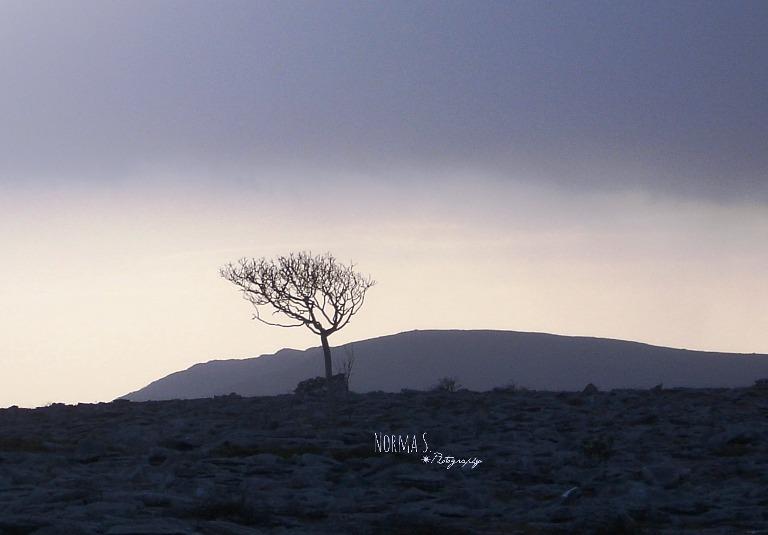
Cloud shadows on a barren hill,
On the rocky coast of Clare.
A watered sky, that goes drifting by,
And salt in the morning air.
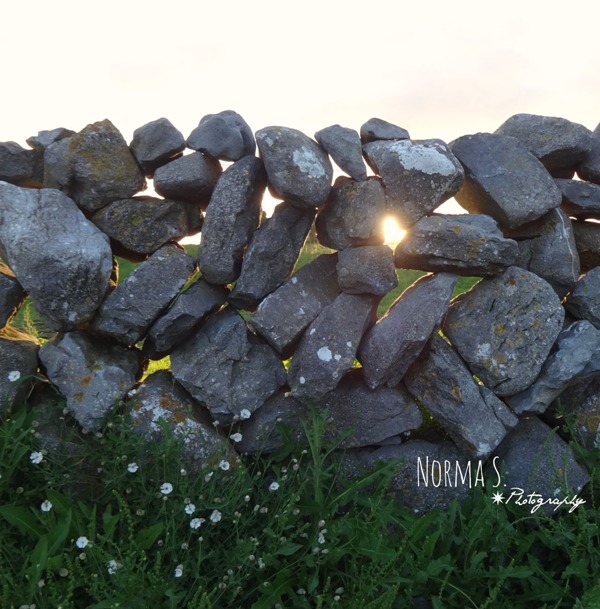
Small fields of stone with rocks around;
A smiling woman at a door.
And always on our ears the sound
Of the sea, on the murmuring shore.
A grey keep in a field of green *
Swans on Kinvara’s blue
White pebbles on the sand washed clean,
Age old, but ever new.
A wheeling gull, a curling wave,
The hiss of spreading foam,
Cliffs, and a distant secret cave,
Some ancient hero’s home.
Long ago about eighty years ago there was a great battle fought in our village. There was a Queen from the North also at the battle. She was fighting among the people and the Queen got killed in the middle of the battle. She had a great lot of precious jewellery. The men buried her standing up in the grave. The people say that it is in Burke’s field she is buried. The men planted a hawthorn tree over her grave and the people say that there are four black cats guarding the treasure there always. Cilleení was the name of the Queen. The grave is still there and plain to be seen.
From the National Folklore Collection, property of University College Dublin held in trust for the people of Ireland. Content was collected by children in 1937 and 1938, carefully transcribed under the supervision of their teachers and forwarded with great pride to form part of the Collection.
From Margaret Cavanagh (c.1937)
When the women of our village “Clúin-a-see” would be leaving a cake out to cool on the window-sill they would first take a bite of it. The fairies would take it only for that.
There is a field near my house it is called poll-a-Feóla. It is called that name because in olden times robbers used to steal sheep from farmers and kill them and hide them there. There is a great big heap of stones in the middle of the hole.
There is another hole near our house and it is called pollac-na-mbó. It is called that because since it was made there are cattle going into it for water. One time people were trying to make a road down to it. Every night the stones used to be put back to the place they cleared. One night they stayed there after six and they saw a stick pointing towards them. Nobody tried to “ready” it since because they think it is haunted.
There is another hole near my house. It is called poll-beacháchán it is so-called because a man was following a fox on horse-back and they fell into the water and got drowned. There is another field called poll na Choonach. There are badgers living in it.
There is another field and my father said there was war in it once. There is another hole called poll-eidhin. It was choked by ivy long ago. The people filled it up with stones for fear the cattle would fall into it.
There are some people great for putting “the bad eye” on things. They would say “Isn’t that a fine child” and would not say “God bless him”. There was a woman and a boy coming home from town at ten in the night and every step she took there used to be a candle-stick before her on the road and she put them in her basket and kept one in her hand and when she reached home she had only the one that she had in her hand and people say that it is in Gort yet.
There is a “lios” near my house and it is down in history. The name is liosin-a-mheala.
(abridged)
1. Asses’ milk for “consumption” (taken fasting).
2. Goat’s milk for “consumption”.
3, Sheep’s milk for sore throat (heated).
4. Carry 3 small potatoes in your pocket for rheumatism or for toothache.
5. Foam of new milk for toothache.
6. Ferrets “leavings” – cure for measles.
7. Fox’s tongue to take out a thorn.
8. Dog’s lick for a sore.
9. Fairy mushroom to stop bleeding.
10. Cobweb to stop bleeding.
11. “Goose gall” rubbed on lumps cure them.
12. Goose grease as an embrocation for stiff knees or joints.
13. Snail in shell rubbed to a corn cures it.
Rub snail on corn – hang up on tree seven days. Repeat if corn is not cured first.
14. Cure for boils – plaster made of sugar soap and soda. Apply on linen rag to boil.
15. Leaf of new cabbage bandaged on sores.
16. Juice of dock leaves for stings – nettles, bees.
17. Rub gold wedding ring on a sty in the eye.
18. Rub penny on a fresh bruise to heal it – or piece of raw mutton.
19. Boiled garlic juice for rheumatism.
This selection of lore comes from the duchas.ie website. It comprises part of the National Folklore Collection, property of University College Dublin held in trust for the people of Ireland. Content was collected by local children in 1937 and 1938, carefully transcribed under the supervision of their teachers and forwarded with great pride to form part of the Collection
Told to Eileen Fallon, Kinvara by Patrick Fallon (abridged)
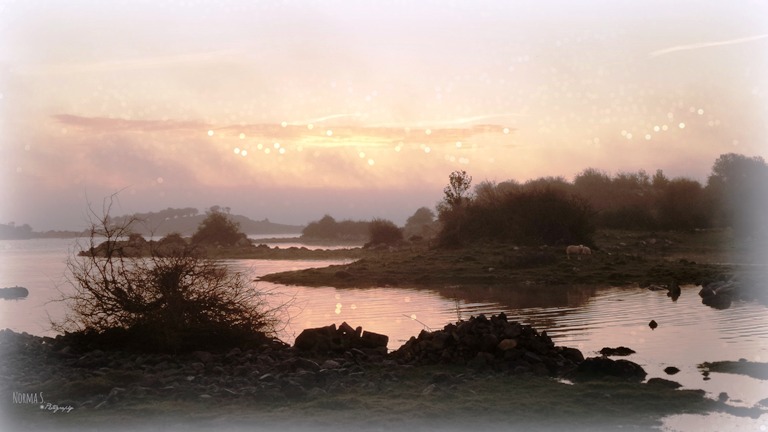
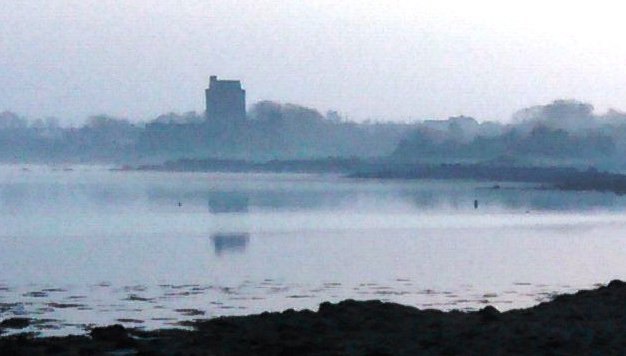
Twilight Photo: EO’D
It is believed that there is a treasure of gold hidden in Carnamadra, which is a little village situated about three miles form the town of Kinvara. It was supposed to be hidden by a miser during the time of the trouble in Ireland, which was in the year 1922. He was afraid the Black and Tans would take it because they used to take everything the people had. When the miser died the gold was still hidden in the same place.
Some men have tried to unearth it but they did not succeed. According as they were digging the earth was falling in again. No attempts have been made since to unearth it. The value of the hidden treasure is supposed to be about twelve thousand pounds.
There were, it is said, cries heard where it is buried, after the miser died. There was a white form seen there. People used to say the white form was the miser. The people who live in Carnamadra say the treasure is guarded by the fairies and that no one will ever be able to get it. There were often lights seen where the treasure is hidden. A few years after the miser died his ghost was to be seen guarding the gold. Only people traveling the roads at night ever saw the miser’s ghost.
This selection of lore comes from the duchas.ie website. It comprises part of the National Folklore Collection, property of University College Dublin held in trust for the people of Ireland. Content was collected by local children, carefully transcribed under the supervision of their teachers and forwarded with great pride to form part of the Collection.
Told by Dilly Finnegan (age 26) to Cissy Shaughnessy
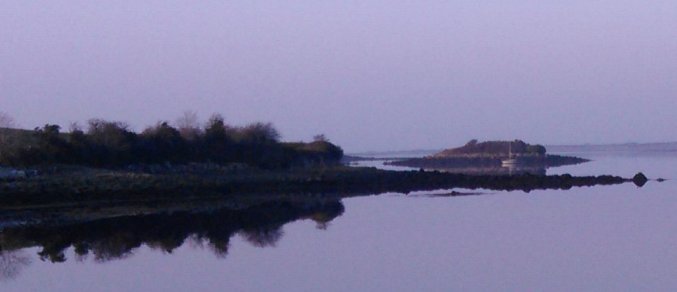
Morning mist Photo: EO’D
There is hardly a district around Ireland that there are not treasures hidden in. In olden times there was a crock of gold hidden in an old graveyard in Kinvara. It was hidden by an old priest. It was hidden many years and nobody could find it.
Early one morning a man got up early and went working. He was disturbed at his work and was told about the hidden treasure. He went to bed that night and he did not sleep well. He was aroused early in the morning out of his sleep. He got up out of bed and he hurried off to the place where the crock was hidden. When he went to dig the crock with all his might a big man appeared dressed all in white. As soon as the man saw him he ran way with fear.
The value of the hidden treasure is supposed to be about twelve thousand guineas. He tried to purchase the crock of gold many times but all in vain, he had no chance of it. He went away from Kinvara for seven years. At the end of the seven years he returned with hopes of finding the treasure. He tried to dig again but the ghostly man sprang at him with terror. He gave him a slap that put the fear of god in his heart. He went home and promised that he would never go to that haunted spot again. A few nights after the ghost came to the bedside of the man. He left his hand on his face and he died that very minute. The print of the Ghosts hand was to be seen on his face. He was buried in the spot where it happened and nobody goes near it because it is haunted.
Told to Maureen Corless Mountscribe or Moneyscreebagh by Patrick Corless – 16th November 1937
In a rock near our house called Cregnagun there is supposed to be a crock of gold hidden. One day some years ago there was a woman going after sheep and she saw a pot of gold with a large cat taking care of it. She wanted to catch the sheep. She went in to catch the sheep and she did not mind the gold until she was coming back. On her return there was no trace of the crock of gold. It is often since there is light seen shining on an old ruin which is quite close to the place where the crock of gold is hidden. Many nights people pass by that place and they see an old woman crying and a big black dog and a cat which is said to be taking care of the gold.
This selection of lore comes from the duchas.ie website.It comprises part of the National Folklore Collection, property of University College Dublin held in trust for the people of Ireland. Content was collected by local children, carefully transcribed under the supervision of their teachers and forwarded with great pride to form part of the Collection.
Patsy Noone, Kilcolgan from Tommy McDonald, Kilcolgan
Around my home and on our farm there are lots of herbs growing.
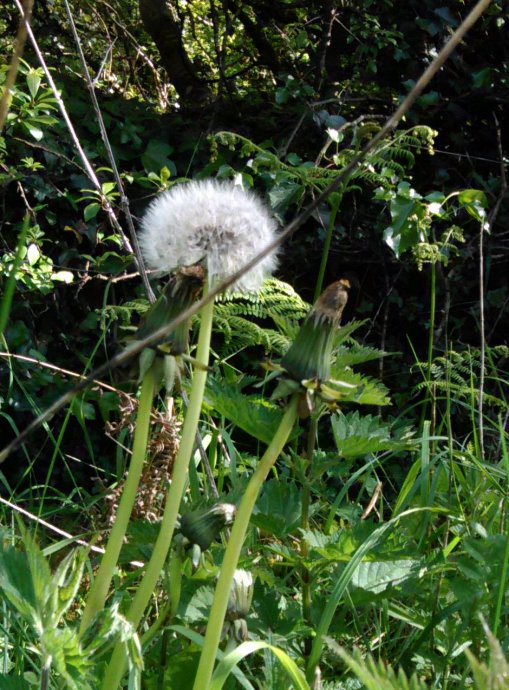
The thistle is a tall pricky weed and when it is over ripe the seeds blow around and destroy the land and hay. There is a white flower growing on our land named vinvan. It kills goslings. Garlic is another weed and when eaten by cows it puts a bad taste in milk. There is a tall purple flower growing on our land named foxglove which kills sheep. From the dandelion people make wine, also from sloes and blackberries. They make jam from blackberries as well. Stains are taken out of clothes by boiling them with ivy leaves. Budgire is a long plant like the centre of a lily, it is poisonous. Nettles are given to young turkeys when boiled as food.
Makenagumpna is a green weed. It is boiled and the juice is rubbed on a burn to cure it. The chicken weed is a long green one, found in kitchen gardens. The juice of it takes off warts. The weed is also given to caged birds and is very good for them.
This selection of lore comes from the duchas.ie website. It comprises part of the National Folklore Collection, property of University College Dublin held in trust for the people of Ireland. Content was collected by local children in 1937 and 1938, carefully transcribed under the supervision of their teachers and forwarded with great pride to form part of the Collection.
Collected by Kathleen Fallon from Patrick Fallon, Kinvara
Photo: Kresten Hartvig Klit Wikimedia Commons
17th May, 1938
There is not a town or a village in Ireland that has not a forge. Forges are not as numerous now as they were long ago. Hardly any person uses a horse now except country people. Long ago horses were used for every kind of work such as travelling and ploughing. With all the horses travelling long ago work was very plentiful for the smith.
There are three forges in the town of Kinvara. One is situated on the south side of Kinvara and is owned by a man named Burke. The second is situated on the north side and the man who runs it is named Griffin. The third forge is owned by a man named Connolly. It is situated in the middle of the town of Kinvara.
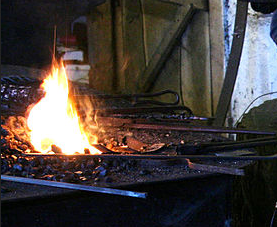
Burke’s forge is situated on the roadside. It is like a shed from the outside. It has one window in the front and a large door. The roof is made of galvanise. There is one fireplace in the forge. The bellows are oval shaped and there are two wooden handles on them to blow. They are made of leather. The bellows are not made locally.
When the Smith is making a horse shoe he puts a piece of iron in the file. When the iron is red he takes it out with a tongs, then he hammers it until it is the shape he wants it. It is said that whenever the sparks from the iron fly towards a person that there is money coming to that person.
The Smith makes all kinds of farm implements such as ploughs, harrows, spades, shovels and axes. When the Smith is shoeing a horse he shoes the horse outside also. When he is putting a rim round the wheel of a cart he puts it on outside the forge.
Excerpt from the National Folklore Collection, property of University College Dublin held in trust for the people of Ireland. Content was collected by children in 1937 and 1938, carefully transcribed under the supervision of their teachers and forwarded with great pride to form part of the Collection.
Collected by Kathleen Fallon, Kinvara from Mrs Fahy Kinvara
Photo: Rodw Wikimedia Commons
10th of May, 1938
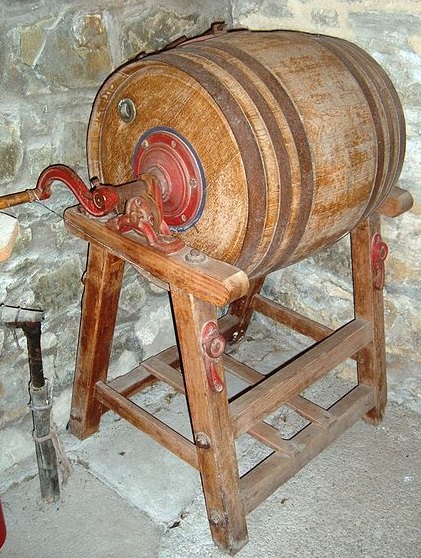
There is scarcely a country house that has not a churn in it. Some of the churns are small and some of them are tall. The tall churns are very wide at the bottom and they get narrower as they go up. The small churns are round on both sides.
In whatever house there is a churn there is always butter made there. Butter is made in country houses twice a week and in Summer three times a week. Sometimes the people make up the butter in bars of two and three pounds. Then they sell it in the town.
We have no churn but a neighbour of ours has. It is about three feet and she makes butter twice a week. Before she makes the butter she gathers all the new milk she has to spare and then she leaves it aside in basins to sit. When the cream is thick she takes it off and then she gives the milk to the calves or makes cakes with it. Then she washes the churn with boiling water. Then she puts in the cream and churns it. It a stranger happens to go into a house where they are churning he gives a hand to help. People say that if people do not help to churn that evil will fall on the churning.
In olden times churns were worked by the foot but now-a-days they are worked by the hand. In summer cold water is poured into the churn to harden the butter. The buttermilk is used for making cakes and people also drink it when it is fresh. In the town there is never any churning done, all the new milk is sent to creameries.



 The Burren and Beyond