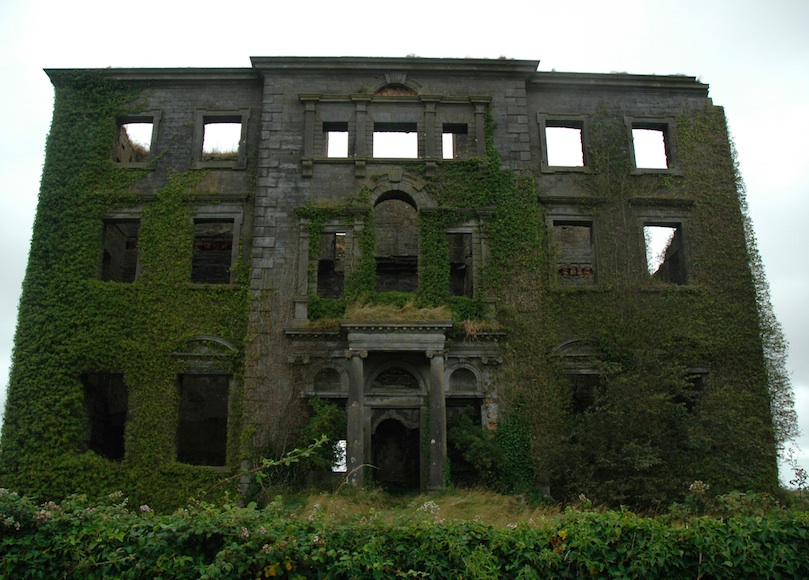
Over 200 men from the parish of Ballinderreen assembled at Kilcolgan to build a house for Redmond Grealy, an evicted tenant, Grealy was evicted in 1883 by William St. George, Tyrone House, his landlord. Since his eviction Grealy has made a long and stubborn fight to keep a grip of his homestead. For retaking possession he has been summoned frequently, heavily fined, sent twice to gaol and his wife three times to gaol.
On their return home from Galway Gaol, Grealy and his wife were met by over 200 men, who escorted them and installed them in the house they had built.
Road to Doolin Photo: Christine Matthews Wikimedia Commons
In declaring the County Clare Feis open at Ennis recently, his Lordship Most Rev Dr. Fogarty, Bishop of Killaloe, having referred at length to the language and industrial movement, said money was not everything. We should try not only to bring money to the Irish home, and neatness and comfort and industry, but the brightness also and the enlightenment that come from the revival of our Irish customs and music and language.
He drove the previous night, coming to the feis, through sixteen miles of the most charming country, studded with those numerous white painted cottages which were such a feature of the County Clare.
It was evening, and the hour for the day’s labor being over the people would naturally turn to relaxation and enjoyment, but that lovely country was as silent as the grave— not a note of music or a volce was heard— and he felt for our people and said, “God bless every man or woman, young or old, Catholic or Protestant, who is doing his best, however little, to bring back to this lovely country and to its dear people the sound of music and contentment and prosperity.”
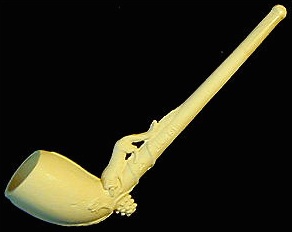
It is pleasant for people of the present day, who do not like tobacco, to know that Sir Walter Raleigh was not the person who introduced the habit of smoking into Ireland anyway, whatever he may have done for England.
The learned Dr. Petrie, the acknowledged chief of Irish antiquarians, says “Smoking-pipes of bronze are frequently found in our Irish tumuli or sepulchral mounds of the most remote antiquity. On the monument of Donogh O’Brien, King of Thomond, who was killed in 1267, and interred in the Abbey of Corcumrue, in the County of Clare, he is represented in the usual recumbent posture, with the short pipe or dhudeen in his mouth.”
Tobacco, after all, was only a substitute. Long before it was introduced into England smoking was commonly practised. The favorite smoke was dried leaves of coltesfoot. In the Historic of Plantes by Dodoens, published in 1578, is the following passage ‘The parfume of the dryed leaves (of coltesfoot) layde upon quick coles, taken into the mouth of a funnell or tunnell helpeth such as are troubled with the shortness of winde and fetch their breathe thick and often.”
In ‘The Travels of Evliya Effendi’ it is stated that an old Greek building in Constantinople was converted into a mausoleum in the early part of the sixteenth century. At the time of the alteration it was computed that the building was a thousand years old. In cutting through the walls to form windows, a tobacco pipe which even then smelt of smoke, was found among the stones.
St. Brlgid is the mother, all men know,
Of Erin’s nuns that have been, or shall be,
From great St. Patrick’s time to that last day
When Christ returns to judge the world by flre.
‘Twas summer eve; upon a grassy plain
She sat, and by her side a fair blind nun,
Of them that followed her, and loved her rule,
And sung her nocturn psalms. They spake of God.
The wonder of His dread inscrutable Being
Round all, o’er all, in all; the wonder next
That man, so slight a thing, can move His love,
Can love Him, can obey; the marvel last
Of God made Man; the infinite in greatness
By infinite descent a creature made,
Perchance within the least of peopled worlds,
For saving of all worlds.
The Sun went down;
Full faced the moon uprose; the night wind sighed,
It broke not their discourse. The dawn returned;
It flushed the clouds; it fired the forest’s roof;
It laughed on distant streams.
St. Brigid gazed upon that dawn; a thought
Keen as a lance transfixed her heart; she mused,
‘Alas, this poor blind sister sees it not!’
She clasped that sister’s hand, she raised, she kissed it;
That blessed one spake: ‘Why weepest thou, mother mine?
Thy tears are on my hand.’ The Saint replied:
‘I weep because thou canst not see the dawn
Nor in it God’s great glory.’ Then the nun:
‘If that thought grieves thee, pray and I shall see.’
St. Brigid knelt; and lo! the blind one saw!
Ireland is smaller than it was, only to an inappreciable extent, it is true, and apart from any action of the waves or weather which may have a tendency to affect its size by natural means. The truth is that some Ireland has been shipped to America in barrels.
Turf from Connaught and Clare, soil from Limerick and Mayo, heather from Croagh Patrick, shamrocks from Donegal, peats from the bogs of Ulster, turf from every county in Ireland, have been sent to Chicago to be used in building a miniature Ireland in the Coliseum. The soil will carpet the floor of the big building during an Irish fair which is to be held in that city. There were thirty-two casks of the soil, and it will be arranged in the shape of the counties from which it waa dug. There were eight great crates of peat, which will supply fuel for the miniature shops, stores, and houses that will be erected in each county.


 The Burren and Beyond