Flax flowers Photo: D. Gordon E. Robertson Wikimedia Commons
Mr James Hill Dickson, for many years connected with the flax manufacture in the north of Ireland, has made a proposal to the chairman and directors of the Midland Great Western Railway, which they have favourably entertained – of erecting a mill on a platform, with wheels to run on the railway, to which will be attached a portable steam engine, of six horse power, with which to work the mill.
The mill, engine and workmen can be transported at the shortest notice to any given point along the line of railway from Dublin to Galway and into the country, to any farm or district along the line, at moderate distances, where flax may be grown, thus doing away with cumbrous and expensive fixed establishments hitherto so necessary to the successful cultivation of the flax plant and, in these depressed times, so difficult to erect and establish
Irish Cliff Fowlers (abridged)
I shall here outline the different methods I have witnessed on the coast of Ireland of descending steep rocks for birds or eggs. At the Gobbins, a climber has been going down the rocks occasionally in the season for above thirty years. He has a monopoly of the aerial exercise in consequence of being the only person in the vicinity supplied with a rope for the purpose. His preparation was the work of a moment; throwing his shoes off, and a noose of the rope over his head so as to embrace his body beneath the arms. Down he dropped from the summit, with much less concern than a lady steps from her carriage. Two or three men (generally his two brothers) ‘give out’ the rope, of which a coil is left back, some little distance from the summit of the cliff. They keep it tight until the egg-gatherer reaches the ledges containing the nests, when he gives a signal to slack it. The liberty thus afforded him to move to either side prevents the necessity of shifting the rope laterally at the summit of the cliff, where it is kept to the same place all the time.
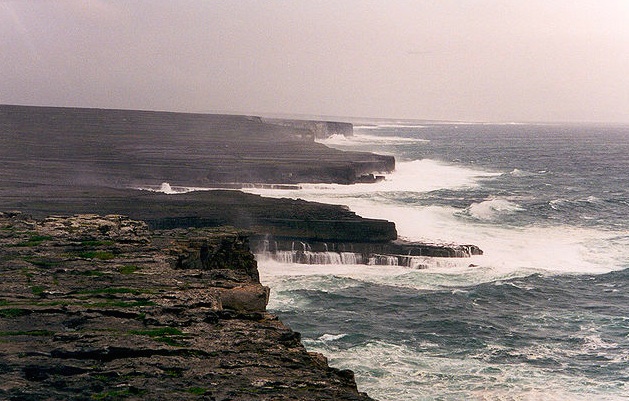
The method adopted at Arranmore, the largest of the islands of Arran off Galway Bay was different. When Mr R. Ball and I visited that island in July 1834 a rock climber – a tall athletic fellow – came up behind, unheard in his ‘pompootes’ . He was lowered over the loftiest limestone cliffs of the island, perhaps five hundred feet in height. His manner of descent was free and easy. He sat upon a stick, about a yard in length and two inches in thickness, to the middle of which one end of the rope was fastened, the other being held by men above.
When coming near his prey, he held the rope in one hand, and with the other threw a rope fastened to a rod around the birds. Several gulls so taken were brought up. When over the cliff he leapt as far into the air from the surface of the precipice as he could do without injury to himself from the rebound. He likewise performed various antics, and with the stick as a seat, looked quite comfortable and at his ease.
Thompson’s Natural History of Ireland.


 The Burren and Beyond